
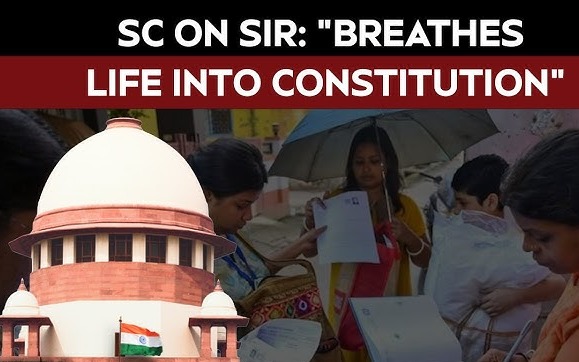
Supreme Court Upholds EC’s Special Roll Revision: A Constitutional Lifeline for Free Elections
Court affirms EC’s powers under Article 324 and RPA, 1950
Judgment stresses integrity of electoral rolls as foundation of democracy
By Legal Reporter
New Delhi: May 27, 2026:
The Supreme Court of India has upheld the Election Commission’s Special Intensive Revision (SIR) of electoral rolls, ruling that it is constitutionally valid under Article 324 and consistent with the Representation of the People Act, 1950. This landmark judgment reinforces the Commission’s authority to ensure the integrity of electoral rolls while balancing proportionality and procedural safeguards.
Background
The Supreme Court judgment in Devu G Nair vs State is an important decision dealing with criminal procedure, constitutional protections, and the obligations of investigating authorities under Indian law. The case examines whether due process requirements were properly followed during investigation and prosecution, while also discussing the balance between state powers and individual liberties. The Supreme Court reaffirmed that fairness, transparency, and adherence to legal safeguards are essential components of the criminal justice system, making this judgment highly relevant for criminal law practitioners, constitutional law researchers, and judicial precedent studies in India.
The Supreme Court’s verdict on May 27, 2026, marks a pivotal moment in India’s electoral jurisprudence. The case revolved around the Election Commission of India’s (ECI) Special Intensive Revision (SIR) of electoral rolls, a process initiated in Bihar and later extended to states like West Bengal, Kerala, and Tamil Nadu. Petitioners argued that the exercise risked disenfranchising genuine voters, particularly migrants and marginalized groups, while exceeding the EC’s constitutional mandate.
Key Legal Provisions Examined
- Article 324 of the Constitution
- Grants the Election Commission plenary powers to supervise and conduct elections.
- The Court emphasized that Article 324 is not ornamental but a substantive provision enabling the EC to act proactively to safeguard electoral integrity.
- Representation of the People Act, 1950 (RPA)
- Section 21(3): Authorizes special revisions of electoral rolls at any time, provided reasons are recorded.
- Section 16: Empowers the Commission to examine questions of citizenship while preparing or revising rolls.
- The Court clarified that such examination does not amount to declaring someone “not a citizen,” but only reflects the EC’s inability to verify eligibility for electoral purposes.
- Principle of Proportionality
- The Court applied the proportionality test: whether the measure pursued a legitimate aim, had a reasonable nexus to the objective, and was not excessive.
- It concluded that the SIR exercise was proportionate, with adequate safeguards to prevent arbitrary exclusion.
Court’s Observations
- Integrity of Electoral Rolls: Free and fair elections depend not just on polling mechanics but on the credibility of rolls.
- Administrative Consistency: Prescribing documents for verification ensure reliability and prevents duplication.
- Safeguards: Names wrongly deleted can be restored upon proof of citizenship by competent authorities.
Implications
- Strengthening EC’s Autonomy: The ruling reaffirms the EC’s independence and authority to act beyond routine modalities when electoral integrity is at stake.
- Balancing Rights & Safeguards: While petitioners feared disenfranchisement, the Court highlighted procedural safeguards to protect genuine voters.
- Future Electoral Reforms: The judgment may encourage the EC to adopt more robust verification mechanisms, especially in states with high migration.
Critical Analysis
The verdict breathes new life into Article 324, underscoring its role as a constitutional backbone for electoral democracy. By upholding the SIR, the Court has struck a balance between administrative necessity and individual rights. However, the challenge remains in ensuring that marginalized communities are not disproportionately affected due to documentation barriers. The ruling implicitly calls for greater outreach and facilitation by the EC to prevent exclusion.
Detailed FAQ on Key Legal Points
Q1: What is the Special Intensive Revision (SIR) of electoral rolls?
A: It is a targeted exercise by the Election Commission to verify and update voter lists beyond routine revisions, aimed at removing duplication and ineligible entries.
Q2: Under which law does the EC have authority to conduct SIR?
A: Under Article 324 of the Constitution and Section 21(3) of the Representation of the People Act, 1950, which explicitly allows special revisions at any time.
Q3: Does the EC have the power to question citizenship during roll revision?
A: Yes, under Section 16 of the RPA, 1950, but this is limited to electoral purposes. It does not amount to declaring someone “not a citizen.”
Q4: What safeguards exist against wrongful deletion of names?
A: If competent authorities later confirm citizenship, the EC must restore the individual’s name to the rolls.
Q5: Why did petitioners oppose the SIR?
A: They argued it could disenfranchise genuine voters, especially migrants and marginalized groups lacking ancestral documentation.
Q6: How did the Court address concerns of proportionality?
A: The Court held that the SIR was proportionate, serving a legitimate aim with reasonable measures and sufficient safeguards.
Q7: What is the broader impact of this ruling?
A: It strengthens the EC’s autonomy, reinforces the importance of credible electoral rolls, and sets a precedent for future electoral reforms.
In essence, the Supreme Court has validated the Election Commission’s proactive role in safeguarding democracy, ensuring that electoral rolls remain accurate, credible, and constitutionally sound.