
COURTKUTCHEHRY SPECIAL SERIES ON LANDMARKS JUDGEMENTS ON WILLS, CODICIL & PROBATE
B. Venkatamuni v. C.J. Ayodhya Ram Singh and Others: Supreme Court Restores Rejection of Suspicious Will
Division Bench Overturned, Apex Court Reaffirms Trial Court’s Findings
Unregistered Will in Favor of Paramour’s Son Declared Unproved
By Vishwas Kumar
New Delhi: March 25, 2026:
In a significant ruling on testamentary law, the Supreme Court of India in B. Venkatamuni v. C.J. Ayodhya Ram Singh and Others (Civil Appeal No. 4550 of 2006, decided on 19 October 2006) addressed the validity of an unregistered Will allegedly executed by an unmarried woman in favour of her paramour’s son. The dispute revolved around whether the Will was genuine or tainted by suspicious circumstances.
explore top will-related judgments in India on B. Venkatamuni Case
The trial court had initially rejected the Will, finding inconsistencies and lack of credible evidence regarding its execution. A Single Judge of the High Court upheld this view, emphasizing that the propounder failed to dispel doubts surrounding the document. However, the Division Bench reversed these findings, holding the Will valid.
On appeal, the Supreme Court, comprising Hon’ble Mr. Justice S.B. Sinha and Hon’ble Mr. Justice D.K. Jain, restored the trial court’s original conclusion. The Court observed that the suspicious circumstances—such as the unnatural bequest to a paramour’s son, absence of registration, and inadequate proof of execution—were not satisfactorily explained. It reiterated that under Indian succession law, the burden lies on the propounder to establish the authenticity of a Will beyond suspicion. Since this burden was not discharged, the Will was declared unproved in law.
This judgment underscores the judiciary’s cautious approach in probate matters, especially when Wills appear unnatural or are surrounded by questionable circumstances. It reinforces the principle that mere production of a document is insufficient; the propounder must convincingly establish its validity to secure probate.
For More, Read Here the Summary of the Judgement from the Book: WILL WRITING SIMPLIFIED, read below or open page no 436, Chapter 14.1 in the book. (Online book purchase link available here on: Buy online: Amazon | Flipkart
|
|
Case Summary |
: |
B. Venkatamuni v. C.J. Ayodhya Ram Singh and Others. |
|
|
Court |
: |
Supreme Court of India |
|
|
Citations |
: |
(2006) 10 SC CK 0054: Civil Appeal No. 4550 of 2006. |
|
|
Link |
: |
https://www.courtkutchehry.com/judgements/658838/b-venkatamuni-vs-cj-ayodhya-ram-singh-and-others/
|
|
|
Decided on |
: |
19 October 2006 |
|
|
Coram |
: |
Hon’ble Mr. Justice S.B. Sinha and Hon’ble Mr. Justice D.K. Jain. |
|
|
Relevant Paragraphs |
: |
Para Nos. 2 – 19 |
1. Facts of the Case:
Smt. B. Akkayamma, an unmarried money-lender of Chittoor and Arkonam, was living with one C.D. Jai Singh. She executed an unregistered Will dated 23 March 1968 bequeathing properties at Chittoor to Respondent No. 1 (C.J. Ayodhya Ram Singh). Jai Singh died on 17 July 1968. Akkayamma executed two registered settlement deeds on 26 September 1968 in favour of Respondents and died on 29 September 1968. Her heir, the Appellant B. Venkatamuni, contested the probate petition filed by Respondents 1–3 alleging forgery and suspicious circumstances. The Trial Court found nine suspicious circumstances and dismissed the probate petition. The learned Single Judge of the High Court concurred and added three more circumstances. The Division Bench (Letters Patent Appeal) reversed those findings and granted probate. Hence, the appeal before the Supreme Court.
2. Law Points Involved:
Proof of Will under Sections 63 of the Indian Succession Act, 1925 and 67–68 of the Evidence Act, 1872 — requirement of attestation and removal of suspicious circumstances — scope of appellate interference under Section 100 CPC and Letters Patent jurisdiction.
3. Acts / Provisions / Articles Referred:
(i). Civil Procedure Code, 1908– Section 100;
(ii). Evidence Act 1872 – Sections 67, 68;
(iii). Indian Succession Act 1925 – Sections 63, 295.
4. Judgments Referred:
(i). Pentakota Satyanarayana v. Pentakota Seetharatnam, (2005) 09 SC CK 0005.
(ii). Umabai and Another Vs Nilkanth Dhondiba Chavan (Dead) by Lrs. and Another, (2005) 04 SC CK 0095.
(iii). Sridevi v. Jayaraja Shetty, (2005) 01 SC CK 0034.
(iv). Meenakshiammal (Dead) through LRs & Others v. Chandrasekaran & Another., (2004) 11 SC CK 0050.
(v). Daulat Ram v. Sodha, (2004) 11 SC CK 0058.
(vi). Manjunath Anandappa Urf. Shivappa Hanasi Vs Tammanasa and Others, (2003) 03 SC CK 0044.
(vii). Smt. Guro v. Atma Singh, (1992) 03 SC CK 0011.
https://www.courtkutchehry.com/judgements/674862/guro-smt-vs-atma-singh-and-others/
(viii). Surendra Pal v. Dr. Saraswati Arora, (1974) 08 SC CK 0018. https://www.courtkutchehry.com/judgements/648122/surendra-pal-and-others-vs-dr-mrs-saraswati-arora-and-an/]
(ix). Smt. Asha Devi v. Dukhi Sao, (1974) 08 SC CK 0014.
(x). H. Venkatachala Iyengar v. B.N. Thimmajamma (1958) 11 SC CK 0008;
(xi). Motibai Hormusjee Kanga v. Jamsetjee Hormusjee Kanga., (1923) 11 PRI CK 0006.
5. Obiter Dicta:
The Court observed that mere compliance with formal requirements under Sections 63 and 68 is not enough; the Court must satisfy its conscience that the Will is free from suspicion. In intra-court appeals, Division Benches should ordinarily not interfere with findings of fact unless there are compelling reasons.
6. Ratio Decidendi:
Where execution of a Will is surrounded by suspicious circumstances such as unregistered document, strangers as attesting witnesses, unnatural dispositions, discrepancy in signatures, or beneficiary’s active participation the burden lies on the propounder to remove such suspicion by clear and satisfactory evidence. The Division Bench erred in ignoring the nine plus three circumstances enumerated by the Trial Court and Single Judge. Mere proof of formal execution does not discharge the propounder’s onus if serious doubts exist.
7. Final Ruling:
Supreme Court set aside the Division Bench judgment and restored the findings of the Trial Court and Single Judge. Appeal allowed with costs (Rs. 10,000 advocate’s fee). Held that the Will was not proved as genuine and was surrounded by unremoved suspicious circumstances.
8. Gist / Dispute & Final Decision:
Dispute concerned probate of an unregistered Will allegedly executed by an unmarried lady in favour of her paramour’s son. Trial Court and Single Judge rejected the Will as suspicious; Division Bench reversed; Supreme Court restored original finding holding that suspicious circumstances were not removed and execution not proved in law.
Read full Judgement Here:
B. Venkatamuni v. C.J. Ayodhya Ram Singh and Others.
Supreme Court of India
(2006) 10 SC CK 0054: Civil Appeal No. 4550 of 2006.
https://www.courtkutchehry.com/judgements/658838/b-venkatamuni-vs-cj-ayodhya-ram-singh-and-others/
You Can Also Purchase the Book from here on: Buy online: Amazon | Flipkart
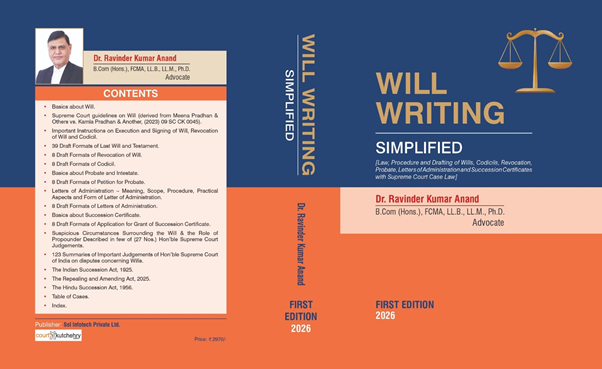
OUR RECOMMENDATION: Check out 123 Key Judgements, as highlighted in the book, WILL WRITING SIMPLIFIED, for the quick research and reference purposes. Click the link here: https://www.courtkutchehry.com/pages/blog/123-supreme-court-judgments-on-wills/
Keywords for SEO & Quick Search
-
- Venkatamuni v. C.J. Ayodhya Ram Singh case
- Supreme Court probate judgment 2006
- Suspicious Will India case law
- Unregistered Will validity India
- Probate disputes Supreme Court of India
- Justice S.B. Sinha and Justice D.K. Jain rulings
- Civil Appeal No. 4550 of 2006