
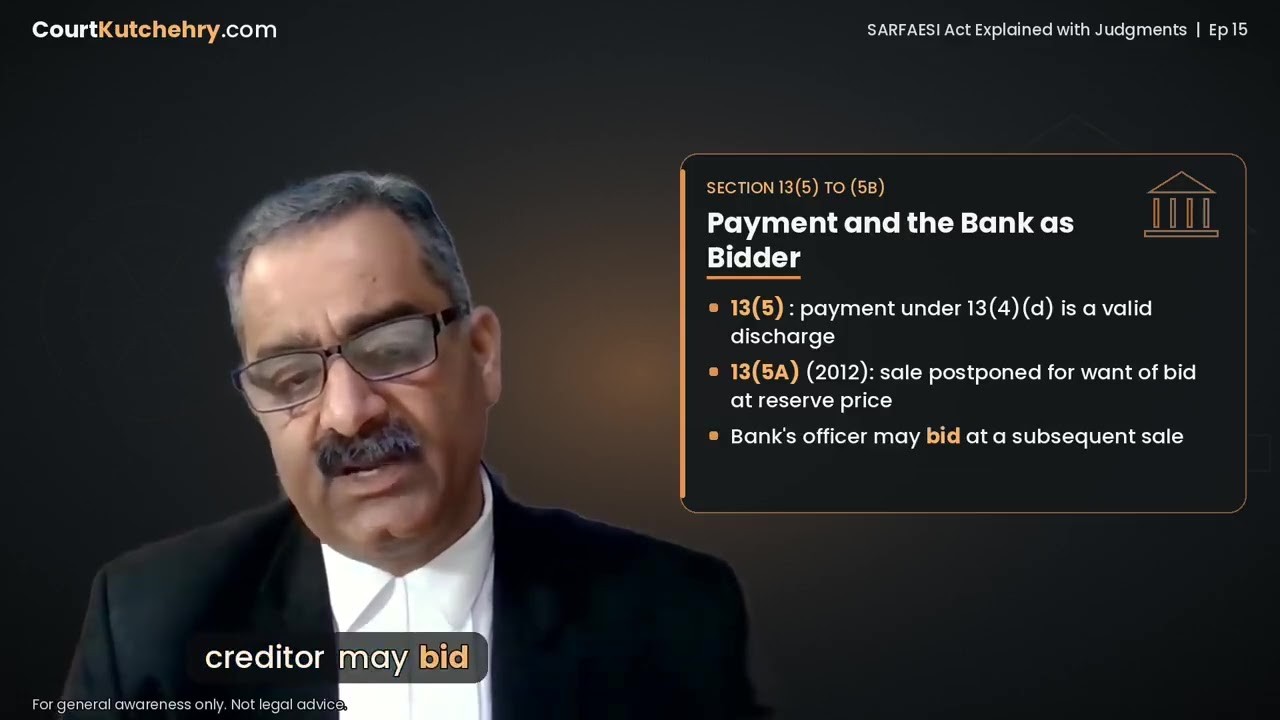
Watch the Video
In this 8-minute video, Vineet Kohli, Advocate, follows the secured asset from valuation to auction to the distribution of the sale proceeds, in Episode 15 of “SARFAESI Act Explained with Judgments”. This article sets out the same points in writing, with a link to the judgment on CourtKutchehry.
From Possession to Sale
Taking possession is not the end of a SARFAESI case. The secured creditor takes possession so that it can sell the asset and recover its dues. This episode follows the property under the Securitisation and Reconstruction of Financial Assets and Enforcement of Security Interest Act, 2002 from valuation, to auction, to the distribution of the sale proceeds, and explains why the courts insist on strict compliance at every step.
The Rules of Sale: Rules 8 and 9
The manner of sale is laid down in Rules 8 and 9 of the Security Interest (Enforcement) Rules, 2002. In outline:
- Valuation. Before sale, the authorised officer must get the immovable property valued by an approved valuer and, in consultation with the secured creditor, fix the reserve price.
- Method of sale. The property may be sold by obtaining quotations, by inviting tenders from the public, by public auction (including e-auction), or by private treaty. Sales are generally by public auction or tender.
- Notice of sale. A notice of sale must be served on the borrower, and the sale cannot take place before 30 days from the notice. The notice is also published in newspapers, affixed on the property and placed on the creditor’s website.
- Payment. The successful bidder pays 25% of the sale price at once (on the same day or by the next working day) and the balance on or before the 15th day of confirmation of the sale, or within a longer period agreed in writing, not exceeding three months.
- Sale certificate. On full payment, the authorised officer issues a sale certificate to the purchaser.
Under Rule 9(2), the sale cannot be confirmed below the reserve price unless both the borrower and the secured creditor agree.
Mathew Varghese v. M. Amritha Kumar (2014): Strict Compliance
In Mathew Varghese vs M. Amritha Kumar and Others, (2014) 02 SC CK 0016, the Supreme Court held that the procedure in Rules 8 and 9 must be strictly followed, because the borrower is being deprived of his property.
The Court read Rule 8(6) and Rule 9(1) together as requiring a clear 30-day notice to the borrower, in addition to the public notice. It held that no sale can proceed without that notice. It also held that if a properly notified sale does not take place, for reasons not solely attributable to the borrower, the earlier notice lapses and the procedure must be followed afresh before a later sale. On the facts, the sales in that case did not meet these requirements, and the sale procedure was held to be vitiated.
Remember this line: in a SARFAESI sale, procedure is not a formality; it is the borrower’s protection.
Sections 13(5) and 13(5A): Payments and the Bank as Bidder
Section 13(5)
Where a person who owes money to the borrower pays the secured creditor in response to a notice under Section 13(4)(d), Section 13(5) says the payment gives that person a valid discharge, as if he had paid the borrower.
Section 13(5A), inserted in 2012
Can the bank bid at its own auction? Section 13(5A) allows it in a limited case. Where the sale of immovable property, for which a reserve price has been specified, has been postponed for want of a bid of an amount not less than the reserve price, an authorised officer of the secured creditor may bid for the property on its behalf at any subsequent sale. If the creditor’s bid succeeds, the price is adjusted against its claim (Section 13(5B)).
Sections 13(6) and 13(7): Title and Proceeds
Under Section 13(6), a transfer of the secured asset by the secured creditor vests in the transferee all rights in the asset as if the transfer had been made by the owner. The purchaser gets title.
Under Section 13(7), the money received is applied in a fixed order:
- first, the costs, charges and expenses properly incurred by the secured creditor;
- then, the dues of the secured creditor; and
- any surplus is paid to the persons entitled to it, which can include the borrower.
The secured creditor holds the money in trust for these purposes. It cannot simply keep the surplus.
Practice Points for Advocates
- Check the valuation. Is the valuer approved? Is the valuation recent? A reserve price that is far below market value is a common ground of challenge.
- Count the 30 days. Work out the date of service of the sale notice on the borrower and the date of sale. After Mathew Varghese, a sale held before the 30 days have run is open to challenge.
- Ask for an account of the sale proceeds. Under Section 13(7), the borrower is entitled to know how the money was applied and to receive any surplus.
- For purchasers: pay the 25% and the balance within the time allowed by Rule 9, and insist on a proper sale certificate.
A Practical Example: A Godown Sold for ₹90 Lakh
A bank’s dues, with costs, come to ₹60 lakh. After following the Rules, it sells the borrower’s godown at auction for ₹90 lakh.
Under Section 13(7), the bank first meets its properly incurred costs and then its dues, ₹60 lakh in all. The remaining ₹30 lakh does not belong to the bank. It must go to the persons entitled to it, which may be a subsequent charge-holder or the borrower himself. The borrower’s advocate should ask the bank for a full account.
Quick Test
- How many days’ sale notice must be given to the borrower? Thirty days.
- In which case did the Supreme Court insist on strict compliance with Rules 8 and 9? Mathew Varghese v. M. Amritha Kumar (2014).
- Can the bank bid at its own auction? Yes, under Section 13(5A), at a subsequent sale, where an earlier sale was postponed for want of a bid at the reserve price.
Key Takeaways
- Rules 8 and 9 require valuation by an approved valuer, a reserve price, a 30-day sale notice to the borrower, sale generally by auction or tender, and 25% at once with the balance within the time allowed.
- Mathew Varghese (2014): Rules 8 and 9 must be strictly followed, because the borrower is losing his property.
- Section 13(5): a debtor of the borrower who pays the bank under a Section 13(4)(d) notice gets a valid discharge.
- Section 13(5A): the bank may bid at a subsequent sale where an earlier sale failed for want of a bid at the reserve price.
- Section 13(6) gives the purchaser title; Section 13(7) applies proceeds to costs, then dues, and any surplus goes to those entitled, including the borrower.
Frequently Asked Questions
How much notice must the borrower get before a SARFAESI sale?
A notice of sale must be served on the borrower, and the sale cannot take place before 30 days from that notice. Mathew Varghese treats this as a strict requirement.
Can the bank sell below the reserve price?
Under Rule 9(2), the sale cannot be confirmed below the reserve price unless both the borrower and the secured creditor agree.
Can the bank itself bid at the auction?
Only in the case covered by Section 13(5A): at a subsequent sale, after an earlier sale was postponed because no bid reached the reserve price.
What happens to the extra money if the property sells for more than the dues?
Under Section 13(7), after costs and the secured creditor’s dues, the surplus must be paid to the persons entitled to it, which can include the borrower.
How long does the auction purchaser have to pay?
The purchaser pays 25% at once and the balance on or before the 15th day of confirmation of sale, or within a longer period agreed in writing, not exceeding three months.
Where can I watch the full explanation?
Watch Vineet Kohli, Advocate, explain it in 8 minutes: https://youtu.be/zGJpY0kPkkQ.
Conclusion
A SARFAESI sale moves fast, but it must move by the Rules: proper valuation, a reserve price, a 30-day notice to the borrower, and payment within the time fixed. The Supreme Court in Mathew Varghese made clear that these are not technicalities.
The proceeds, too, follow a fixed order, and any surplus belongs to those entitled to it. The next episode looks at the borrower’s last chance to save the property: the right of redemption under Section 13(8), and how the 2016 amendment changed it.
▶ Watch the video: SARFAESI Auction Rules: 30-Day Notice, Reserve Price and Mathew Varghese | SARFAESI Explained Ep 15
📖 Read more: ‘Sanctity Is the Reward of Legality’: Supreme Court Sets Aside Rs 20 Crore SARFAESI Sale of Ooty Resort
Research Judgments Like These on CourtKutchehry
Every judgment cited in this article, and lakhs more, can be searched and read on CourtKutchehry. Searching and reading judgments is free. A membership adds unlimited summaries, all related judgments, original court PDF downloads, bookmarks, notes and the CourtKutchehry AI assistant.
| Membership | Price | Works out to | AI credits |
|---|---|---|---|
| Monthly (1 month) | ₹599 | ₹599 / month | 1,000 / month |
| Quarterly (3 months) · Save 16% | ₹1,499 | ₹499.67 / month | 1,100 / month |
| Six-monthly (6 months) · Save 33% | ₹2,399 | ₹399.83 / month | 1,200 / month |
| Yearly (12 months) · Save 44% · Best value | ₹3,999 | ₹333.25 / month | 1,300 / month |
Every plan is a one-off purchase for a fixed period: nothing auto-renews and no card is kept on file. Prices are exclusive of applicable tax, which is added at checkout. Extra AI chat credits can be topped up from ₹99. A free verified account gets 5 summaries and 50 AI trial credits.
Prices are as displayed on courtkutchehry.com on 20 November 2026 and are subject to change without notice. Please check the pricing page for the current plans and offers.
For more judgments, legal opinions and case analysis, visit courtkutchehry.com
Visit CourtKutchehry →