
COURTKUTCHEHRY SPECIAL SERIES ON LANDMARKS JUDGEMENTS ON WILLS, CODICIL & PROBATE
Sadhu Singh v. Gurdwara Sahib Narike and Others: Supreme Court Clarifies Widow’s Limited Estate Under Will
Section 14(2) of Hindu Succession Act Prevails Over Absolute Ownership Claim
Appellant Granted Possession as Remainderman
By Vishwas Kumar
New Delhi: March 25, 2026:
In Sadhu Singh v. Gurdwara Sahib Narike and Others (Civil Appeal No. 1854 of 2003, decided on 8 September 2006), the Supreme Court of India delivered a landmark judgment on the interpretation of Section 14 of the Hindu Succession Act, 1956. The case revolved around whether a widow’s limited interest under her husband’s Will could be enlarged into absolute ownership under Section 14(1), or whether Section 14(2) restricted her rights.
check important Supreme Court rulings on wills of Sadhu Singh Case
The widow had been bequeathed only a limited estate by her husband’s Will, executed after the enactment of the Hindu Succession Act. She later attempted to gift and alienate the property, claiming absolute ownership under Section 14(1). The legatees challenged this, arguing that Section 14(2) governs testamentary dispositions made after 1956, where the Will expressly limits the estate.
The Supreme Court bench, comprising Hon’ble Mr. Justice B.P. Singh and Hon’ble Mr. Justice P.K. Balasubramanyan, upheld the legatees’ contention. The Court ruled that Section 14(2) applies to Wills executed after the Act, and where the testator clearly restricts the widow’s interest, she cannot claim absolute ownership. Consequently, the widow’s attempt to gift or alienate the property was invalid. The appellant, as remainderman under the Will, was granted possession.
This ruling reaffirms the principle that Section 14(1) enlarges only pre-existing rights of Hindu women, while Section 14(2) preserves the testator’s intention in post-1956 Wills. It underscores the importance of respecting testamentary autonomy and clarifies that limited estates created by Wills remain enforceable, preventing unintended expansion of property rights.
For More, Read Here the Summary of the Judgement from the Book: WILL WRITING SIMPLIFIED, read below or open page no 436, Chapter 14.1 in the book. (Online book purchase link available here on: Buy online: Amazon | Flipkart
|
|
Case Summary |
: |
Sadhu Singh v. Gurdwara Sahib Narike and Others. |
|
|
Court |
: |
Supreme Court of India |
|
|
Citations |
: |
(2006) 09 SC CK 0020: Civil Appeal No. 1854 of 2003. |
|
|
Link |
: |
https://www.courtkutchehry.com/judgements/658180/sadhu-singh-vs-gurdwara-sahib-narike-and-others/
|
|
|
Decided on |
: |
08 September 2006 |
|
|
Coram |
: |
Hon’ble Mr. Justice B.P. Singh and Hon’ble Mr. Justice P.K. Balasubramanyan. |
|
|
Relevant Paragraphs |
: |
Para Nos. 1–24 |
1. Facts of the Case:
Ralla Singh, owner of self-acquired property, executed a will (7.10.1968) bequeathing his estate to his wife Isher Kaur for life, with remainder to his nephews Pritam Singh and Sadhu Singh. After his death (19.3.1977), the widow gifted the property to a Gurdwara (21.1.1980). Sadhu Singh challenged the gift, claiming that under the will Isher Kaur had only a life estate. The trial court dismissed the suit holding the will invalid and recognizing the widow as absolute owner. On appeal, the will was upheld, the widow was held to have only a limited estate, and the gift was declared void. The High Court reversed, wrongly applying V. Tulasamma v. V. Shesha Reddi (1977) 3 SCR 261, holding that Section 14(1) of the Hindu Succession Act made her absolute owner. The plaintiff appealed to the Supreme Court.
2. Law Points Involved:
(i). Scope and distinction between Sections 14(1) and 14(2) of the Hindu Succession Act, 1956.
(ii). Whether property received by a widow under her husband’s will is governed by Section 14(1) (absolute ownership) or Section 14(2) (restricted estate).
(iii). Effect of testamentary disposition under Section 30 of the Act vis-à-vis female heirs.
(iv). Interpretation of wills creating successive interests—principles of harmonisation and repugnancy.
3. Acts / Provisions / Articles Referred:
(i). Hindu Succession Act, 1956 — Sections 8, 14(1), 14(2), 30
(ii). Hindu Adoptions and Maintenance Act, 1956 — Sections 18, 21, 22, 27, 28
(iii). Transfer of Property Act, 1882 — Section 39
4. Judgments Referred:
(i). V. Tulasamma v. V. Shesha Reddi, , (1977) 03 SC CK 0031.
(ii). Raghubar Singh v. Gulab Singh, (1998) 07 SC CK 0017.
(iii). Mst. Karmi v. Amru, (1971) 01 SC CK 0004.
https://www.courtkutchehry.com/judgements/646540/mst-karmi-vs-amru-and-others/]
(iv). Bhura v. Kashi Ram, (1994) 01 SC CK 0039.
https://www.courtkutchehry.com/judgements/677377/bhura-and-others-appellant-hash-kashiram-respondent]
(v). Sharad Subramanyan v. Soumi Mazumdar, (2006) 04 SC CK 0038.
(vi). Ramchandra Shenoy v. Hilda Brite, (1963) 04 SC CK 0003.
(vii). Gummalapura Kotturuswami v. Setra Veeravva, (1958) 12 SC CK 0015.
(viii). Eramma v. Veerupana, (1965) 11 SC CK 0031.
(ix). Dindayal v. Rajaram, (1970) 04 SC CK 0045.
https://www.courtkutchehry.com/judgements/646131/dindayal-anr-appellant-hash-rajaram-respondent]
5. Obiter Dicta:
Section 14(1) operates only where the female Hindu is possessed of property at the commencement of the Act under a pre-existing right. Testamentary bequests post-Act that restrict the estate fall within Section 14(2). Section 30 preserves the male Hindu’s right to create a limited estate by will.
6. Ratio Decidendi:
Where a Hindu male bequeaths his self-acquired property to his widow for life with remainder over, Section 14(2) of the Hindu Succession Act applies; the widow’s estate remains limited in accordance with the will. The Act does not enlarge her rights to absolute ownership under Section 14(1) since she had no pre-existing right in such property. Testamentary dispositions are expressly saved by Section 30, and Section 14(2) reinforces the testator’s power to limit the estate.
7. Final Ruling:
The Supreme Court set aside the High Court’s judgment, restored the decree of the first appellate court, and held that Isher Kaur had only a life estate. The gift to the Gurdwara was invalid beyond her lifetime. The appellant (Sadhu Singh) was entitled to possession after her death. Gurdwara was exempted from mesne profits if property surrendered within six months, failing which liable for mesne profits from the appellate decree date until delivery of possession. Appeal allowed. No order as to costs.
8. Gist / Dispute & Final Decision:
The key dispute was whether the widow’s limited interest under her husband’s will was enlarged to absolute ownership under Section 14(1). The Supreme Court held in favour of the legatees, reaffirming that Section 14(2) governs wills executed after 1956 that expressly limit the estate. The widow could not gift or alienate the property. The appellant was granted possession as remainderman.
Read full Judgement Here:
Sadhu Singh v. Gurdwara Sahib Narike and Others.
Supreme Court of India
(2006) 09 SC CK 0020: Civil Appeal No. 1854 of 2003.
https://www.courtkutchehry.com/judgements/658180/sadhu-singh-vs-gurdwara-sahib-narike-and-others/
You Can Also Purchase the Book from here on: Buy online: Amazon | Flipkart
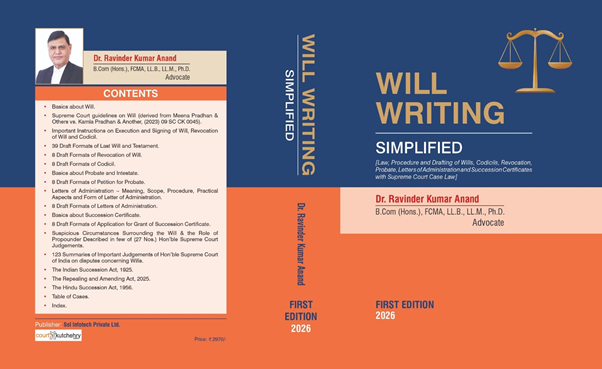
OUR RECOMMENDATION: Check out 123 Key Judgements, as highlighted in the book, WILL WRITING SIMPLIFIED, for the quick research and reference purposes. Click the link here: https://www.courtkutchehry.com/pages/blog/123-supreme-court-judgments-on-wills/
Keywords for SEO & Quick Search
- Sadhu Singh v. Gurdwara Sahib Narike case
- Supreme Court Hindu Succession Act 2006 judgment
- Section 14(1) vs Section 14(2) case law
- Widow’s limited estate under Will India
- Testamentary succession Supreme Court ruling
- Civil Appeal No. 1854 of 2003 judgment
- Justice B.P. Singh and Justice P.K. Balasubramanyan decisions