
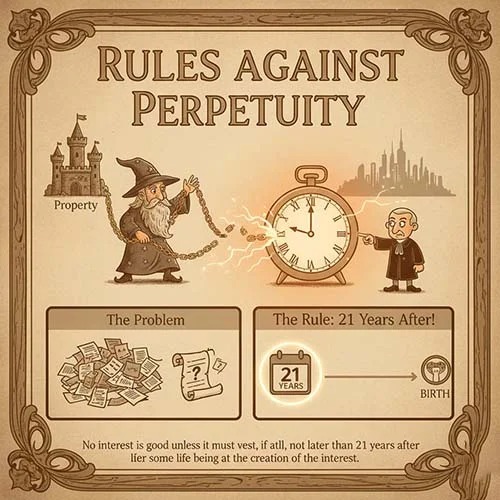
The Rule Against Perpetuity: Guardrails on Testamentary Freedom
Why Wills Cannot Stretch Forever
Safeguards for Family and Charitable Bequests
By Vishwas Kumar
New Delhi: April 18, 2026:
The law of succession is not only about honouring the wishes of the deceased but also about ensuring that property rights remain practical, enforceable, and fair. One of the most significant doctrines in this area is the Rule Against Perpetuity, which prevents wills from creating interests that remain uncertain or unvested for generations. Alongside this, related provisions regulate bequests to classes, contingent gifts, and charitable uses. Together, these rules form a framework that balances testamentary freedom with social order.
[Check all legal rulings on wills here. Click the link here: https://www.courtkutchehry.com/pages/blog/123-supreme-court-judgments-on-wills/]
The Rule Against Perpetuity
The principle is simple yet profound: no bequest is valid if the vesting of the property may be delayed beyond the lifetime of one or more persons living at the testator’s death, plus the minority of someone alive at that time who will eventually inherit upon reaching majority.
This ensures that property does not remain in limbo indefinitely. The law recognizes that while a testator may wish to control succession, such control cannot extend endlessly into the future. The doctrine thus protects society from “dead hand control,” where property is tied up by conditions that may never be fulfilled.
Bequest to a Class of Persons
Another important rule deals with bequests to a class of persons. If a gift is made to a group, and for some members it is void under Sections 113 or 114 (because they were not in existence or because the interest given is partial), the bequest is void only for those individuals, not for the entire class.
This principle prevents the invalidity of one part of a gift from destroying the whole. For example, if a fund is left to “all daughters of A,” and some daughters are born after the testator’s death, the gift is valid for those who qualify under the law, even if it fails for others.
Bequest on Failure of Prior Bequest
The law also addresses situations where a later bequest is intended to take effect upon the failure of a prior one. If the prior bequest is void under Sections 113 or 114, then the subsequent bequest also fails. This rule prevents testators from indirectly circumventing the restrictions on unborn beneficiaries or partial interests by layering bequests.
Bequest to Religious or Charitable Uses
A particularly striking provision limits the ability to bequeath property to religious or charitable purposes. If a testator has a nephew, niece, or closer relative, he cannot leave property to charity unless:
- The will was executed at least 12 months before death, and
- It was deposited within six months of execution in a legally recognized place for safe custody.
This safeguard reflects a policy concern: to prevent undue influence or hasty decisions in favor of charities at the expense of close family members. It ensures that charitable bequests are deliberate, long considered, and properly recorded.
Broader Implications
These rules collectively highlight the law’s dual objectives: respecting individual autonomy while protecting family rights and societal interests. The Rule Against Perpetuity ensures that property remains transferable and usable, not locked in endless contingencies. The rules on class bequests and prior failures prevent unfairness and uncertainty. The restrictions on charitable gifts reflect a cultural and legal emphasis on family obligations.
For testators, the lesson is clear: precision and foresight are essential in drafting wills. Overly complex conditions or reliance on unborn heirs can render gifts void. For families, these provisions provide reassurance that property will not be indefinitely tied up or diverted without due process.
[RESEARCH RESOURCES]
EXTRACTS FROM BOOK, WILL WRITING SIMPLIFIED, By Dr Ravinder Kumar Anand. [📘 Buy Will Writing Simplified online: Amazon | Flipkart ]
Rule against perpetuity. — No bequest is valid whereby the vesting of the thing bequeathed may be delayed beyond the life-time of one or more persons living at the testator’s death and the minority of some person who shall be in existence at the expiration of that period and to whom, if he attains full age, the thing bequeathed is to belong.
Illustrations
(i) A fund is bequeathed to A for his life and after his death to B for his life; and after B’s death to such of the sons of B as shall first attain the age of 25. A and B survive the testator. Here the son of B who shall first attain the age of 25 may be a son born after the death of the testator; such son may not attain 25 until more than 18 years have elapsed from the death of the longer liver of A and B; and the vesting of the fund may thus be delayed beyond the lifetime of A and B and the minority of the sons of B. The bequest after B's death is void.
(ii) A fund is bequeathed to A for his life and after his death to B for his life and after B’s death to such of B's sons as shall first attain the age of 25. B dies in the lifetime of the testator, leaving one or more sons. In this case the sons of B are persons living at the time of the testator’s decease and the time ashen either of them will attain 25 necessarily falls within his own lifetime. The bequest is valid.
(iii) A fund is bequeathed to A for his life and after his death to B for his life, with a direction that after B’s death it shall be divided amongst such of B’s children as shall attain the age of 18, but that, if no child of B shall attain that age, the fund shall go to C. Here the time for the division of the fund must arrive at the latest at the expiration of 18 years from the death of B, a person living at the testator's decease. All the bequests are valid.
(iv) A fund is bequeathed to trustees for the benefit of the testator’s daughters, with a direction that, if any of them marry under age, her share of the fund shall be settled so as to devolve after her death upon such of her children as shall attain the age of 18. Any daughter of the testator to whom the direction applies must be in existence at his decease and any portion of the fund which may eventually be settled as directed must vest not later than 18 years from the death of the daughters whose share it was. All these provisions are valid.
115. Bequest to a class some of whom may come under rules in sections 113 and 114.—If a bequest is made to a class of persons with regard to some of whom it is inoperative by reason of the provisions of section 113 or section 114, such bequest shall be [1][void in regard to those persons only and not in regard to the whole class].
Illustrations
(i) A fund is bequeathed to A for life and after his death to all his children who shall attain the age of 25. A survives the testator and has some children living at the testator’s death. Each child of A’s living at the testator’s death must attain the age of 25 (if at all) within the limits allowed for a bequest. But A may have children after the testator’s decease, some of whom may not attain the age of 25 until more than 18 years have elapsed after the decease of A. The bequest to A’s children, therefore, is inoperative as to any child born after the testator’s death; [2][and in regard to those who do not attain the age of 25 within 18 years after A’s death, but is operative in regard to the other children of Al
(ii) A fund is bequeathed to A for his life and after his death to B, C, D and all other children of A who shall attain the age of 25. B, C, D are children of A living at the testator’s decease. In all other respects the case is the same as that supposed in Illustration (i). 2[Although the mention of B, C and D does not prevent the bequest from being regarded as a bequest to a class, it is not wholly void. It is operative as regards any of the children B, C or D, who attain the age of 25 within 18 years after A’s death].
[3][116. Bequest to take effect on failure of prior bequest. — Where by reason of any of the rules contained in sections 113 and 114, any bequest in favour of a person or of a class of persons is void in regard to such person or the whole of such class, any bequest contained in the same will and intended to take effect after or upon failure of such prior bequest is also void.]
Illustrations
(i) A fund is bequeathed to A for his life and after his death to such of his sons as shall first attain the age of 25, for his life and after the decease of such son to B. A and B survive the testator. The bequest to B is intended to take effect after the bequest to such of the sons of A as shall first attain the age of 25, which bequest is void under section 114. The bequest to B is void.
(ii) A fund is bequeathed to A for his life and after his death to such of his sons as shall first attain the age of 25 and, if no son of A shall attain that age, to B. A and B survive the testator. The bequest to B is intended to take effect upon failure of the bequest to such of A’s sons as shall first attain the age of 25, which bequest is void under section 114. The bequest to B is void.
[4][117. Effect of direction for accumulation.—
(1) Where the terms of a will direct that the income arising from any property shall be accumulated either wholly or in part during any period longer than a period of eighteen years from the death of the testator, such direction shall, save as hereinafter provided, be void to the extent to which the period during which the accumulation is directed exceeds the aforesaid period and at the end of such period of eighteen years the property and the income thereof shall be disposed of as if the period during which the accumulation has been directed to be made had elapsed.
(2) This section shall not effect any direction for accumulation for the purpose of—
(i) the payment of the debts of the testator or any other person taking any interest under the will, or
(ii) the provision of portions for children or remoter issue of the testator or of any other person taking any interest under the will or
(iii) the preservation or maintenance of any property bequeathed; and such direction may be made accordingly.]
118. Bequest to religious or charitable uses. — No man having a nephew or niece or any nearer relative shall have power to bequeath any property to religious or charitable uses, except by a will executed not less than twelve months before his death and deposited within six months from its execution in some place provided by law for the safe custody of the wills of living persons:
[5][Provided that nothing in this section shall apply to a Parsi.]
Illustrations
A having a nephew makes a bequest by a will not executed and deposited as required— for the relief of poor people;
for the maintenance of sick soldiers; for the erection or support of a hospital;
for the education and preferment of orphans; for the support of scholars;
for the erection or support of a school; for the building and repairs of a bridge; for the making of roads;
for the erection or support of a church; for the repairs of a church;
for the benefit of ministers of religion;
for the formation or support of a public garden; All these bequests are void.
COMMENT
Section 118 comes within the purview of articles 14 and 15 of the Constitution of India and it is, therefore, necessary that all testators who are similarly situated should be subjected to the same rule of procedure. There cannot be any unusual burden of Christian testators alone when all other testators, making similar bequests for similar charities and similar religious purposes are not subjected to such procedure. Therefore section 118 is anomalous, discriminatory and violative of articles 14, 15, 25 and 26 of Constitution.
The Court in exercise of its jurisdiction and to remedy the violation of fundamental rights, declared this section as invalid and unconstitutional; John Vallamattom v. Union of India, (2003) 6 SCC 611.
FAQ: Quick Guide to Perpetuity and Bequests
Q1. What is the Rule Against Perpetuity?
It is a legal principle that prevents property from being tied up indefinitely. A bequest must vest within the lifetime of persons alive at the testator’s death plus the minority of someone alive at that time.
Q2. Why does the law impose this rule?
To prevent property from being locked in uncertainty for generations and to ensure free transferability.
Q3. What happens if a bequest is made to a class of persons, some of whom are not valid beneficiaries?
The bequest is void only for those invalid members, not for the entire class.
Q4. If a prior bequest fails under Sections 113 or 114, can a later bequest take effect?
No. If the prior bequest is void, any subsequent bequest dependent on it also fails.
Q5. Can property be left to charity freely?
Not always. If the testator has close relatives (like nieces or nephews), charitable bequests are valid only if the will was executed at least 12 months before death and deposited within six months of execution.
Q6. Why are charitable bequests restricted?
To protect family members from being disinherited by sudden or influenced decisions in favor of charities.
Q7. What is the practical takeaway for drafting wills?
Avoid conditions that delay vesting beyond the allowed period, be clear when gifting to classes, and follow strict rules for charitable bequests if close relatives exist.
In essence, the Rule Against Perpetuity and related provisions act as guardrails, ensuring that wills serve both the wishes of the deceased and the stability of property rights for the living.