
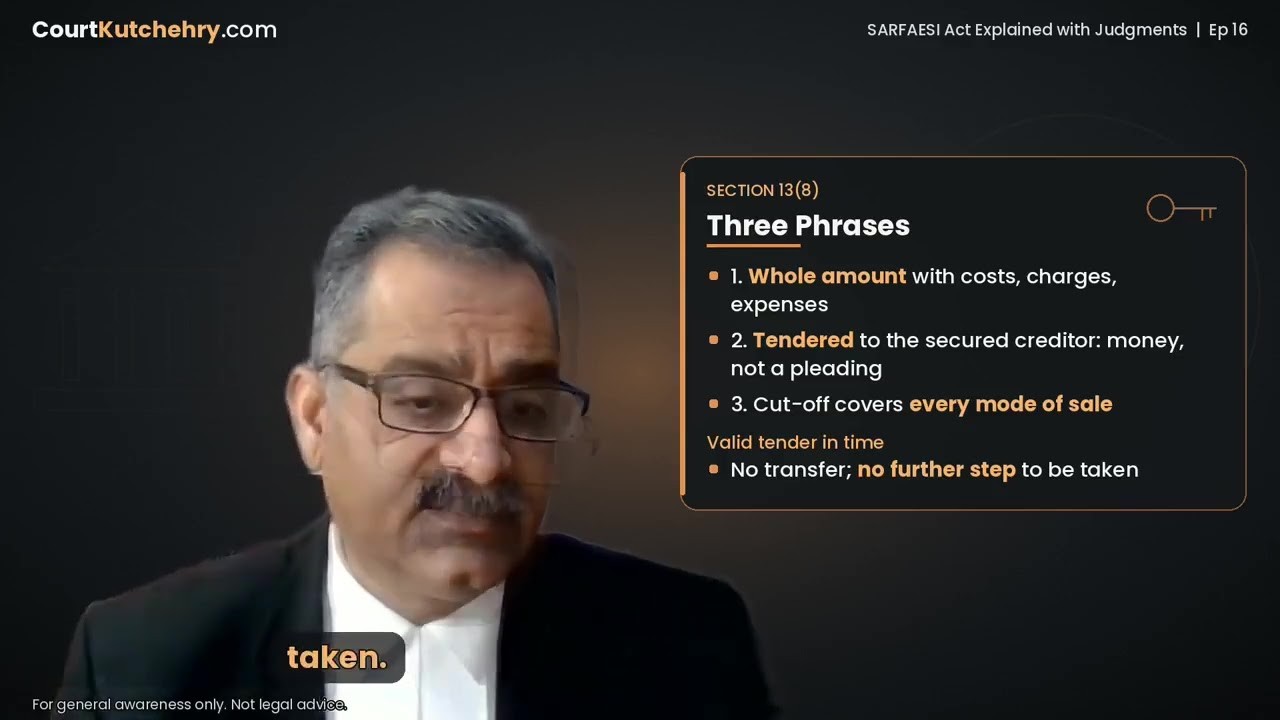
Watch the Video
In this 8-minute video, Vineet Kohli, Advocate, explains the right of redemption under Section 13(8), how the 2016 amendment changed it, and how the Supreme Court applied the new rule, in Episode 16 of “SARFAESI Act Explained with Judgments”. This article sets out the same points in writing, with links to the judgments on CourtKutchehry.
Until When Can the Borrower Save the Property?
A borrower whose property is headed for a SARFAESI auction will always ask one question: if I pay everything now, can I still save it? The answer lies in Section 13(8) of the Securitisation and Reconstruction of Financial Assets and Enforcement of Security Interest Act, 2002, the provision on the right of redemption. It is one of the most litigated questions under the Act, and the answer changed in 2016.
What Redemption Means
The right of redemption comes from Section 60 of the Transfer of Property Act, 1882. Once the mortgage money becomes due, the mortgagor may pay or tender it and ask for his property back. The proviso to Section 60 says the right lasts until it is extinguished by act of the parties or by decree of a court.
Under the SARFAESI Act there is no court decree. So the question is: at what point does the secured creditor’s action end this right? Section 13(8) answers it.
Section 13(8) Before 2016
As originally enacted, Section 13(8) said that if the dues of the secured creditor, with all costs, charges and expenses, were tendered at any time before the date fixed for sale or transfer, the secured asset shall not be sold or transferred.
In Mathew Varghese vs M. Amritha Kumar and Others, (2014) 02 SC CK 0016, the Supreme Court read this provision with Section 60 of the Transfer of Property Act. It held that the borrower must be told the date and time of sale so that he can exercise this right, and the effect of its reading was that the right of redemption continued until the sale was complete. This gave borrowers a long window, and some sales were undone even after bidders had deposited their money.
Section 13(8) After the 2016 Amendment
The 2016 amendment, in force from 1 September 2016, rewrote Section 13(8). Now, if the dues of the secured creditor, with all costs, charges and expenses, are tendered to the secured creditor at any time before the date of publication of notice for public auction or inviting quotations or tender from public or private treaty for transfer by way of lease, assignment or sale, then:
- the secured asset shall not be transferred by way of lease, assignment or sale; and
- no further step shall be taken by the secured creditor for transfer or sale of the asset.
Three phrases that matter
- “Dues together with all costs, charges and expenses”: the whole amount, not just the overdue instalments.
- “Tendered to the secured creditor”: a real tender of the money, not an offer in a pleading.
- “Before the date of publication of notice”: the cut-off covers every mode of sale, auction, quotations, tender or private treaty.
Remember this line: after 2016, the window to redeem closes when the auction notice is published, not on the day of the auction.
Celir LLP v. Bafna Motors (Mumbai) Pvt. Ltd. (2023)
The facts
In Celir LLP vs Bafna Motors (Mumbai) Pvt. Ltd., (2023) 09 SC CK 3137, the bank’s dues were about ₹123.83 crore. Eight auctions failed. In the ninth, Celir LLP bid about ₹105.05 crore; the bank confirmed it as the highest bidder, and Celir paid the full price. The borrowers then sought redemption, first before the DRT and then in a writ petition before the Bombay High Court. The High Court allowed them to redeem the property by paying the dues on a fixed schedule, and the bank went along with that arrangement.
The decision
On 21 September 2023, the Supreme Court allowed the auction purchaser’s appeals and held that:
- under the amended Section 13(8), the borrower’s right of redemption is extinguished on the date of publication of the auction notice;
- to that extent, the amended Section 13(8), a special law with overriding effect under Section 35, prevails over Section 60 of the Transfer of Property Act, and Mathew Varghese stood partially overruled by the amendment;
- the High Court should not have entertained a writ petition when the borrowers had a remedy under the Act; and
- the bank could not accept a redemption offer after the right had lapsed and after confirming the sale, and should have issued the sale certificate.
So, once the auction notice is published, a High Court cannot let the borrower redeem after the auction merely by paying the dues.
Why the Change Matters
The amendment balances two interests. The borrower gets a fair chance to save his property, up to the publication of the sale notice. Bidders get certainty: a person who deposits money in a SARFAESI auction must be confident that the sale will not be undone at the last minute.
If sales could be reopened at will, serious buyers would stay away, prices would fall, and in the end the borrower himself would get less for his property.
Practice Points for Advocates
- Act before the auction notice. If the client wants to save the property, the time to pay or settle is before the notice of sale is published.
- Make a real tender of the full dues. Offer the entire amount with costs, charges and expenses, in writing, with the money ready. A proposal to pay in instalments is not a tender under Section 13(8).
- Check the dates for pre-2016 actions. Where the sale steps were taken before the amendment came into force, the older position may still be relevant. The date of the auction notice is usually the decisive date; the next episode shows how the Supreme Court treated a pre-2016 loan.
A Practical Example: Dues Offered 19 Days Too Late
A bank publishes a notice for public auction of a borrower’s property. Nineteen days after the notice is published, and before the auction date, the borrower offers to pay all the dues.
Under the amended Section 13(8), as applied in Celir LLP, the statutory right to redeem ended on the date the auction notice was published. The bank is not bound to stop the sale. Any settlement now depends on the bank’s agreement, and even then it cannot defeat a sale already confirmed in a purchaser’s favour. Had the borrower tendered the full dues before the notice was published, the bank could not have proceeded with the sale.
Quick Test
- Until when can a borrower redeem after the 2016 amendment? Until the date of publication of the notice for public auction, quotations, tender or private treaty.
- Which 2023 Supreme Court judgment applied the amended Section 13(8)? Celir LLP v. Bafna Motors (Mumbai) Pvt. Ltd.
- Before 2016, how did Mathew Varghese read the right of redemption? As continuing until the sale was complete.
Key Takeaways
- The right of redemption comes from Section 60 of the Transfer of Property Act; Section 13(8) fixes when SARFAESI action ends it.
- Before 2016, dues could be tendered any time before the date fixed for sale; Mathew Varghese (2014) read the right as continuing until the sale was complete.
- From 1 September 2016, the right ends on publication of the notice for public auction, quotations, tender or private treaty.
- Celir LLP v. Bafna Motors (SC, 21 September 2023): once the auction notice is published, redemption is extinguished, and a High Court cannot let the borrower redeem after the auction.
- Act before the auction notice, and make a real tender of the full dues with costs.
Frequently Asked Questions
What is the right of redemption under SARFAESI?
It is the borrower’s right to pay the secured creditor’s full dues, with costs, charges and expenses, and stop the sale of the secured asset. Section 13(8) fixes the deadline.
When does the right of redemption end after the 2016 amendment?
On the date of publication of the notice for public auction, or inviting quotations or tenders, or for private treaty.
Can a High Court allow redemption after the auction?
No. In Celir LLP v. Bafna Motors, the Supreme Court set aside a High Court order that had permitted redemption after the auction, holding that the right had already been extinguished.
Does Section 60 of the Transfer of Property Act still give a longer window?
Not to the extent of the amended Section 13(8). The Supreme Court held that the SARFAESI provision, with the overriding effect of Section 35, prevails.
Can I redeem by paying only the overdue instalments?
No. Section 13(8) requires the tender of the full dues together with all costs, charges and expenses.
Where can I watch the full explanation?
Watch Vineet Kohli, Advocate, explain it in 8 minutes: https://youtu.be/EMOeUWibwKY.
Conclusion
The right of redemption is the borrower’s last statutory chance to save his property. Since 2016, that chance ends when the notice of sale is published, and the Supreme Court in Celir LLP has applied that cut-off firmly in favour of auction purchasers.
The practical advice is simple: act early and tender the full amount. The next episode looks at three recent judgments, from the Supreme Court and the Delhi High Court, that show how firmly courts now protect a completed auction sale.
▶ Watch the video: Right of Redemption Under Section 13(8): The 2016 Change and Celir LLP | SARFAESI Explained Ep 16
Research Judgments Like These on CourtKutchehry
Every judgment cited in this article, and lakhs more, can be searched and read on CourtKutchehry. Searching and reading judgments is free. A membership adds unlimited summaries, all related judgments, original court PDF downloads, bookmarks, notes and the CourtKutchehry AI assistant.
| Membership | Price | Works out to | AI credits |
|---|---|---|---|
| Monthly (1 month) | ₹599 | ₹599 / month | 1,000 / month |
| Quarterly (3 months) · Save 16% | ₹1,499 | ₹499.67 / month | 1,100 / month |
| Six-monthly (6 months) · Save 33% | ₹2,399 | ₹399.83 / month | 1,200 / month |
| Yearly (12 months) · Save 44% · Best value | ₹3,999 | ₹333.25 / month | 1,300 / month |
Every plan is a one-off purchase for a fixed period: nothing auto-renews and no card is kept on file. Prices are exclusive of applicable tax, which is added at checkout. Extra AI chat credits can be topped up from ₹99. A free verified account gets 5 summaries and 50 AI trial credits.
Prices are as displayed on courtkutchehry.com on 20 November 2026 and are subject to change without notice. Please check the pricing page for the current plans and offers.
For more judgments, legal opinions and case analysis, visit courtkutchehry.com
Visit CourtKutchehry →