
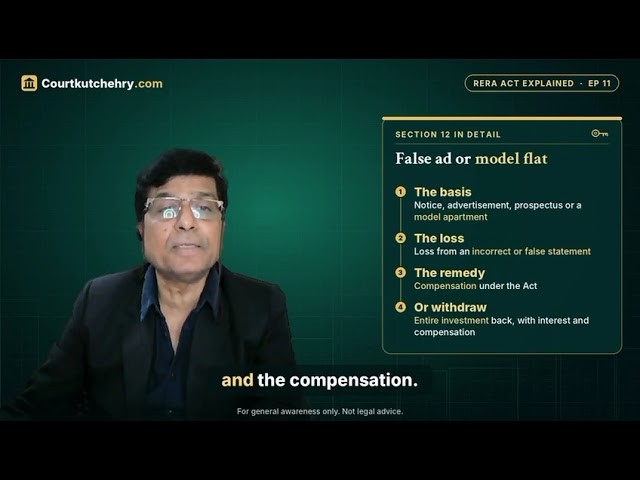
Watch the Video
In this 7-minute video, Episode 11 of “RERA Act Explained with Judgments” asks two practical questions: is a builder’s brochure only marketing or a legal promise, and how much can a builder take before signing a registered agreement? It explains Sections 12 and 13 of the Real Estate (Regulation and Development) Act, 2016 and two Supreme Court judgments on agreements written only in the builder’s favour. This article covers the same ground, with links to both judgments on CourtKutchehry.
Brochure or Promise?
Most flats in India are sold before they exist. The buyer sees a brochure, a website, a hoarding and perhaps a model flat, and pays on the strength of them. If what is finally built is different, the builder often replies that the brochure was “only for illustration”.
Sections 12 and 13 answer that reply. Section 12 makes the promoter answerable for what his advertisements and model flats say. Section 13 stops him from collecting large sums before the promises are written into a proper, registered agreement in a fair form.
Section 12: Truthful Advertisements
Section 12 applies where a person makes an advance or deposit on the basis of information in a notice, advertisement or prospectus, or on the basis of a model apartment, plot or building, and then suffers loss or damage because that information was incorrect or false. In that case:
- the promoter is liable to compensate the buyer in the manner provided in the Act; and
- if the buyer chooses to withdraw from the project, he must be returned his entire investment with interest at the prescribed rate, along with compensation.
Examples of Section 12 claims
- The brochure shows a golf course beside the towers. It never comes.
- The model flat has Italian marble flooring. The actual flat has ordinary tiles.
- A plot is sold as a “three-side open corner plot”. On the ground, it is boxed in by other plots.
In each case the buyer relied on what he was shown. The promoter cannot escape by saying the brochure was only illustrative. A disclaimer in small print does not change the fact that the advertisement was used to sell the unit.
Section 13: The 10% Rule
Section 13(1) says a promoter shall not accept more than 10% of the cost of the apartment, plot or building as an advance payment or application fee from a person without first entering into a written agreement for sale with that person and registering it under the law for the time being in force.
Before RERA, buyers were often asked to pay 20%, 30% or more on a booking form or allotment letter, while the actual agreement came months later on the builder’s terms. By then the buyer had too much money locked in to refuse.
What the agreement must contain
Under Section 13(2), the agreement for sale must be in the form prescribed by the rules and must specify, among other things:
- the particulars of development of the project, including construction of the building and apartments, with specifications and internal and external development works;
- the dates and manner of payment towards the cost;
- the date of handing over possession; and
- the rates of interest payable by the promoter to the allottee and by the allottee to the promoter in case of default.
Model agreements
States have notified model agreements for sale under their RERA rules. A builder can add project-specific details, but he cannot use his own clauses to dilute the rights the model agreement and the Act give the buyer.
Remember this line: no more than 10% before a registered agreement, and the agreement must be in the prescribed form.
Pioneer Urban Land v. Govindan Raghavan (2019)
In Pioneer Urban Land & Infrastructure Ltd. v. Govindan Raghavan & Ors., (2019) 04 SC CK 0173, (2019) 5 SCC 725, decided on 2 April 2019 by Uday Umesh Lalit and Indu Malhotra, JJ., the buyer had booked an apartment in a Gurugram project. The occupancy certificate came about two years after the deadline in the agreement. The buyer sought a refund before the National Consumer Disputes Redressal Commission.
The one-sided terms
The apartment buyer’s agreement allowed the builder to charge 18% interest on late payments and to cancel the allotment if an instalment was more than 30 days in arrears, with forfeiture of earnest money. The buyer, on the other hand, could terminate only after a long delay and on giving notice, and the builder’s liability for its own delay was far more limited.
What the Supreme Court held
- The terms were ex facie one-sided, unfair and unreasonable, and the builder could not bind the buyer to them.
- A term of a contract will not be final and binding if the flat buyers had no option but to sign on the dotted line of a contract framed by the builder.
- Incorporating such one-sided clauses is an unfair trade practice under the Consumer Protection Act, 1986.
The Court upheld the NCDRC’s order directing a refund with interest at 10.7% per annum, which the Commission had linked to the rate under the Haryana RERA Rules.
Why it matters for Section 13
Pioneer shows exactly the problem Section 13 was designed to fix: a buyer who had already paid heavily and then signed an agreement drafted only for the builder. Requiring a registered agreement in the prescribed form before more than 10% is taken gives the buyer bargaining power at the start, not after his money is gone.
IREO Grace Realtech v. Abhishek Khanna (2021)
In IREO Grace Realtech Pvt. Ltd. v. Abhishek Khanna & Ors., (2021) 01 SC CK 0012, (2021) 3 SCC 241, decided on 11 January 2021 by a Bench of Dr. D.Y. Chandrachud, Indu Malhotra and Indira Banerjee, JJ. (judgment by Indu Malhotra, J.), the Supreme Court again examined an apartment buyer’s agreement for a Gurugram project.
The agreement charged buyers 20% per annum on delayed instalments, while delay compensation payable by the developer was fixed at a small amount per square foot per month, which the Court worked out at roughly 1% a year. It also contained forfeiture and termination clauses loaded in the developer’s favour.
The Court held the terms wholly one-sided and an unfair trade practice, and held that the developer cannot compel buyers to be bound by them. It also held that the remedies under RERA and the consumer law are concurrent, so a buyer may choose his forum.
The model agreement under Section 13 is Parliament’s answer to contracts of this kind. Where the State’s prescribed form governs, the interest for default must be the same both ways, and one-sided penalty clauses have no place.
How Sections 12 and 13 Work Together
Section 12 protects what the buyer was told. Section 13 protects what the buyer signs. Together with the two judgments, they lead to three working rules:
- Advertisements and model flats are part of the bargain. False ones lead to compensation or a full refund with interest.
- A builder who takes more than 10% without a registered agreement has broken the Act at the very first step.
- One-sided clauses do not bind buyers, whether the dispute is before RERA or a consumer commission.
Practice Point
If a builder collected more than 10% without a registered agreement, plead Section 13 first. It shows the promoter broke the Act at the very start of the relationship, and it frames every later term he relies on in that light. Collect the booking form, allotment letter and payment receipts to show exactly how much was paid before the agreement was registered.
The next episode takes up Section 14 and the Supertech twin towers.
Key Takeaways
- Section 12: a buyer who pays relying on a false advertisement, prospectus or model flat gets compensation, or a full refund with interest and compensation if he withdraws.
- “The brochure was only for illustration” is not a defence to a Section 12 claim.
- Section 13: no more than 10% of the cost can be taken before a written, registered agreement for sale in the prescribed form.
- Pioneer v. Govindan Raghavan (2019): terms buyers had to sign “on the dotted line” are not final and binding; one-sided clauses are an unfair trade practice.
- IREO Grace v. Abhishek Khanna (2021): one-sided clauses do not bind buyers, and RERA and consumer remedies are concurrent.
Frequently Asked Questions
Is a builder’s brochure legally binding?
For the purposes of Section 12, yes. If a buyer paid an advance relying on a brochure, advertisement or model flat and suffered loss because it was false, the promoter must compensate him, or refund the entire amount with interest if he withdraws.
How much can a builder take before the agreement for sale?
Not more than 10% of the cost of the apartment, plot or building, as advance or application fee, until a written agreement for sale is signed and registered (Section 13(1)).
What did the Supreme Court decide in Pioneer v. Govindan Raghavan?
On 2 April 2019 it held that one-sided terms in a builder’s agreement, which buyers had no option but to sign, are not final and binding and amount to an unfair trade practice. It upheld a refund with 10.7% interest.
What did IREO Grace v. Abhishek Khanna add?
Decided on 11 January 2021, it again held that one-sided clauses in an apartment buyer’s agreement do not bind buyers, and that a buyer can choose between RERA and the consumer forum.
Can a builder change the model agreement prescribed under the State RERA rules?
He can fill in project details, but he cannot dilute the buyer’s rights under the Act and the prescribed form by adding his own one-sided clauses.
Where can I watch the full explanation?
Watch the 7-minute video here: https://youtu.be/i3jJA2F9ckc.
Conclusion
Sections 12 and 13 deal with the moment a buyer is most exposed: when he pays on the strength of a brochure and before he has a proper contract. Section 12 makes the brochure count; Section 13 caps the early payment at 10% until a registered, fair agreement is in place.
The Supreme Court’s rulings in Pioneer and IREO Grace show why. Agreements drafted only for the builder do not bind buyers, and the Act’s model agreement is designed to stop such clauses from being written in the first place.
▶ Watch the video: RERA Sections 12 & 13: False Ads, 10% Rule & One-sided Builder Agreements | Pioneer, Ireo | Ep 11
Research Judgments Like These on CourtKutchehry
Every judgment cited in this article, and lakhs more, can be searched and read on CourtKutchehry. Searching and reading judgments is free. A membership adds unlimited summaries, all related judgments, original court PDF downloads, bookmarks, notes and the CourtKutchehry AI assistant.
| Membership | Price | Works out to | AI credits |
|---|---|---|---|
| Monthly (1 month) | ₹599 | ₹599 / month | 1,000 / month |
| Quarterly (3 months) · Save 16% | ₹1,499 | ₹499.67 / month | 1,100 / month |
| Six-monthly (6 months) · Save 33% | ₹2,399 | ₹399.83 / month | 1,200 / month |
| Yearly (12 months) · Save 44% · Best value | ₹3,999 | ₹333.25 / month | 1,300 / month |
Every plan is a one-off purchase for a fixed period: nothing auto-renews and no card is kept on file. Prices are exclusive of applicable tax, which is added at checkout. Extra AI chat credits can be topped up from ₹99. A free verified account gets 5 summaries and 50 AI trial credits.
Prices are as displayed on courtkutchehry.com on 20 November 2026 and are subject to change without notice. Please check the pricing page for the current plans and offers.
For more judgments, legal opinions and case analysis, visit courtkutchehry.com
Visit CourtKutchehry →