
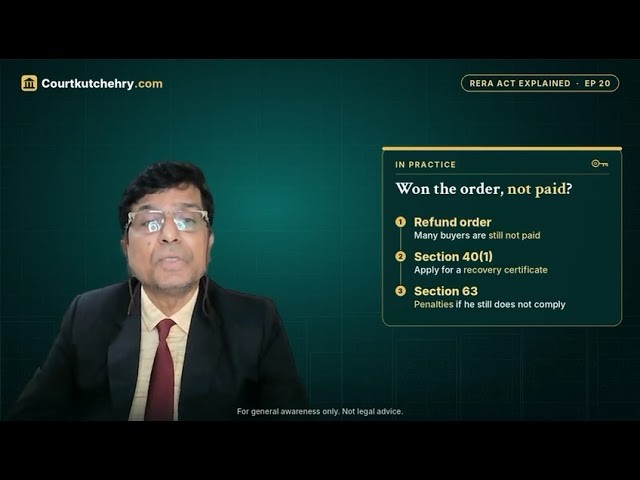
Watch the Video
In this 7-minute video, Episode 20 of “RERA Act Explained with Judgments”, we take up a problem many homebuyers know too well: winning a refund order and still not getting paid. Sections 37 to 40 of the Real Estate (Regulation and Development) Act, 2016 tell us how the Authority gives binding directions, imposes penalty or interest, corrects mistakes in its orders, and recovers unpaid money as arrears of land revenue. This article explains each section and the practical steps for recovery.
An Order Is Only as Good as Its Enforcement
A refund order on paper does not pay a home loan. The four sections in this episode are about the Authority’s power to make its decisions count: to direct, to penalise, to correct, and above all to recover.
Section 37: Binding Directions
Under Section 37, the Authority may, for discharging its functions, issue such directions from time to time to promoters, allottees or real estate agents as it considers necessary, and those directions are binding on all concerned.
Section 37 in practice
Directions are often general, applying to every promoter in the State. For example, an Authority may direct all promoters to:
- upload their quarterly progress reports by a fixed date;
- display the RERA registration number at the project site and in advertisements; or
- not demand any amount beyond the agreed price without the buyer’s consent.
Because these directions are binding, breaking one is itself a contravention that can attract a penalty.
Section 38: Penalty or Interest, With Natural Justice
Section 38 has three parts:
- Section 38(1): the Authority has power to impose penalty or interest for any contravention of the obligations cast on promoters, allottees and real estate agents under the Act, rules and regulations.
- Section 38(2): the Authority is guided by the principles of natural justice and, subject to the Act and the rules, may regulate its own procedure.
- Section 38(3): where an issue is raised about an agreement, action, omission, practice or procedure that has an appreciable effect of preventing, restricting or distorting competition in the development of a real estate project, or an effect of market power or monopoly adverse to allottees, the Authority may on its own motion refer the issue to the Competition Commission of India.
What natural justice means here
Two rules lie at the heart of natural justice:
- No one should be condemned unheard. The promoter or buyer must get notice of the case and a fair chance to reply.
- No one should be a judge in his own cause. The member deciding the matter must be free from bias.
A final order passed without notice and hearing is open to challenge in appeal. The exception is the urgent interim order under Section 36, which the Act itself allows without notice where necessary, and which is followed by a full hearing.
Section 39: Rectifying a Mistake, Not Rewriting the Order
Under Section 39, the Authority may, within two years from the date of an order, amend it to rectify any mistake apparent from the record, and must do so if a party brings the mistake to its notice. Two provisos limit the power:
- no amendment can be made in an order against which an appeal has been filed; and
- while rectifying, the Authority cannot amend the substantive part of its order.
So Section 39 is a power to correct a wrong figure, date or name. It is not a power to review or reverse the decision. A party who disagrees with the decision itself must appeal.
Section 40: Recovery as Arrears of Land Revenue
Section 40 is the buyer’s key to actually getting paid.
- Section 40(1): if a promoter, allottee or real estate agent fails to pay any interest, penalty or compensation imposed by the Adjudicating Officer, the Authority or the Appellate Tribunal, it is recoverable in the prescribed manner as an arrears of land revenue.
- Section 40(2): if any order or direction of the Adjudicating Officer, the Authority or the Appellate Tribunal is not complied with, it is enforced in the manner prescribed by the rules.
What about the principal amount of a refund? The Supreme Court settled this in M/s Newtech Promoters and Developers Pvt. Ltd. v. State of U.P., (2021) 11 SC CK 0015, decided on 11 November 2021. It held that the amount determined as refundable by the Authority or the Adjudicating Officer can also be recovered as arrears of land revenue under Section 40(1), so a recovery certificate can be issued for the refund itself, not merely for the interest on it.
Remember this line: a RERA money order is recovered like land revenue, through the Collector.
How Recovery Works in Practice
Recovery under Section 40(1) runs through the State’s revenue machinery. The usual steps are:
- The buyer applies to the Authority for a recovery certificate once the time to pay has passed.
- The Authority issues the certificate to the Collector of the district where the promoter has property or carries on business.
- The Collector’s office issues a demand notice.
- If the amount is still not paid, the revenue officers attach bank accounts and attach and auction property, using the coercive powers that the State’s land revenue law provides.
If the promoter still does not comply with the Authority’s orders, Section 63 provides a separate penalty for that failure, which the series studies later.
An example
Suppose a promoter is ordered to refund ₹40 lakh with interest and does not pay. The buyer applies for a recovery certificate. The Authority issues it to the Collector, who attaches the promoter’s unsold flats in another project and the company’s bank account. Faced with attachment, the promoter pays, and the amount is recovered within months.
A Common Difficulty: Unexecuted Orders
Many recovery certificates are never executed, because the promoter has no visible assets or because the revenue office gives them low priority. The Supreme Court noticed the wider problem in Mansi Brar Fernandes v. Shubha Sharma, (2025) 09 SC CK 0301, decided on 12 September 2025. It said RERA Authorities must not become toothless, and that they should have effective enforcement mechanisms so that their orders are implemented swiftly; it also directed the States to ensure the Authorities are adequately staffed and resourced.
Buyers can help the process along by identifying the promoter’s assets for the revenue officers: other projects, unsold units, land and bank accounts.
Practice point
After a refund order, do not wait for months. If the money is not paid within the time given, apply immediately for a recovery certificate, and list every bank account and property of the promoter you know about. Follow up with the Collector’s office, and keep the Authority informed if recovery stalls.
Quick Test
- How are unpaid RERA dues recovered under Section 40(1)? As arrears of land revenue.
- Within how long can the Authority rectify a mistake in its order? Within two years.
- Can Section 39 be used to change the substance of a decision? No.
Key Takeaways
- Section 37 directions, often general directions to all promoters, are binding; breaking them is a contravention.
- Section 38 empowers the Authority to impose penalty or interest, guided by natural justice, and to refer anti-competitive practices to the Competition Commission of India.
- Section 39 allows rectification of mistakes apparent from the record within two years, but not of an order under appeal and never of its substance.
- Section 40(1) makes unpaid interest, penalty and compensation recoverable as arrears of land revenue; Newtech confirms the refund amount itself can be recovered this way.
- Apply for a recovery certificate as soon as the payment deadline passes, and point the Collector to the promoter’s assets.
Frequently Asked Questions
The builder has not paid my RERA refund. What should I do?
Apply to the Authority for a recovery certificate under Section 40(1). The amount is then recovered through the Collector as arrears of land revenue.
Does a recovery certificate cover the principal refund, or only interest?
The principal too. In Newtech Promoters (2021), the Supreme Court held that the refundable amount determined by the Authority or Adjudicating Officer is recoverable as arrears of land revenue.
Can RERA correct a wrong figure in its order?
Yes, under Section 39, within two years, if it is a mistake apparent from the record, and provided no appeal has been filed against the order.
Can the Authority review its decision under Section 39?
No. Section 39 expressly bars amending the substantive part of the order. The remedy against the decision itself is an appeal.
Can RERA refer a builder to the Competition Commission?
Yes. Under Section 38(3), the Authority may on its own motion refer anti-competitive practices or abuse of market power in real estate development to the Competition Commission of India.
Where can I watch the full explanation?
Watch Episode 20 of RERA Act Explained with Judgments here: https://youtu.be/pZBD5yGOZMA.
Conclusion
Sections 37 to 40 give the RERA Authority the tools to make its orders count: binding directions, penalty and interest under the discipline of natural justice, a narrow power to correct mistakes, and recovery of money through the revenue machinery of the State.
For the buyer, the lesson is practical. A refund order is the beginning of recovery, not the end. Apply for the recovery certificate promptly, help the Collector find the assets, and keep pressing. In the next episode, we settle a question that delays many RERA cases: which matters go to the Authority, and which to the Adjudicating Officer.
▶ Watch the video: RERA Orders Not Paid? Recovery Certificate, Penalties and Directions | RERA Explained Ep 20
📖 Read more: Challenges in Enforcing RERA Orders for Homebuyers in India
Research Judgments Like These on CourtKutchehry
Every judgment cited in this article, and lakhs more, can be searched and read on CourtKutchehry. Searching and reading judgments is free. A membership adds unlimited summaries, all related judgments, original court PDF downloads, bookmarks, notes and the CourtKutchehry AI assistant.
| Membership | Price | Works out to | AI credits |
|---|---|---|---|
| Monthly (1 month) | ₹599 | ₹599 / month | 1,000 / month |
| Quarterly (3 months) · Save 16% | ₹1,499 | ₹499.67 / month | 1,100 / month |
| Six-monthly (6 months) · Save 33% | ₹2,399 | ₹399.83 / month | 1,200 / month |
| Yearly (12 months) · Save 44% · Best value | ₹3,999 | ₹333.25 / month | 1,300 / month |
Every plan is a one-off purchase for a fixed period: nothing auto-renews and no card is kept on file. Prices are exclusive of applicable tax, which is added at checkout. Extra AI chat credits can be topped up from ₹99. A free verified account gets 5 summaries and 50 AI trial credits.
Prices are as displayed on courtkutchehry.com on 20 November 2026 and are subject to change without notice. Please check the pricing page for the current plans and offers.
For more judgments, legal opinions and case analysis, visit courtkutchehry.com
Visit CourtKutchehry →