
Watch the Video
In this 7-minute video, Episode 19 of “RERA Act Explained with Judgments”, we see the Real Estate Regulatory Authority not as a complaints counter but as a regulator with real teeth. Sections 34, 35 and 36 of the Real Estate (Regulation and Development) Act, 2016 let it keep public records, investigate promoters with the powers of a civil court, and stop a wrong act immediately by an interim order. This article explains each power and how a buyer or lawyer can use it.
A Regulator, Not Just a Forum
A court waits for a case to come to it. A regulator watches the field all the time. The three sections in this episode give the RERA Authority that second character: it records what promoters promise, it can look into their affairs on its own, and it can act before the damage is done.
Section 34: Functions of the Authority
Section 34 lists what the Authority must do. Its functions include:
- to register and regulate real estate projects and real estate agents;
- to publish and maintain a website of records, for public viewing, of all registered projects, with the details prescribed, including the information the promoter provides;
- to maintain a database of defaulters on its website, for public viewing, entering the names and photographs of promoters as defaulters, with details of projects whose registration has been revoked or which have been penalised, and the reasons;
- to maintain a database of real estate agents, including those whose registration has been rejected or revoked;
- to fix, through regulations, the standard fees to be levied on allottees, promoters and agents;
- to ensure compliance with the obligations cast on promoters, allottees and agents, and with its own regulations, orders and directions; and
- to perform other functions entrusted to it by the appropriate Government.
The defaulters’ database with photographs is a striking feature. Public naming is itself a deterrent: a promoter on that list will find it harder to sell the next project.
How to Use the RERA Website Before Booking a Flat
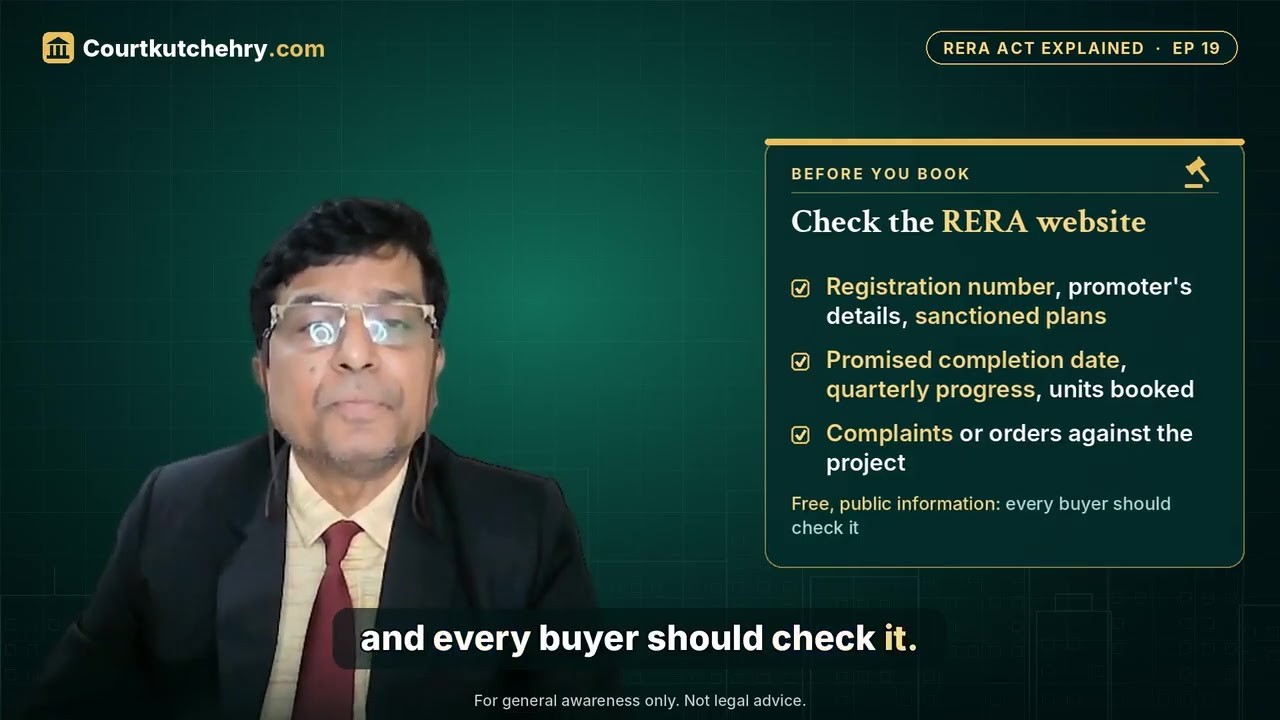
Because of Section 34, every buyer has free access to information that once only insiders had. Before booking, check the project on your State RERA website. Depending on the State, it typically shows:
- the registration number and validity of the registration;
- the promoter’s details and past projects;
- the sanctioned plans and layout;
- the promised completion date;
- the quarterly progress updates and the number of units booked; and
- complaints and orders relating to the project.
If a project is not on the website at all, ask why. Selling an unregistered project that requires registration is itself a contravention of the Act.
Section 35: The Power to Call for Information and Investigate
Section 35(1): on a complaint or on its own motion
Where the Authority considers it expedient, it may, on a complaint or suo motu, by a written order recording reasons, call upon any promoter, allottee or real estate agent to furnish in writing information or explanation about its affairs, and may appoint one or more persons to make an inquiry into those affairs.
Section 35(2): the powers of a civil court
For this purpose, notwithstanding anything in any other law, the Authority has the same powers as a civil court under the Code of Civil Procedure, 1908 while trying a suit, in respect of:
- the discovery and production of books of account and other documents, at the place and time it specifies;
- summoning and enforcing the attendance of persons and examining them on oath;
- issuing commissions for the examination of witnesses or documents; and
- any other matter that may be prescribed.
Remember this line: the Authority does not have to wait for a complaint; Section 35 lets it look on its own.
Using Section 35 in a Dispute: The 70% Account
Here is a common situation. The promoter says he has spent all the buyers’ money on construction, but the site shows little progress. Under Section 4(2)(l)(D), a promoter must deposit 70% of the amounts realised from allottees for a project in a separate account and use it only for the cost of land and construction of that project, with withdrawals certified by an engineer, an architect and a chartered accountant.
The buyers can ask the Authority to use Section 35 to call for the books of account of that separate account and examine whether the rule was followed. If the money was diverted, the promoter faces penalty under Section 60, which deals with false information and contraventions of Section 4.
Section 36: Interim Orders, Even Without Notice
Section 36 is the emergency brake. Where, during an inquiry, the Authority is satisfied that an act in contravention of the Act, rules or regulations has been committed, is continuing, or is about to be committed, it may by order restrain the promoter, allottee or agent from carrying on that act until the inquiry concludes or until further orders, without giving notice to the party where it considers this necessary.
What an interim order can stop
Typical restraints include:
- creating third-party rights in unsold or disputed flats;
- transferring the project or the majority rights in it; and
- withdrawing money from the project account.
Its limits
An interim order is temporary. It lasts until the inquiry ends or further orders are passed, and the Authority must still hear the parties fully before its final decision. The power to act without notice is for urgent cases only, where giving notice would defeat the purpose.
How the Three Powers Work Together
Take an example. Buyers complain that a promoter is about to sell the same flats twice. The three sections then work as one:
- Under Section 35, the Authority calls for the booking register and the sale records.
- Under Section 36, it restrains further sales in the project until the inquiry ends.
- Under Section 34, the public records on its website let other buyers see the project’s status and any orders passed.
Practice point
If the danger is urgent, such as a promoter creating third-party rights or removing machinery from the site, ask for an interim order under Section 36 in your first application. Explain why the harm cannot wait for the final hearing, and attach whatever evidence you have of the threatened act. Do not wait for the final hearing to raise it.
Quick Test
- Can the Authority inquire into a promoter’s affairs on its own motion? Yes, under Section 35.
- What powers does it have during that inquiry? The powers of a civil court under the CPC for production of documents, summons, examination on oath and commissions.
- Can an interim order under Section 36 be passed without notice? Yes, where the Authority considers it necessary.
Key Takeaways
- Section 34 makes the Authority a keeper of public records: registered projects, agents, and a defaulters’ database with promoters’ names and photographs.
- Every buyer should check the project on the State RERA website before booking.
- Section 35 lets the Authority inquire on a complaint or suo motu, with civil-court powers to call for books of account, summon and examine on oath, and issue commissions.
- Section 35 is a practical tool to test whether the 70% separate-account rule was followed.
- Section 36 allows interim orders restraining a contravention, even without notice where necessary, until the inquiry ends.
Frequently Asked Questions
Can the RERA Authority act without any complaint?
Yes. Section 35(1) allows it to call for information and order an inquiry on its own motion.
Can RERA summon a builder’s accounts?
Yes. Under Section 35(2), it has the powers of a civil court for the discovery and production of books of account and other documents.
Can RERA stop a builder from selling flats while a complaint is pending?
Yes. If it is satisfied during an inquiry that a contravention is being or is about to be committed, Section 36 lets it restrain the act until the inquiry ends or further orders.
Is an interim order the final decision?
No. It is temporary, and the Authority must still give a full hearing before its final order.
What is the defaulters’ database?
Under Section 34, the Authority maintains a public database on its website naming defaulting promoters, with photographs and details of projects whose registration was revoked or which were penalised.
Where can I watch the full explanation?
Watch Episode 19 of RERA Act Explained with Judgments here: https://youtu.be/eT5LtRo9cRQ.
Conclusion
Sections 34 to 36 turn the RERA Authority into a working regulator. It keeps the public record, it can investigate on its own with the powers of a civil court, and it can stop a wrong act before it is completed. For buyers, these are practical tools: check the website before booking, ask for the accounts when money seems to have vanished, and seek an interim order when harm is imminent.
In the next episode, we read Sections 37 to 40: the Authority’s binding directions, its power to impose penalty or interest, rectification of its orders, and how money awarded by RERA is actually recovered.
▶ Watch the video: RERA Authority's Powers: Investigation, Civil Court Powers, Interim Orders | RERA Explained Ep 19
Research the Law on CourtKutchehry
CourtKutchehry gives you lakhs of Indian judgments, searchable for free. A membership adds unlimited summaries, all related judgments, original court PDF downloads, bookmarks, notes and the CourtKutchehry AI assistant.
| Membership | Price | Works out to | AI credits |
|---|---|---|---|
| Monthly (1 month) | ₹599 | ₹599 / month | 1,000 / month |
| Quarterly (3 months) · Save 16% | ₹1,499 | ₹499.67 / month | 1,100 / month |
| Six-monthly (6 months) · Save 33% | ₹2,399 | ₹399.83 / month | 1,200 / month |
| Yearly (12 months) · Save 44% · Best value | ₹3,999 | ₹333.25 / month | 1,300 / month |
Every plan is a one-off purchase for a fixed period: nothing auto-renews and no card is kept on file. Prices are exclusive of applicable tax, which is added at checkout. Extra AI chat credits can be topped up from ₹99. A free verified account gets 5 summaries and 50 AI trial credits.
Prices are as displayed on courtkutchehry.com on 20 November 2026 and are subject to change without notice. Please check the pricing page for the current plans and offers.
For more judgments, legal opinions and case analysis, visit courtkutchehry.com
Visit CourtKutchehry →