
Watch the Video
In this 8-minute video, Episode 21 of “RERA Act Explained with Judgments”, we settle a question that delays many RERA cases: should the complaint go to the Regulatory Authority or to the Adjudicating Officer? The answer lies in Sections 71 and 72 of the Real Estate (Regulation and Development) Act, 2016, read with the Supreme Court’s judgment in Newtech Promoters and a 2025 Delhi High Court judgment that applied it. This article explains the division of work, how to prove a compensation claim, and how to draft when a client wants both refund and damages.
Section 71: The Adjudicating Officer
Under Section 71(1), for the purpose of adjudging compensation under Sections 12, 14, 18 and 19, the Authority appoints, in consultation with the appropriate Government, one or more judicial officers who are or have been District Judges as Adjudicating Officers. The Adjudicating Officer holds an inquiry in the prescribed manner after giving the person concerned a reasonable opportunity of being heard.
The four sections named are the ones that give a buyer a right to compensation: Section 12 (false or incorrect statements in advertisements or prospectus), Section 14 (deviation from sanctioned plans and structural defects), Section 18 (failure to give possession, defective title and other defaults) and Section 19 (rights of allottees).
The consumer-forum proviso
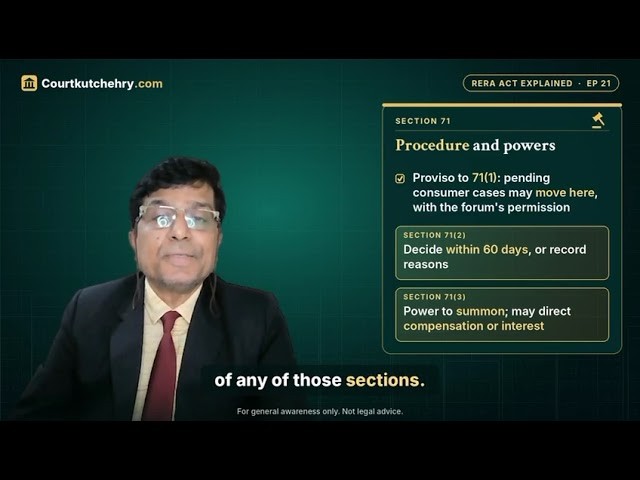
The proviso to Section 71(1) deals with complaints already pending when the Act began. A person whose complaint on these matters was pending before a consumer forum or commission under the Consumer Protection Act, 1986 on or before the commencement of the Act may, with the permission of that forum or commission, withdraw it and file an application before the Adjudicating Officer. This avoids two parallel proceedings on the same claim.
Section 72: Factors for Compensation
When deciding the quantum of compensation or interest under Section 71, the Adjudicating Officer must have due regard to:
- the amount of disproportionate gain or unfair advantage made by the defaulter, wherever quantifiable;
- the amount of loss caused as a result of the default;
- the repetitive nature of the default; and
- such other factors as the Adjudicating Officer considers necessary in the interests of justice.
Newtech Promoters v. State of U.P. (2021)
The leading authority is M/s Newtech Promoters and Developers Pvt. Ltd. v. State of U.P., (2021) 11 SC CK 0015, decided on 11 November 2021 by a three-Judge Bench of Justices Uday Umesh Lalit, Ajay Rastogi and Aniruddha Bose. Reading Sections 18, 19, 71 and 72 together, the Court drew a clear line:
- Refund of the amount, interest on the refund, and interest for delayed possession, as well as penalty, are matters for the Regulatory Authority.
- Compensation, and interest by way of compensation, under Sections 12, 14, 18 and 19 is for the Adjudicating Officer exclusively, keeping in view the factors in Section 72.
The Court reasoned that letting the Adjudicating Officer decide refunds as well would expand his role beyond what Section 71 gives him and go against the scheme of the Act. It also upheld the Authority’s power under Section 81 to delegate the hearing of complaints, including refund claims, to a single Member.
Remember this line: refund and interest to the Authority; compensation to the Adjudicating Officer.
The Delhi High Court Applies Newtech
In M/s Revanta Multistate CGHS Ltd. v. Sunny Sapen, (2025) 05 DEL CK 2059, decided on 30 May 2025, a Division Bench of the Delhi High Court (Justices Navin Chawla and Shalinder Kaur) applied Newtech directly. The buyer had sought a refund with interest, and Delhi RERA had allowed it. The society argued that the claim should have gone to the Adjudicating Officer. The Court rejected the objection: a refund claim is for the Authority, so the complaint was correctly filed, and the appeal was dismissed with costs.
Section 71(2) and (3): Speed and Powers
- Section 71(2): an application for adjudging compensation is to be dealt with as expeditiously as possible and disposed of within 60 days of its receipt. If it cannot be, the Adjudicating Officer must record his reasons in writing.
- Section 71(3): during the inquiry, the Adjudicating Officer has power to summon and enforce the attendance of any person acquainted with the facts and to require production of any useful document. If satisfied that the person has failed to comply with any of Sections 12, 14, 18 or 19, he may direct payment of compensation or interest as he thinks fit under those sections.
Section 72 in Practice: How to Prove Loss
Section 72 makes compensation a matter of evidence. The Adjudicating Officer will ask three questions:
- What did the promoter gain? For example, did he use the buyers’ money interest-free for years, or sell other units at higher prices?
- What did the buyer lose? Rent paid during the delay, extra home-loan interest and pre-EMI interest, and the hardship of the wait.
- Was the default repeated? A promoter who has delayed several projects is treated more strictly.
The documents that usually make the difference are:
- the rent agreement and rent receipts;
- the home loan statement showing pre-EMI interest;
- correspondence showing repeated requests for possession; and
- evidence of hardship, such as a family member’s medical needs or a job move that could not be made.
Compensation claimed without proof is usually small. Compensation backed by documents can be substantial.
Compensation for Mental Agony
The Adjudicating Officer may award compensation for mental agony and harassment, but the award must be reasoned. It should consider the length of the delay, the promoter’s conduct and the buyer’s circumstances, such as a family living in rented accommodation for years. An award that is arbitrary, or that simply duplicates the interest already granted by the Authority, is vulnerable in appeal. So the application should explain clearly why compensation is needed over and above the interest.
The Practical Outcome, and a Caution
After Newtech, a buyer who wants both money back and damages ordinarily has two proceedings: one before the Authority, one before the Adjudicating Officer. In Delhi, for instance, the Rules provide separate forms for each. Procedures differ from State to State, so check your State’s rules and regulations.
Two mistakes to avoid:
- Do not file a refund claim before the Adjudicating Officer; you will lose time.
- Do not ask the Authority for compensation for mental agony or rent paid; that belongs to the Adjudicating Officer.
Practice point
When a client wants both a refund and damages, draft two separate proceedings: refund and interest before the Authority, and compensation before the Adjudicating Officer, supported by evidence of loss such as rent receipts and loan statements.
Quick Test
- Who decides compensation under Section 71? The Adjudicating Officer.
- What rank must the Adjudicating Officer hold or have held? District Judge.
- Under Newtech, who decides refund and interest for delay? The Regulatory Authority.
Key Takeaways
- The Adjudicating Officer, a present or former District Judge, decides compensation under Sections 12, 14, 18 and 19.
- Section 72 factors: unfair gain to the promoter, loss to the buyer, repetitive default and other relevant factors.
- Newtech (11 November 2021): refund, interest on refund and delay interest go to the Authority; compensation goes exclusively to the Adjudicating Officer; single-Member benches under Section 81 are valid.
- Revanta v. Sunny Sapen (Delhi HC, 30 May 2025) applied Newtech to uphold a refund order made by the Authority.
- Prove loss with documents, and keep mental-agony claims reasoned and separate from interest.
Frequently Asked Questions
Where do I file for a refund of my booking amount with interest?
Before the RERA Authority. Newtech holds that refund and interest are for the Authority, not the Adjudicating Officer.
Where do I claim compensation for rent and mental agony?
Before the Adjudicating Officer under Section 71, who decides the amount using the factors in Section 72.
Who can be an Adjudicating Officer?
A judicial officer who is or has been a District Judge, appointed by the Authority in consultation with the appropriate Government.
How quickly must a compensation application be decided?
Section 71(2) sets a target of 60 days from receipt; if it is not met, the Adjudicating Officer must record reasons in writing.
My consumer complaint was pending when RERA came into force. Can I move it?
Under the proviso to Section 71(1), you may withdraw it with the consumer forum’s permission and file before the Adjudicating Officer.
Where can I watch the full explanation?
Watch Episode 21 of RERA Act Explained with Judgments here: https://youtu.be/-XgShBXf48s.
Conclusion
RERA has two decision-makers, and the line between them is now settled. The Authority decides refunds and interest; the Adjudicating Officer decides compensation, on evidence, by the factors in Section 72. Newtech drew that line in 2021, and the Delhi High Court applied it in 2025.
Getting the forum right is half the work. Getting the proof right is the other half. In the next episode, we move up a level, to the Central Advisory Council and the Real Estate Appellate Tribunal, and see how a RERA appeal is filed.
▶ Watch the video: RERA Authority or Adjudicating Officer? Sections 71, 72 and Newtech | RERA Explained Ep 21
Research Judgments Like These on CourtKutchehry
Every judgment cited in this article, and lakhs more, can be searched and read on CourtKutchehry. Searching and reading judgments is free. A membership adds unlimited summaries, all related judgments, original court PDF downloads, bookmarks, notes and the CourtKutchehry AI assistant.
| Membership | Price | Works out to | AI credits |
|---|---|---|---|
| Monthly (1 month) | ₹599 | ₹599 / month | 1,000 / month |
| Quarterly (3 months) · Save 16% | ₹1,499 | ₹499.67 / month | 1,100 / month |
| Six-monthly (6 months) · Save 33% | ₹2,399 | ₹399.83 / month | 1,200 / month |
| Yearly (12 months) · Save 44% · Best value | ₹3,999 | ₹333.25 / month | 1,300 / month |
Every plan is a one-off purchase for a fixed period: nothing auto-renews and no card is kept on file. Prices are exclusive of applicable tax, which is added at checkout. Extra AI chat credits can be topped up from ₹99. A free verified account gets 5 summaries and 50 AI trial credits.
Prices are as displayed on courtkutchehry.com on 20 November 2026 and are subject to change without notice. Please check the pricing page for the current plans and offers.
For more judgments, legal opinions and case analysis, visit courtkutchehry.com
Visit CourtKutchehry →