
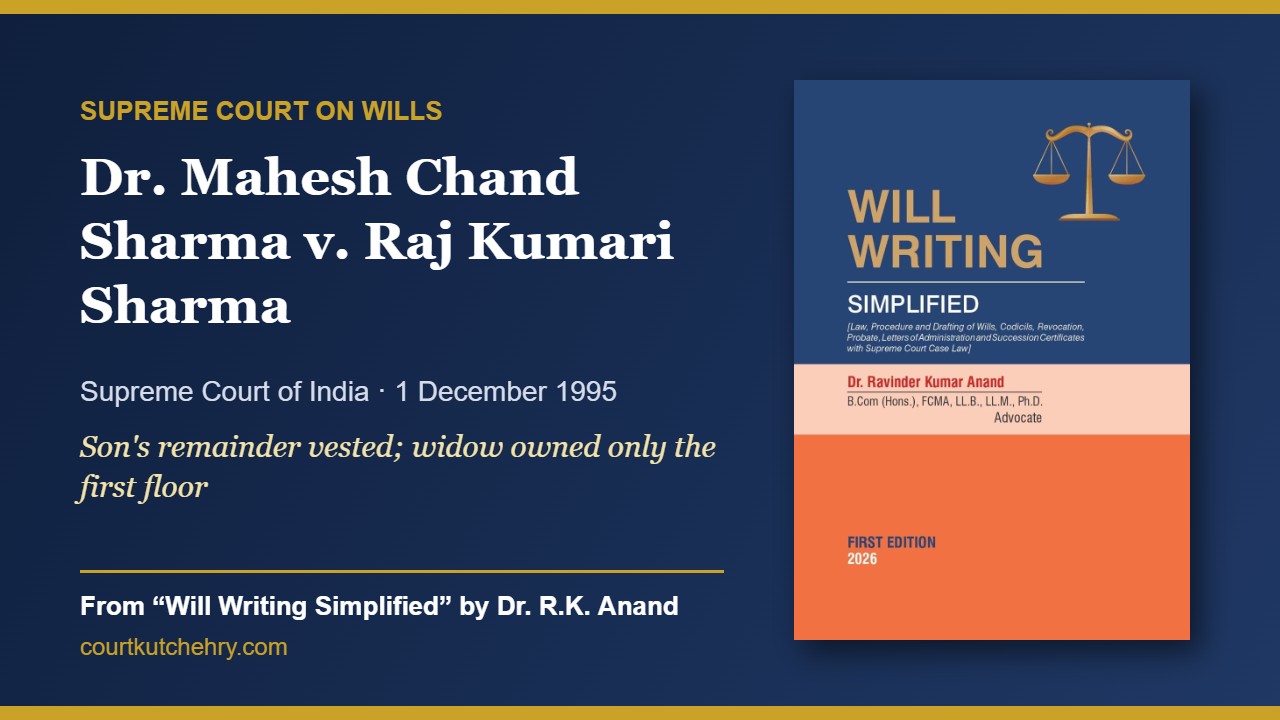
A Delhi man leaves his house to his wife for life, and after her to his “legal heirs”. When he made the Will in 1942, his only heir in law was his son; by the time the widow died in 1972, the Hindu Succession Act had made his daughters heirs too. So who took the house: the son alone, or all the children? On 1 December 1995, the Supreme Court held that the remainder vested in the son on the testator’s death, but that the widow’s right to live on the first floor had ripened into ownership, which her daughters then shared. This article explains Dr. Mahesh Chand Sharma v. Raj Kumari Sharma (Smt) & Ors. and what it teaches about life estates, vested remainders and Section 14.
Case at a Glance
| Case | Dr. Mahesh Chand Sharma v. Raj Kumari Sharma (Smt) & Ors. |
|---|---|
| Court | Supreme Court of India |
| Citation | (1995) 12 SC CK 0023; Civil Appeal Nos. 547–548 of 1991 |
| Decided on | 1 December 1995 |
| Bench | Justice B.P. Jeevan Reddy and Justice S.B. Majmudar (judgment by Justice B.P. Jeevan Reddy) |
| Provisions | Sections 111, 119 and 120, Indian Succession Act, 1925; Sections 14 and 15, Hindu Succession Act, 1956; Order 6 Rule 2 CPC |
| Result | Appeals allowed in part; sale of ground floor upheld; daughter’s 1/5th share confined to the first floor |
The Facts
Ram Nath Dewan owned House No. 5, Doctor’s Lane, New Delhi. By a Will dated 10 April 1942, he gave it to his wife Satyawati for her life, without any right to transfer it; she could live in it and let it out. After her death, it was to go to “the legal heirs of the testator”. He died in 1953. His son Rajender Nath set up a later Will of 1950, but it was never proved.
Mother and son quarrelled, and several suits were filed. On 27 January 1955, they settled. Satyawati acknowledged the son’s ownership of the house (except another property, 58 Todar Mal Road, which remained hers). In return she was given the right to reside on the first floor and maintenance of Rs. 125 a month (Rs. 150 if she did not live there).
On 4 March 1971, the son’s general power of attorney holder sold the entire house to his own brother and that brother’s two sons. Satyawati died on 2 July 1972. One of her daughters then sued for partition, claiming a 1/5th share as one of the five children.
What the Delhi High Court Held
- The Single Judge (original side) dismissed the suit as regards the Doctor’s Lane house, holding that the 1955 settlement vested full ownership in the son.
- A Division Bench, in the daughter’s appeal, held the 1942 Will valid, treated Satyawati’s interest as a life estate, held the settlement was not a valid surrender, and said the “legal heirs” were to be identified on Satyawati’s death. That gave each of the five children 1/5th of the whole house.
The buyers appealed to the Supreme Court.
The Question Before the Supreme Court
When did the remainder under the 1942 Will vest, and in whom? Was the 1955 settlement valid? Did Section 14(1) of the Hindu Succession Act make Satyawati an absolute owner of any part of the house? And was the daughter’s suit within time, or had the buyers acquired title by adverse possession?
The Law on Vesting of Legacies and Section 14
Section 119 of the Indian Succession Act says that where a legacy is given without specifying when it is to take effect, or is to take effect after a prior interest, the legatee’s interest becomes vested on the testator’s death, unless a contrary intention appears in the Will. Illustration (iii) to Section 119 covers a life interest followed by a gift over.
Section 111 deals with a bequest to a class of persons described as standing in a particular degree of kindred to “a specified individual”, where the possession is postponed. Section 120 deals with legacies contingent on an uncertain event.
Section 14(1) of the Hindu Succession Act makes a female Hindu the full owner of property “possessed” by her, while Section 14(2) preserves restricted estates created afresh by a gift, Will or other instrument. Under V. Tulasamma v. Sesha Reddy, (1977) 03 SC CK 0031, a limited interest given in recognition of a pre-existing right of maintenance falls under sub-section (1). The Court applied its own decision in Mangat Mal v. Punni Devi (1995), which held that a right of residence given in lieu of maintenance can enlarge in the same way.
The Supreme Court’s Reasoning
1. The remainder vested on the testator’s death
Applying Section 119, the Court held that “the legacy to the legal heirs of the testator became vested in such legal heir(s) on the date of death of the testator” (para 18). On the Court’s analysis, that heir in 1953 was the son. Nothing in the Will showed a contrary intention.
2. Sections 111 and 120 did not apply
The exception in Section 111 speaks of relatives of “a specified individual”. The Court held that “the words ‘a specified individual’ cannot refer to or mean ‘the testator’” (para 20). Section 120 did not apply because the gift was not contingent on any uncertain event. The plural “heirs” did not change this: “In the year 1942, Ram Nath could not have foreseen the enactment of Hindu Succession Act, 1956” (para 24).
3. The 1955 settlement was a valid compromise
The settlement resolved conflicting claims while several suits were pending. It was not a transfer by a limited owner, and it gave Satyawati maintenance she was not entitled to under the Will. Arguments that a widow’s surrender must be total did not apply.
4. Section 14(1) enlarged the first-floor residence
Satyawati’s right to live on the first floor was given in lieu of her pre-existing right of maintenance, so Section 14(1) applied. It did not matter that the daughter had not pleaded Section 14 specifically: “Section 14 operates on its own force once the facts requisite for attracting its application are established” (para 29). “Possessed” means a right to possession, and she lived there till shortly before her death. But “Satyawati became the absolute owner only of the first floor of the Doctor’s Lane house” (para 30), since she had given up the ground floor in 1955.
5. Limitation and adverse possession failed
The trial judge’s finding that the suit was within time had not been challenged before the Division Bench. The plea of adverse possession, pleaded from 1954, collapsed once the Will and vesting were upheld, and no other starting date had been properly pleaded.
The Final Decision
The Supreme Court allowed the appeals in part and modified the Division Bench’s decree:
- the 1971 sale is valid and effective for the ground floor, which belonged to the son;
- the first floor was Satyawati’s absolute property under Section 14(1) and on her death passed under Section 15 to her son and four daughters equally; and
- “Defendant Nos. 3 to 5 will be entitled only to the 1/5th share of the first defendant in the first floor” (para 40); the plaintiff and her sisters each take 1/5th of the first floor.
There was no order as to costs.
Key Takeaways
- A gift to “legal heirs” after a life estate vests on the testator’s death under Section 119, unless the Will shows a contrary intention.
- The heirs are identified at the testator’s death, not at the life tenant’s death, so later changes in succession law do not alter them.
- A widow’s right of residence given in lieu of maintenance can ripen into full ownership under Section 14(1), but only of the portion she was entitled to occupy.
- A genuine family settlement of disputed claims is upheld, even if it departs from the Will.
- Section 14 applies by force of law once the facts are proved, even if not specifically pleaded.
Practical Lessons for Will Makers and Lawyers
- Name your remaindermen. “My legal heirs” is uncertain; name the persons and say what happens if one dies first.
- Say when the gift vests if you want heirs identified at the life tenant’s death rather than yours.
- Be clear about a widow’s life estate. State whether it is in lieu of maintenance, since that affects Section 14.
- Record family settlements properly, with clear terms on ownership, residence and maintenance.
- For lawyers: buyers should examine every Will, settlement and Section 14 claim in the title chain; a power of attorney holder can convey only what his principal owns.
Frequently Asked Questions
What is a vested remainder?
An interest that belongs to the remainderman from the testator’s death, though he enjoys it only after the life estate ends. Under Section 119, a remainder after a life interest is vested unless the Will says otherwise.
Who were the “legal heirs” in this Will?
The son. The Court held that the remainder vested in the testator’s legal heir on his death in 1953, before the Hindu Succession Act, 1956, and that heir was the son.
How did the daughters get anything, then?
Through their mother. Her right to live on the first floor, given in lieu of maintenance, became full ownership under Section 14(1), and on her death it passed equally to all five children under Section 15.
Was the sale by the power of attorney holder valid?
Only for the ground floor, which the son owned. It could not pass the first floor, which belonged to Satyawati.
Can Section 14 be relied on if it was not pleaded?
Yes. The Court held that Section 14 operates on its own force once the facts needed for it are established.
Conclusion
Mahesh Chand Sharma is a careful lesson in how a Will, a family settlement and the Hindu Succession Act interact. The Will decided who took the remainder; the settlement and Section 14 decided what the widow ended up owning.
For Will makers, the safest course is precise drafting: name the people, say when their interest begins, and explain the basis of any life estate.
Read More in “Will Writing Simplified”

This judgment is one of 123 Supreme Court judgments on Wills summarised in Chapter 14 of Will Writing Simplified by Advocate Dr. Ravinder Kumar Anand. The book covers the law, procedure and drafting of Wills, codicils, revocation, probate, letters of administration and succession certificates, with Supreme Court case law.
Special limited-period offer: available at 50% off on Amazon.
Buy Will Writing Simplified on Amazon →
Research Judgments Like These on CourtKutchehry
Every judgment cited in this article, and lakhs more, can be searched and read on CourtKutchehry. Searching and reading judgments is free. A membership adds unlimited summaries, all related judgments, original court PDF downloads, bookmarks, notes and the CourtKutchehry AI assistant.
| Membership | Price | Works out to | AI credits |
|---|---|---|---|
| Monthly (1 month) | ₹599 | ₹599 / month | 1,000 / month |
| Quarterly (3 months) · Save 16% | ₹1,499 | ₹499.67 / month | 1,100 / month |
| Six-monthly (6 months) · Save 33% | ₹2,399 | ₹399.83 / month | 1,200 / month |
| Yearly (12 months) · Save 44% · Best value | ₹3,999 | ₹333.25 / month | 1,300 / month |
Every plan is a one-off purchase for a fixed period: nothing auto-renews and no card is kept on file. Prices are exclusive of applicable tax, which is added at checkout. Extra AI chat credits can be topped up from ₹99. A free verified account gets 5 summaries and 50 AI trial credits.
Prices are as displayed on courtkutchehry.com on 20 November 2026 and are subject to change without notice. Please check the pricing page for the current plans and offers.
For more judgments, legal opinions and case analysis, visit courtkutchehry.com
Visit CourtKutchehry →