
No More Surprise Debits: RBI’s 2026 E-Mandate Rules Redefine Digital Payments
Unified Framework: All prior guidelines repealed, consolidated under one directive.
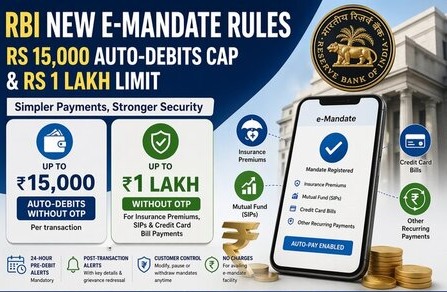
Customer First: Mandatory alerts, free registration, and liability protection.
By Vishwas Kumar
New Delhi: April 23, 2026:
RBI’s 2026 E-Mandate Framework ushers in a unified, customer-centric regime for recurring digital payments, eliminating hidden charges, mandating pre-debit alerts, and setting clear transaction limits. It consolidates all prior circulars under the Payment and Settlement Systems Act, 2007, ensuring transparency, security, and consumer control.
The Reserve Bank of India (RBI) has issued the Digital Payments – E-Mandate Framework, 2026, a landmark consolidation of earlier circulars governing recurring transactions. This framework, effective immediately, is designed to strengthen consumer protection, streamline processes, and enhance trust in India’s fast-growing digital payments ecosystem.
Legal Foundation
The framework derives authority from Sections 10(2) and 18 of the Payment and Settlement Systems (PSS) Act, 2007, empowering RBI to regulate payment systems in the public interest. By repealing earlier fragmented guidelines, RBI has created a single, comprehensive legal instrument for recurring transactions across cards, UPI, and prepaid payment instruments (PPIs). Reserve Bank of India
Key Provisions
- One-Time Registration with AFA
- Customers must register mandates with Additional Factor Authentication (AFA).
- Any modification or withdrawal also requires AFA, ensuring security.
- Pre-Transaction Notification
- Issuers must send alerts 24 hours before debit, detailing merchant, amount, and purpose.
- Customers can cancel or block transactions before execution.
- Post-Transaction Transparency
- Immediate alerts after debit, including grievance redressal details.
- Strengthens accountability and dispute resolution.
- Transaction Limits
- Up to ₹15,000 per transaction: No AFA required.
- Special categories (insurance, mutual funds, credit cards): Limits extended to ₹1,00,000.
- Customer Rights
- Free registration of mandates.
- Facility to modify validity or withdraw mandates anytime.
- Liability protection against unauthorized debits.
- Applicability
- Covers domestic and cross-border recurring transactions.
- Applies to all Payment System Providers and Participants.
Impact Analysis
- For Consumers: Greater control, no hidden charges, and protection against unauthorized deductions.
- For Businesses: Streamlined compliance, reduced disputes, and improved customer trust.
- For Regulators: A unified framework reduces ambiguity and strengthens oversight.
This framework balances convenience with security—routine payments like OTT subscriptions or utility bills can flow seamlessly, while high-value transactions remain safeguarded by authentication.
[RESEARCH RESOURCES]
BUY & READ THE BOOK, WILL WRITING SIMPLIFIED, By Dr Ravinder Kumar Anand. [📘 Buy Will Writing Simplified online: Amazon | Flipkart ]
Detailed FAQ
Q1. What law empowers RBI to issue these rules?
A: The framework is issued under Sections 10(2) and 18 of the Payment and Settlement Systems Act, 2007, giving RBI authority to regulate payment systems.
Q2. Do I need to pay for registering an e-mandate?
A: No. RBI has mandated that no charges shall be levied for registration.
Q3. How will I know before money is deducted?
A: You will receive a pre-transaction notification at least 24 hours in advance, allowing you to cancel or prepare funds.
Q4. What is the transaction limit without authentication?
A: Recurring transactions up to ₹15,000 can be processed without AFA. For insurance, mutual funds, and credit cards, the limit is ₹1,00,000.
Q5. Can I cancel or modify a mandate?
A: Yes. Customers can modify validity or withdraw mandates anytime, but changes require AFA validation.
Q6. What happens after a debit?
A: You will receive a post-transaction alert with full details and grievance redressal information.
Q7. Does this apply to international transactions?
A: Yes. The framework covers domestic and cross-border recurring payments.
Conclusion
The RBI’s 2026 E-Mandate Framework is a decisive step toward a smarter, safer, and more transparent digital payments future. By consolidating rules, mandating alerts, and empowering consumers, it not only strengthens trust but also aligns India’s payment ecosystem with global best practices.