

COURTKUTCHEHRY SPECIAL SERIES ON LANDMARKS JUDGEMENTS ON WILLS, CODICIL & PROBATE
Ramchandra Rambux v. Champabai & Ors.: Supreme Court Declares Disputed Will False, Appeal Dismissed
High Court’s Suspicion Affirmed by Apex Court
Fabricated Document Found Without Testator’s Knowledge
By Vishwas Kumar
New Delhi: March 30, 2026:
On 17 February 1964, the Supreme Court of India delivered a decisive ruling in Ramchandra Rambux v. Champabai & Others (Civil Appeal No. 758 of 1963; (1964) 02 SC CK 0018), settling a bitter succession dispute over a vast estate allegedly bequeathed through a contested Will. The appellant, Ramchandra Rambux, sought a declaration of title based on a Will purportedly executed by Ramdhan, while the respondents—his widow and daughters—vehemently denied its authenticity, alleging fabrication.
For deeper legal insight, refer to this comprehensive Indian probate law case collection with Supreme Court judgments on wills .
The Trial Court had initially upheld the Will, accepting the appellant’s claim. However, the High Court reversed this finding, pointing to multiple suspicious features surrounding the document’s execution. The matter then reached the Supreme Court, where Hon’ble Mr. Justice K. Subba Rao and Hon’ble Mr. Justice J.R. Mudholkar examined the evidence with great care.
The apex court agreed with the High Court’s assessment, concluding that the Will was “in all probability a false document brought into existence without the knowledge of the testator.” The Court emphasized that the suspicious circumstances were too grave to ignore, and the appellant had failed to dispel them with credible evidence. As a result, the Supreme Court dismissed the appeal, thereby affirming the widow and daughters’ rights to the estate.
This ruling reinforced the principle that courts must scrutinize testamentary documents rigorously, especially when they appear to exclude natural heirs or contain unexplained irregularities. It remains a significant precedent in Indian succession law, underscoring that fabricated Wills cannot stand against the weight of suspicion and lack of proof.
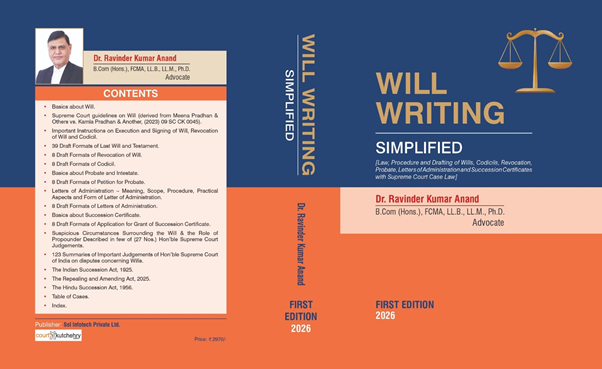
For More, Read Here the Summary of the Judgement from the Book: WILL WRITING SIMPLIFIED, read below or open page no 436, Chapter 14.1 in the book. (Online book purchase link available here on: Buy online: Amazon | Flipkart
|
|
Case Summary |
: |
Ramchandra Rambux v. Champabai & Ors. |
|
|
Court |
: |
Supreme Court of India |
|
|
Citations |
: |
(1964) 02 SC CK 0018: Civil Appeal No.758 of 1963. |
|
|
Link |
: |
https://www.courtkutchehry.com/judgements/643682/ramchandra-rambux-vs-champabai-and-others/
|
|
|
Decided on |
: |
17 February 1964 |
|
|
Coram |
: |
Hon’ble Mr. Justice K. Subba Rao and Hon’ble Mr. Justice J.R. Mudholkar. |
|
|
Relevant Paragraphs |
: |
Para Nos.1–24 |
1. Facts of the Case:
The dispute arose over the genuineness of a will allegedly executed by one Ramdhan on 23 May 1947, bequeathing almost his entire property 16 fields, houses, cash, gold, silver, and movables—worth several lakhs to the appellant, Ramchandra, excluding his widow Sitabai and three married daughters. Sitabai, in possession after Ramdhan’s death (31 October 1948), denied the execution and alleged fabrication. The appellant claimed strained relations between Ramdhan and Sitabai justified her exclusion. During the suit, one Madanlal also intervened, claiming adoption by Ramdhan. The Trial Court upheld the will as genuine; the High Court reversed, terming it a false document executed under suspicious circumstances.
2. Law Points Involved:
(i). Burden of Proof in Wills: Propounder must prove due execution and attestation per Section 63 of the Indian Succession Act and Section 68 of the Indian Evidence Act.
(ii). Suspicious Circumstances: When a will appears unnatural, improbable, or unfair, or when the propounder benefits substantially and participates in execution, the onus to dispel suspicion lies heavily on him.
(iii). Test of Proof: Proof must satisfy the conscience of the Court—mere attestation or formal compliance is insufficient where suspicion exists.
(iv). Role of Circumstantial Evidence: Credibility of witnesses to be tested against attendant circumstances, not in isolation.
3. Acts / Provisions / Articles Referred:
(i). Section 63, Indian Succession Act, 1925 – Execution and attestation of wills
(ii). Section 68, Indian Evidence Act, 1872 – Proof of execution of document required by law to be attested
4. Judgments Referred:
(i). Sarat Kumari Bibi v. Sakhi Chand, (1928) 11 BOM CK 0037
(ii). H. Venkatachala Iyengar v. B.N. Thimmajamma (1958) 11 SC CK 0008;
(iii). Shashi Kumar Banerjee v. Subodh Kumar Banerjee, (1963) 09 SC CK 0012.
(v). Ratan Koer Vs Chotey Narain Singh and Karorpati Narain Singh and another, (1894) 12 PRI CK 0001.
5. Obiter Dicta:
(i). Proof of a will cannot rest on isolated witness testimony; surrounding probabilities and conduct are integral to assessing genuineness.
(ii). The theory of improbability does not replace scrutiny of evidence but aids in evaluating credibility.
6. Ratio Decidendi:
Where a will excludes natural heirs and confers substantial benefits on the propounder who actively participates in its execution, the burden lies on him to completely remove all legitimate suspicions. Failure to do so renders the will invalid. Proof of attestation alone does not suffice unless the conscience of the Court is satisfied regarding genuineness and free volition of the testator.
7. Final Ruling:
The Supreme Court upheld the High Court’s finding that the will was surrounded by suspicious circumstances and not proved to be genuine. The appellant failed to remove suspicion arising from (i) execution in his own house, (ii) presence of his acquaintances as witnesses, (iii) improbable travel of the testator, (iv) unnatural exclusion of wife and daughters, and (v) use of paper bearing pre-existing signature. The appeal was dismissed with costs.
8. Gist Highlighting Dispute with Final Decision:
The appellant sought declaration of title based on a disputed will by Ramdhan bequeathing vast property to him. The respondents (widow and daughters) denied its execution, alleging fabrication. The Trial Court upheld the will; the High Court reversed, citing multiple suspicious features. The Supreme Court affirmed the High Court, holding that the will was “in all probability a false document brought into existence without the knowledge of the testator.” The appeal was dismissed.
Read full Judgement Here:
Ramchandra Rambux v. Champabai & Ors.
Supreme Court of India
(1964) 02 SC CK 0018: Civil Appeal No.758 of 1963.
https://www.courtkutchehry.com/judgements/643682/ramchandra-rambux-vs-champabai-and-others/
You Can Also Purchase the Book from here on: Buy online: Amazon | Flipkart
Keywords for Search Optimization
Ramchandra Rambux v. Champabai case, Supreme Court of India 1964 judgment, Civil Appeal No. 758 of 1963, Justice K. Subba Rao, Justice J.R. Mudholkar, disputed Will India, fabricated Will succession law, inheritance dispute Supreme Court, forged Will precedent, Indian succession law.