

COURTKUTCHEHRY SPECIAL SERIES ON LANDMARKS JUDGEMENTS ON WILLS, CODICIL & PROBATE
Raman Nadar Viswanathan Nadar & Ors. v. Snehappoo Rasalamma & Ors.: Supreme Court Declares Bequest Void, Succession to Follow Hindu Succession Act
Joint Will Found Ineffective for Sons Born Posthumously
Case Remanded to Decide Legitimacy, Intestacy Rules Apply
By Vishwas Kumar
New Delhi: March 30, 2026:
On 17 September 1969, the Supreme Court of India delivered a landmark ruling in Raman Nadar Viswanathan Nadar & Ors. v. Snehappoo Rasalamma & Ors. (Civil Appeal No. 2467 of 1966; (1969) 09 SC CK 0059), addressing succession rights under a joint will executed in Travancore prior to legislative reforms. The central issue was whether sons born after the testator’s death could inherit property under such a will.
To understand the legal principles applied in such cases, refer to this detailed compilation of landmark Supreme Court judgments on wills in India, covering validity, proof, and inheritance disputes.
The Kerala High Court had earlier held that the bequest was void, reasoning that a will could not confer rights on persons not in existence at the time of the testator’s death. The matter reached the Supreme Court, where a Full Bench comprising Hon’ble Chief Justice J.C. Shah, Hon’ble Mr. Justice V. Ramaswami (I), and Hon’ble Mr. Justice A.N. Grover examined the validity of the bequest.
The apex court affirmed the High Court’s finding that the bequest was void, as succession rights could not be extended to sons born after the testator’s death under the pre-reform Travancore law. However, the Court went further, clarifying that since the will failed, succession would be governed by the Hindu Succession Act, 1956, which applies in cases of intestacy. Importantly, the Court remanded the matter to determine the legitimacy of the sons, a crucial factor in deciding their entitlement under intestate succession.
By striking down the bequest and directing intestate succession, the Supreme Court reinforced the principle that testamentary instruments must comply with established legal norms, and that legislative reforms under the Hindu Succession Act ensure equitable distribution of property when wills fail.
This judgment remains a significant precedent in Indian succession law, particularly in cases involving joint wills and questions of legitimacy, highlighting the transition from customary law to codified statutory succession.
For More, Read Here the Summary of the Judgement from the Book: WILL WRITING SIMPLIFIED, read below or open page no 436, Chapter 14.1 in the book. (Online book purchase link available here on: Buy online: Amazon | Flipkart
|
|
Case Summary |
: |
Raman Nadar Viswanathan Nadar & Ors. v. Snehappoo Rasalamma & Ors. |
|
|
Court |
: |
Supreme Court of India |
|
|
Citations |
: |
(1969) 09 SC CK 0059: Civil Appeal No. 2467 of 1966. |
|
|
Link |
: |
|
|
|
Decided on |
: |
17 September 1969 |
|
|
Coram |
: |
Hon’ble Mr. Chef Justice J.C. Shah, Hon’ble Mr. Justice V. Ramaswami (I) and Hon’ble Mr. Justice A.N. Grover. (Full Bench) |
|
|
Relevant Paragraphs |
: |
Para Nos.2–17 |
1. Facts of the Case
Krishnan Nadar and his brother Raman Nadar jointly executed a will (Ex. P-2) on 9 May 1946 concerning properties of Krishnan. The will provided that, after Krishnan’s death, Raman would enjoy a life estate, and if Raman later had sons, they would succeed to the estate, excluding daughters. Krishnan died in 1947. Raman subsequently married again and had sons (plaintiffs). Litigation ensued over the validity of the bequest to unborn sons and competing claims of daughters and sons under Travancore Hindu Law.
2. Law Points Involved
(i). Whether a Hindu under the pure Travancore law (pre-legislative) could make a valid bequest in favour of an
unborn person.
(ii). Whether the will (Ex. P-2) was a joint will taking effect only after the death of both testators.
(iii). Whether sons born after the testator’s death could take under the will.
(iv). Validity and effect of defeasance clause in favour of daughters.
(v). Effect of the Hindu Succession Act, 1956, on intestacy arising from invalid bequest.
(vi). Determination of legitimacy of sons born to Raman Nadar’s second marriage.
3. Acts / Provisions / Articles Referred
(i). Pure Hindu Law as applicable in Travancore (pre-legislative period)
(ii). Hindu Transfers and Bequests Act, 1914
(iii). Hindu Disposition of Property Act, 1916
(iv). Hindu Transfers and Bequests (City of Madras) Act, 1921
(v). Indian Succession Act, 1925 — Sections 113–116
(vi). Hindu Succession Act, 1956
4. Judgments Referred
Tagore v. Tagore, (1872) 07 PRI CK 0003.
5. Obiter Dicta
(i). The Privy Council’s rule in Tagore’s case—though possibly based on a misconstruction of Dayabhaga—has stood for long and must be treated as settled law by application of the maxim communis error facit jus.
(ii). Common error, by long acceptance, becomes law where rights and property arrangements have long been settled under it.
6. Ratio Decidendi
(i). Under pure Hindu law, as applicable to Travancore at the relevant time, a bequest to an unborn person is void.
(ii). Sons born to Raman Nadar after Krishnan Nadar’s death were not in existence either in fact or in contemplation of law and thus could not take under the will.
(iii). The daughters’ bequest was conditional upon the father dying without sons; since he left sons, the bequest to daughters also failed.
(iv). Resultant intestacy attracted operation of the Hindu Succession Act, 1956, entitling lawful heirs (sons) to shares by succession, not under the will.
7. Final Ruling
(i). The Supreme Court set aside the Kerala High Court judgment (A.S. No. 848 of 1960) and remanded the matter to the High Court to determine whether plaintiffs were legitimate sons of Raman Nadar.
(ii). Declared that bequests in favour of unborn sons were void under pure Hindu law, and that the daughters’ interest was defeasible upon the birth of sons.
(iii). Directed that if plaintiffs were found legitimate, they would inherit under the Hindu Succession Act, 1956.
(iv). No order as to costs up to this stage; application for Receiver to be dealt with by the High Court.
8. Gist Highlighting Dispute with Final Decision
The dispute centered on whether sons born after the testator’s death could inherit under a joint will executed in Travancore prior to legislative reforms. The Kerala High Court held such a bequest void; the Supreme Court affirmed the voidness but remanded the case to decide legitimacy and clarified that succession would be governed by the Hindu Succession Act due to intestacy.
Read full Judgement Here:
Raman Nadar Viswanathan Nadar & Ors. v. Snehappoo Rasalamma & Ors.
Supreme Court of India
(1969) 09 SC CK 0059: Civil Appeal No. 2467 of 1966.
You Can Also Purchase the Book from here on: Buy online: Amazon | Flipkart
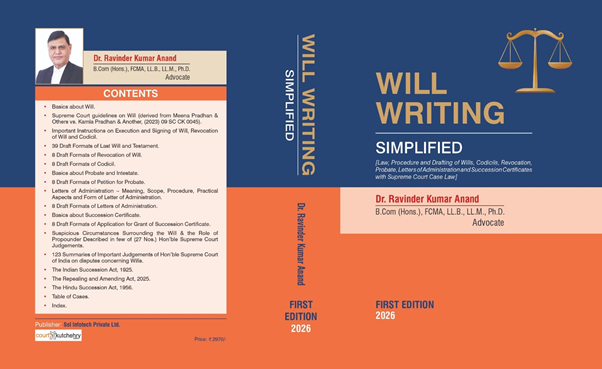
OUR RECOMMENDATION: Check out 123 Key Judgements, as highlighted in the book, WILL WRITING SIMPLIFIED, for the quick research and reference purposes. Click the link here: https://www.courtkutchehry.com/pages/blog/123-supreme-court-judgments-on-wills/
Keywords for Search Optimization
Raman Nadar v. Snehappoo Rasalamma case, Supreme Court of India 1969 judgment, Civil Appeal No. 2467 of 1966, Chief Justice J.C. Shah, Justice V. Ramaswami, Justice A.N. Grover, Travancore joint will dispute, Hindu Succession Act intestacy, posthumous sons inheritance India, succession law precedent.