
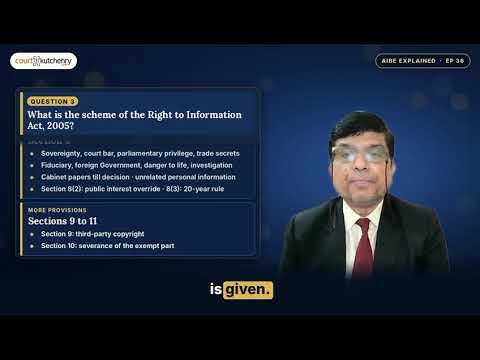
Watch the Video
In this 13-minute video, Episode 36 of the “AIBE Explained” series, the episode covers three short statutes that give the AIBE its favourite one-line questions: the Protection of Human Rights Act, 1993, the Maintenance and Welfare of Parents and Senior Citizens Act, 2007 and the Right to Information Act, 2005. It takes them in four questions and then solves five practice questions in the style of past papers. This article explains the same provisions in writing.
Three Short-Answer Favourites
These Acts are short, and so are the questions on them: who chairs the NHRC, how many days an information officer has to reply, which tribunal decides a parent’s maintenance claim. Learn each section with its figure.
Q1: The Protection of Human Rights Act, 1993
Human rights are defined in Section 2(1)(d) as the rights relating to life, liberty, equality and dignity of the individual guaranteed by the Constitution or embodied in the International Covenants and enforceable by courts in India.
The National Human Rights Commission
- Constitution (Section 3): since the 2019 amendment, the Chairperson is a person who has been the Chief Justice of India or a Judge of the Supreme Court.
- Selection (Section 4): by the President on the recommendation of a committee headed by the Prime Minister.
- Term: three years or until the age of 70, whichever is earlier.
- Functions (Section 12): inquiring into violations on a petition or on its own motion, intervening in court proceedings, visiting jails and promoting human rights awareness.
- Powers (Section 13): while inquiring, the Commission has the powers of a civil court under the CPC, such as summoning witnesses and requiring documents.
- After the inquiry (Section 18): it can recommend compensation, prosecution or other action, and approach the Supreme Court or the High Court. Its findings are recommendations, not decrees.
- Armed forces (Section 19): for complaints against the armed forces, the Commission can only seek a report from the Central Government and make recommendations.
States, courts and the one-year bar
State Human Rights Commissions are set up under Section 21. Under Section 30, a Court of Session in each district can be specified as a Human Rights Court. And under Section 36(2), the Commission cannot inquire into a matter after one year from the date of the alleged violation.
Q2: Remedies Under the Senior Citizens Act, 2007
Maintenance
- Section 4: a senior citizen (60 years or above) or a parent who cannot maintain himself or herself can claim maintenance from children, and a childless senior citizen from a relative who holds or will inherit his or her property.
- Section 7: claims go to a Maintenance Tribunal, and the Act requires the application to be decided within 90 days of notice, extendable in exceptional cases.
- Section 9: maximum maintenance of ₹10,000 a month; the episode notes that some States have raised this.
- Section 15: an Appellate Tribunal presided over by an officer not below the rank of District Magistrate hears appeals.
- Section 17: parties before the Tribunals cannot be represented by a legal practitioner, a point worth remembering for one-line questions.
Section 23: property given on condition of care
Under Section 23(1), where a senior citizen transfers property by gift or otherwise on the condition that the transferee will provide basic amenities and physical needs, and the transferee refuses or fails to do so, the transfer is deemed to have been made by fraud, coercion or undue influence, and the Tribunal can declare it void at the option of the transferor.
In Sudesh Chhikara v. Ramti Devi, (2022) 12 SC CK 0027, the Supreme Court held that two conditions must both be shown: the transfer was made subject to such a condition, and the transferee refused or failed to provide the amenities. Because transfers to children are often made out of love and affection, the existence of the condition must be proved.
In Urmila Dixit v. Sunil Sharan Dixit, (2025) 01 SC CK 1552, decided on 2 January 2025, the Supreme Court applied the same two conditions but held that, the Act being beneficial legislation, they must be read purposively and not strictly. A mother had gifted property to her son, who undertook the same day to look after her. When he failed to, the Court quashed the gift deed and held that Tribunals can order possession restored to the senior citizen.
Section 24 makes it an offence for a person having care of a senior citizen to leave him or her with the intention of wholly abandoning them, punishable with imprisonment up to three months, or fine up to ₹5,000, or both.
Remember this line: under Section 23, a gift made for care can be undone if the care is refused.
Q3: The Scheme of the Right to Information Act, 2005
- Section 3: all citizens have the right to information.
- Section 2(h): a “public authority” includes bodies set up by or under the Constitution or a law, and bodies and NGOs owned, controlled or substantially financed by the government.
- Section 4: every public authority must disclose key information about itself on its own (proactive disclosure).
- Section 7: information must be given within 30 days, or within 48 hours where it concerns the life or liberty of a person.
Exemptions and the public interest
Section 8(1) lists the exemptions, such as sovereignty and security, fiduciary information and Cabinet papers. Under Section 8(2), information may still be disclosed if the public interest in disclosure outweighs the harm. Under Section 8(3), most exemptions lapse after 20 years.
The personal information exemption in Section 8(1)(j) was amended by Section 44(3) of the Digital Personal Data Protection Act, 2023, which came into force on 14 November 2025. The clause now simply exempts information which relates to personal information; the earlier wording that allowed disclosure in the larger public interest within that clause was removed, so a public-interest argument now has to be made under Section 8(2).
Appeals, penalty and exempt organisations
- Section 19: first appeal within 30 days to a senior officer; second appeal to the Central or State Information Commission within 90 days.
- Section 20: penalty of ₹250 per day, up to a maximum of ₹25,000, on a defaulting Public Information Officer.
- Section 24: intelligence and security organisations in the Second Schedule are outside the Act, except for information on corruption and human rights violations.
Q4: Leading Decisions on the RTI Act
- CPIO, Supreme Court of India v. Subhash Chandra Agarwal, (2020) 5 SCC 481: a Constitution Bench, on 13 November 2019, held that the office of the Chief Justice of India is a public authority under the Act, and that requests touching personal information or judicial independence must be decided by balancing the right to information against privacy, case by case.
- CBSE v. Aditya Bandopadhyay, (2011) 8 SCC 497, decided on 9 August 2011, held that an evaluated answer book is “information”, that the examining body does not hold it in a fiduciary relationship with the examinee, and that students can inspect their answer books. It also said the Act covers only existing information.
- Girish Ramchandra Deshpande v. Central Information Commissioner (2012), reported in (2013) 1 SCC 212, held that memos, show-cause notices and punishment orders in a public servant’s service record, and details of his assets and income-tax returns, are personal information, disclosable only if a larger public interest justifies it.
- Institute of Chartered Accountants of India v. Shaunak H. Satya, AIR 2011 SC 3336, decided on 2 September 2011, held that instructions and model solutions given by an examining body to its examiners are held in a fiduciary relationship and exempt under Section 8(1)(e), though the intellectual property exemption in Section 8(1)(d) ordinarily stops applying once the examination is over.
The Practice Questions
The episode ends with five practice questions in the style of past papers. Options here are usually close numbers, so make a one-page table of every time limit and amount in these three Acts and revise it before the paper.
Key Takeaways
- The NHRC Chairperson must have been the Chief Justice of India or a Supreme Court Judge; the selection committee is headed by the Prime Minister.
- Senior citizens claim maintenance before a Maintenance Tribunal, capped at ₹10,000 a month under Section 9.
- Section 23 lets the Tribunal declare void a transfer made on condition of care where care is refused; Urmila Dixit (2025) says this condition must be read liberally and possession can be restored.
- RTI: 30 days (48 hours for life or liberty), first appeal 30 days, second appeal 90 days, penalty ₹250 a day up to ₹25,000.
Frequently Asked Questions
Who can be the Chairperson of the NHRC?
After the 2019 amendment, a person who has been the Chief Justice of India or a Judge of the Supreme Court.
Can parents take back property gifted to a child who does not look after them?
Yes, if the transfer was made on the condition that the child would provide basic amenities and physical needs, and the child refuses or fails to do so. The Maintenance Tribunal can declare the transfer void under Section 23.
How long does a Public Information Officer have to reply?
Thirty days from receipt of the request, or 48 hours where the information concerns the life or liberty of a person.
Can a student see his evaluated answer book under the RTI Act?
Yes. In CBSE v. Aditya Bandopadhyay (2011), the Supreme Court held that evaluated answer books are information and students are entitled to inspect them.
Where can I watch the full explanation?
Watch Episode 36 of AIBE Explained in 13 minutes: https://youtu.be/f9KglK0wpiE.
Conclusion
AIBE questions on these three Acts test exact numbers: the NHRC’s composition, the one-year bar, the ₹10,000 cap, the 30-day and 48-hour limits and the ₹250-a-day penalty. Section 23, with Sudesh Chhikara and Urmila Dixit, is where the case law matters most.
The next three episodes of the series together make a complete 100-question AIBE mock test, solved on screen with the bare act open.
▶ Watch the video: Human Rights Act 1993, Senior Citizens Act 2007 & RTI Act 2005 for AIBE: NHRC, Section 23 Ep 36
📖 Read more: Gift Your House, Keep Your Rights: Supreme Court Cancels a Son’s Gift Deed for Failing to Care for His Mother
Research Judgments Like These on CourtKutchehry
Every judgment cited in this article, and lakhs more, can be searched and read on CourtKutchehry. Searching and reading judgments is free. A membership adds unlimited summaries, all related judgments, original court PDF downloads, bookmarks, notes and the CourtKutchehry AI assistant.
| Membership | Price | Works out to | AI credits |
|---|---|---|---|
| Monthly (1 month) | ₹599 | ₹599 / month | 1,000 / month |
| Quarterly (3 months) · Save 16% | ₹1,499 | ₹499.67 / month | 1,100 / month |
| Six-monthly (6 months) · Save 33% | ₹2,399 | ₹399.83 / month | 1,200 / month |
| Yearly (12 months) · Save 44% · Best value | ₹3,999 | ₹333.25 / month | 1,300 / month |
Every plan is a one-off purchase for a fixed period: nothing auto-renews and no card is kept on file. Prices are exclusive of applicable tax, which is added at checkout. Extra AI chat credits can be topped up from ₹99. A free verified account gets 5 summaries and 50 AI trial credits.
Prices are as displayed on courtkutchehry.com on 20 November 2026 and are subject to change without notice. Please check the pricing page for the current plans and offers.
For more judgments, legal opinions and case analysis, visit courtkutchehry.com
Visit CourtKutchehry →