
COURTKUTCHEHRY EXCLUSIVE: EXTRACTS FROM BEST SELLING BOOK: WILL WRITING SIMPLIFIED
Propounder in Indian Will Law: The Burden of Proving Testamentary Validity
Propounder Must Establish Soundness of Mind, Voluntary Execution, and Proper Attestation
Courts Rely on Credibility of Propounder and Witnesses in Probate Proceedings
By Vishwas Kumar
New Delhi: March 31, 2026:
When a Will is contested in India, the spotlight often shifts to one key figure—the propounder. This is the person who presents the Will before the court for probate or validation. Unlike beneficiaries or executors, the propounder carries a heavy burden: they must prove that the Will was executed properly, that the Testator was of sound mind, and that no coercion or fraud tainted the process.
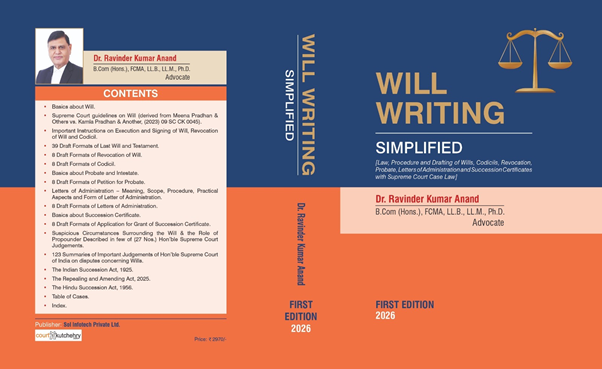
The extract from Will Writing Simplified by Dr. Ravinder Kumar Anand [📘 Buy Will Writing Simplified online: Amazon 🔹 Flipkart] explains the role of the propounder in probate proceedings. This article expands on that extract, breaking down the responsibilities of the propounder, the legal framework governing probate, and the implications for families and courts.
Detailed Explanation of the Extract
The extract provides the following insights:
- “Propounder is not defined in the Indian Succession Act, 1925 but is generally the person who presents a Will for probate or validation before a court.”
→ Meaning: The law does not formally define the term, but in practice, the propounder is the one who seeks legal recognition of the Will. - “The propounder must prove that: (i) The Will was duly signed by the Testator; (ii) The Testator was in a sound and disposing state of mind at the time of execution; (iii) The Testator understood the contents and executed the Will voluntarily without coercion, undue influence, or fraud; and (iv) The Will was duly attested by at least two competent witnesses.”
→ Meaning: The propounder must establish four key elements: signature, mental capacity, voluntary execution, and attestation. - “The credibility, consistency, and reliability of the propounder and the attesting witnesses form the backbone of probate proceedings.”
→ Meaning: Courts rely heavily on the trustworthiness of the propounder and witnesses to decide whether the Will is valid.
Legal Context
Indian Succession Act, 1925
- Section 59: Only persons of sound mind, not minors, can make Wills.
- Section 63: Requires signature of the Testator and attestation by two witnesses.
- Section 222: Probate can only be granted to an executor named in the Will, but the propounder initiates the process.
Hindu Succession Act, 1956
- Applies when there is no Will. Property devolves by intestate succession.
- A valid Will presented by a propounder overrides these default rules.
Judicial Principles
Courts emphasize:
- The propounder must dispel suspicious circumstances.
- Witness testimony is crucial to proving execution and mental capacity.
- Credibility of the propounder is often decisive in probate disputes.
Examples and Case Studies
- Hypothetical Example:
A son presents his father’s Will for probate. He must prove that his father signed it, was of sound mind, and executed it voluntarily. - Hypothetical Example:
A charity is named as beneficiary in a Will. The charity, as propounder, must prove the Will’s validity, especially if family members contest it. - Hypothetical Example:
A Will is challenged on grounds of undue influence. The propounder must show that the Testator acted freely and understood the contents.
LEGAL RESEARCH RESOURCES: Check out 123 Key Judgements, as highlighted in the book, WILL WRITING SIMPLIFIED, for the quick research and reference purposes. Click the link here: https://www.courtkutchehry.com/pages/blog/123-supreme-court-judgments-on-wills/
FAQ Section
1. Who is a propounder?
The person who presents a Will for probate or validation before a court.
2. Is “propounder” defined in law?
No. It is not defined in the Indian Succession Act but recognized in practice.
3. What must a propounder prove?
Signature of the Testator, sound mind, voluntary execution, and attestation by two witnesses.
4. Can a beneficiary be a propounder?
Yes, if they present the Will for probate.
5. What if the propounder fails to prove validity?
The Will may be rejected, and property devolves under intestate succession.
6. Why is credibility important?
Courts rely on the trustworthiness of the propounder and witnesses to decide disputes.
7. Can multiple people act as propounders?
Yes, especially if multiple executors or beneficiaries are involved.
Conclusion
The extract from Will Writing Simplified highlights a crucial truth: the propounder carries the burden of proving the validity of a Will. Their role is not symbolic but legal, requiring them to establish signature, mental capacity, voluntary execution, and attestation. Courts rely heavily on the credibility of the propounder and witnesses, making their testimony the backbone of probate proceedings.
For families, a trustworthy propounder ensures fairness. For courts, it provides clarity. For society, it safeguards against fraud. The lesson is simple: the propounder must be prepared, credible, and consistent to uphold the Testator’s final wishes.
Book Reference
📘 Buy Will Writing Simplified online: Amazon 🔹 Flipkart
Sentences Used from Extract
- “Propounder is not defined in the Indian Succession Act, 1925 but is generally the person who presents a Will for probate or validation before a court.”
- “The propounder must prove that: (i) The Will was duly signed by the Testator; (ii) The Testator was in a sound and disposing state of mind at the time of execution; (iii) The Testator understood the contents and executed the Will voluntarily without coercion, undue influence, or fraud; and (iv) The Will was duly attested by at least two competent witnesses.”
- “The credibility, consistency, and reliability of the propounder and the attesting witnesses form the backbone of probate proceedings.”
Historical and Comparative Context
- Colonial Legacy: The Indian Succession Act, 1925, consolidated testamentary law but left terms like “propounder” undefined.
- UK Law: Executors usually propound Wills in probate courts.
- US Law: Personal representatives or beneficiaries often initiate probate proceedings.
- Evolution in India: Courts emphasize the burden of proof on the propounder, requiring strong evidence of validity.
Implications for Society, Families, and Courts
- Families: Propounders often face challenges from relatives, making probate proceedings contentious.
- Courts: Propounders and witnesses provide the backbone of evidence in Will disputes.
- Society: Clear rules on propounders ensure fairness and protect against fraudulent Wills.
Suggested Keywords
- Propounder in Indian Will law
- Indian Succession Act probate rules
- Duties of propounder Will India
- Probate proceedings propounder India
- Attestation proof Will India
- Testamentary capacity proof India
- Credibility of propounder probate India