
Watch the Video
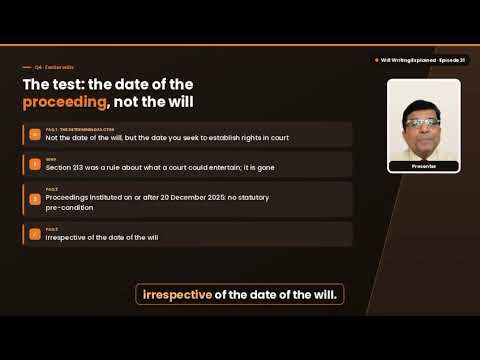
In this 11-minute video, CourtKutchehry presents Episode 21 of “Will Writing Explained”: from 20 December 2025, probate of a will is no longer compulsory anywhere in India. The episode explains the Repealing and Amending Act, 2025 (Act 37 of 2025), what it changed in Sections 3, 213 and 370 of the Indian Succession Act, 1925, what it means for a legatee in Mumbai, Chennai or Kolkata, whether it applies to older wills and pending probate cases, what has not changed, and why applying for probate is often still wise. This article explains the same change in writing.
The Change in One Sentence
The Repealing and Amending Act, 2025, which received the President’s assent on 20 December 2025, omitted Section 213 of the Indian Succession Act. That section had said that no right as executor or legatee could be established in court without probate, for certain wills of Hindus, Buddhists, Sikhs, Jains and Parsis connected with the old presidency areas. With it gone, no will anywhere in India needs probate before the legatee can rely on it in court.
The change came in an unusual vehicle. Repealing and amending Acts are usually housekeeping laws that clean up obsolete statutes. This one, through its Second Schedule, also made a substantive change to succession law.
What Exactly Was Amended: Sections 3, 213 and 370
The Second Schedule to the 2025 Act made four amendments to the Indian Succession Act:
| Provision | Amendment | Effect |
|---|---|---|
| Section 3(1) | The figures “, 213” omitted | Section 3 lets State Governments exempt communities from certain provisions; the reference to Section 213 is no longer needed. |
| Section 213 | Omitted | Probate is no longer a precondition for establishing a right as executor or legatee. |
| Section 370(1) | “or section 213 to be established by letters of administration or probate” replaced by “to be established by letters of administration” | The bar on succession certificates now refers only to cases where letters of administration are required (Section 212). |
| Section 370(2)(b) | Omitted | A clause in the definition of “security” for succession certificates removed. |
The notes to the Bill explained the purpose: the amendments seek to attain uniformity by omitting Section 213, which was described as discriminatory.
What It Means for a Legatee in Mumbai, Chennai or Kolkata
Before the amendment, a daughter who inherited a Mumbai flat under her father’s will had to obtain probate before she could, for example, sue to recover possession or defend her title under the will. After 20 December 2025:
- she can rely on the will directly in a suit, and prove it in the ordinary way through an attesting witness;
- a housing society, bank or registrar no longer has a statutory basis to insist on probate as a legal requirement, although many institutions may still ask for it, or for indemnities, as a matter of their own risk policy; and
- the position in these cities is now the same as in Delhi and the rest of India, which the Supreme Court had explained in Kanta Yadav v. Om Prakash Yadav, (2019) 07 SC CK 0085.
Remember this line: probate is now a choice, not a condition.
Older Wills and Pending Probate Cases
The 2025 Act does not contain a special transitional rule for Section 213. Two questions follow.
Wills made, or deaths occurring, before 20 December 2025
Section 213 was a rule about how a right under a will could be established in court. Many commentators therefore read the omission as applying whenever a legatee seeks to establish a right after 20 December 2025, even if the will was made or the testator died earlier. Courts dealing with the earlier Kerala exemption for Christians took a similar view of Section 213 as procedural.
Pending probate petitions
A probate petition already filed does not become invalid. Probate is still available under the Act, so the court can continue and decide it. A petitioner who now considers probate unnecessary may choose whether to continue, but must weigh the benefits explained below. Where Section 213 was raised as an objection in a pending suit, the effect of the omission, and of the savings clause in Section 4 of the 2025 Act and Section 6 of the General Clauses Act, 1897, will be argued case by case.
Reported commentary up to 2026 notes that the Supreme Court has not yet ruled directly on these transitional questions, so advice on a pending matter should be taken on its own facts.
What Has Not Changed
- Probate is still available. All the provisions on granting probate and letters of administration remain in force.
- The will must still be proved. Without probate, a legatee who relies on a will in a suit must prove it under Section 63 of the Indian Succession Act and Section 68 of the Indian Evidence Act (now Section 67 of the Bharatiya Sakshya Adhiniyam, 2023), and answer any suspicious circumstances.
- Section 212 is unchanged. Letters of administration for intestate estates are still not required for Hindus, Muslims, Buddhists, Sikhs, Jains, Indian Christians and Parsis.
- Succession certificates under Part X continue for debts and securities.
- Section 211, under which the executor is the legal representative of the deceased, and the executor’s duties are unchanged.
Why Applying for Probate Is Often Still Wise
Optional does not mean useless. Probate has advantages that a simple will does not:
- It binds the whole world. Probate is a judgment in rem on the genuineness of the will. A will proved in an ordinary suit binds only the parties to that suit.
- It settles disputes early. Citations and caveats bring objectors forward now, rather than years later when witnesses have died.
- It reassures third parties. Banks, societies, buyers and lenders are more comfortable dealing with a probated will, and Section 273 protects those who pay or hand over property to the executor.
- It gives the executor clear authority to collect assets, pay debts and distribute the estate.
- It helps with assets in several places, including some foreign institutions that expect a court grant.
Probate may be less necessary where the family agrees, the estate is simple, and institutions are willing to act on the will with indemnities.
Key Takeaways
- The Repealing and Amending Act, 2025 omitted Section 213; probate is no longer compulsory anywhere in India from 20 December 2025.
- It also amended Sections 3(1) and 370 to remove references to Section 213.
- Legatees in Mumbai, Chennai and Kolkata are now in the same position as those in Delhi.
- Transitional questions about older wills and pending cases are still being worked out; take advice on the facts.
- Probate remains available and often wise, because it binds everyone and gives third parties confidence.
Frequently Asked Questions
Is probate compulsory in Mumbai after 2025?
No. With Section 213 omitted, no statute requires probate before a legatee can rely on a will in court, in Mumbai or anywhere else.
When did the change take effect?
The Repealing and Amending Act, 2025 received the President’s assent on 20 December 2025, which the series treats as the date of the change.
Can a housing society still ask for probate?
It may ask, but there is no longer a statutory requirement. Societies and banks often accept a will with indemnity bonds and no-objection letters from other heirs.
Do I still need to prove the will?
Yes. If anyone disputes it, the will must be proved through an attesting witness and suspicious circumstances must be explained.
Should I withdraw my pending probate case?
Not automatically. A probate decree binds everyone and may still be valuable. Decide on the facts with legal advice.
Where can I watch the full explanation?
Watch the video explain the 2025 change in 11 minutes: https://youtu.be/9kKNGob24ag.
Conclusion
The Repealing and Amending Act, 2025 ended a century-old rule that tied a family’s rights to the city where a will was made or a flat was located. Probate is now optional throughout India.
But the will itself still has to be proved, and probate still offers what nothing else does: a single decision on the will that binds everyone. For many families, especially where disputes are possible or assets are spread out, it remains the safer route.
▶ Watch the video: Probate No Longer Compulsory: Repealing and Amending Act 2025 | Will Writing Ep 21
Research Judgments Like These on CourtKutchehry
Every judgment cited in this article, and lakhs more, can be searched and read on CourtKutchehry. Searching and reading judgments is free. A membership adds unlimited summaries, all related judgments, original court PDF downloads, bookmarks, notes and the CourtKutchehry AI assistant.
| Membership | Price | Works out to | AI credits |
|---|---|---|---|
| Monthly (1 month) | ₹599 | ₹599 / month | 1,000 / month |
| Quarterly (3 months) · Save 16% | ₹1,499 | ₹499.67 / month | 1,100 / month |
| Six-monthly (6 months) · Save 33% | ₹2,399 | ₹399.83 / month | 1,200 / month |
| Yearly (12 months) · Save 44% · Best value | ₹3,999 | ₹333.25 / month | 1,300 / month |
Every plan is a one-off purchase for a fixed period: nothing auto-renews and no card is kept on file. Prices are exclusive of applicable tax, which is added at checkout. Extra AI chat credits can be topped up from ₹99. A free verified account gets 5 summaries and 50 AI trial credits.
Prices are as displayed on courtkutchehry.com on 20 November 2026 and are subject to change without notice. Please check the pricing page for the current plans and offers.
For more judgments, legal opinions and case analysis, visit courtkutchehry.com
Visit CourtKutchehry →