
COURTKUTCHEHRY EXCLUSIVE: EXTRACTS FROM BEST SELLING BOOK: WILL WRITING SIMPLIFIED
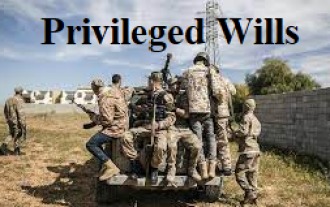
Privileged Wills in Indian Succession Law: Special Rights for Soldiers, Mariners, and Airmen
Extraordinary circumstances allow certain individuals to make simplified Wills.
Privileged Wills safeguard property rights during war, expeditions, and voyages.
By Vishwas Kumar
New Delhi: April 01, 2026:
In ordinary life, making a Will requires compliance with strict legal formalities. But what happens when a soldier is fighting in battle, a mariner is at sea, or an airman is engaged in an expedition? The law recognizes that such individuals may not have the luxury of time or access to legal procedures. To protect their rights and ensure their property is disposed of according to their wishes, Indian succession law provides for Privileged Wills.
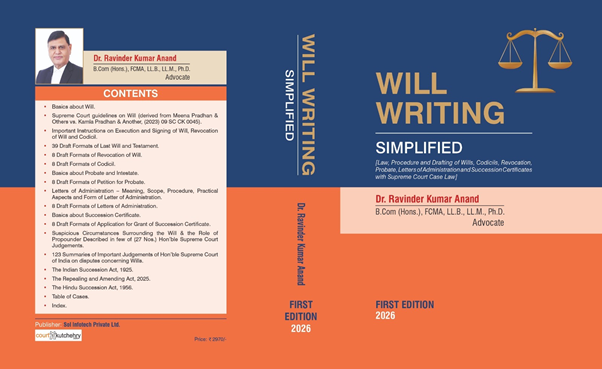
The extract from Will Writing Simplified by Dr. Ravinder Kumar Anand [📘 Buy Will Writing Simplified online: Amazon 🔹 Flipkart] explains this unique category of Wills. Privileged Wills are designed for soldiers, airmen, and mariners in extraordinary circumstances, allowing them to make valid Wills under simplified rules. This article explores the meaning, scope, and implications of Privileged Wills, situating them within the broader framework of Indian succession law.
Detailed Explanation of the Extract in Plain Language
The extract states: “Any soldier being employed in an expedition or engaged in actual warfare, [or an airman so employed or engaged,] or any mariner being at sea, may, if he has completed the age of eighteen years, dispose of his property by a will made in the manner provided in section 66. Such wills are called privileged wills.”
Breaking this down:
- Who can make a privileged Will?
- Soldiers in expeditions or warfare.
- Airmen in expeditions or warfare.
- Mariners at sea.
- Age requirement: Must be at least 18 years old.
- Why privileged? Because these individuals face extraordinary risks and may not be able to follow the usual formalities.
The extract provides illustrations:
- A medical officer attached to a regiment in an expedition can make a privileged Will.
- A purser on a merchant ship at sea can make a privileged Will.
- A soldier fighting insurgents in the field can make a privileged Will.
- A mariner temporarily on shore while the ship is in harbour is still considered “at sea” and can make a privileged Will.
- An admiral living on shore who only occasionally boards his ship is not considered “at sea” and cannot make a privileged Will.
- A mariner serving on a military expedition but not at sea is treated as a soldier and can make a privileged Will.
The extract also includes a comment: “A testator by making a Will does not alter the existing state of things in regard to the property. It follows that making a Will in regard to a property does not violate an order of status quo in regard to such properties hence dispute not void; N. Ramesh v. Nagaraj, AIR 2001 Karn 395.”
This means that writing a Will does not change property ownership during the testator’s lifetime—it only expresses future wishes.
Legal Context
- Indian Succession Act, 1925: Section 65 and 66 deal with Privileged Wills. They relax formal requirements for soldiers, airmen, and mariners.
- Testamentary capacity: The minimum age is 18 years, lower than the usual requirement of majority (21 years under earlier law).
- Case law reference: N. Ramesh v. Nagaraj clarified that making a Will does not violate a court’s order of status quo, since it does not alter property ownership during the testator’s lifetime.
Examples and Case Studies (Hypothetical)
- Example 1: Soldier in battle
A soldier fighting insurgents writes a simple Will on a piece of paper, leaving his savings to his parents. This is valid as a privileged Will. - Example 2: Mariner at sea
A purser on a merchant ship writes a Will during a voyage, leaving his estate to his wife. This is valid. - Example 3: Admiral on shore
An admiral living on land who only occasionally boards his ship writes a Will. This is not privileged, since he is not considered “at sea.” - Example 4: Mariner on expedition
A mariner serving in a military expedition but not at sea writes a Will. He is treated as a soldier, so his Will is privileged.
Historical and Comparative Context
- India: Privileged Wills were introduced by Act 10 of 1927, recognizing the special circumstances of soldiers, airmen, and mariners.
- England: Similar provisions exist for soldiers and sailors, reflecting the need for flexibility during war and voyages.
- United States: Military personnel often have special rules for Wills, ensuring their wishes are respected even in combat zones.
This shows a global recognition of the unique risks faced by those in service.
Implications for Society, Families, and Courts
- For families: Privileged Wills ensure that soldiers, mariners, and airmen can protect their loved ones even in dangerous circumstances.
- For society: They reflect respect for service members and safeguard property rights.
- For courts: Privileged Wills require careful interpretation, especially in defining who qualifies as “at sea” or “engaged in warfare.”
FAQ Section
1. What is a privileged Will?
A Will made by soldiers, airmen, or mariners in extraordinary circumstances, with relaxed formalities.
2. Who can make a privileged Will?
Soldiers in expeditions or warfare, airmen in expeditions or warfare, and mariners at sea.
3. What is the minimum age?
18 years.
4. Does making a Will change property ownership?
No. A Will only takes effect after death.
5. Is an admiral living on shore eligible?
No. He is not considered “at sea.”
6. Can a mariner on a military expedition make a privileged Will?
Yes, but he is treated as a soldier, not as a mariner.
7. Why are privileged Wills important?
They protect the rights of individuals in extraordinary circumstances where normal formalities are impractical.
Conclusion
Privileged Wills are a vital safeguard in Indian succession law. They recognize the unique risks faced by soldiers, airmen, and mariners, allowing them to make valid Wills even in extraordinary circumstances. By ensuring testamentary freedom in the face of danger, the law protects both individuals and their families. Courts, families, and society must respect these provisions, which balance practicality with fairness.
Explore all important will-related Supreme Court judgments here. Check out 123 Key Judgements, as highlighted in the book, WILL WRITING SIMPLIFIED, for the quick research and reference purposes. Click the link here: https://www.courtkutchehry.com/pages/blog/123-supreme-court-judgments-on-wills/
Book Reference
Exact Sentences Used from the Extract
- “Any soldier being employed in an expedition or engaged in actual warfare, Ins. by Act 10 of 1927, s. 2 and the First Schedule (w.e.f. 4-4-1927) [or an airman so employed or engaged,] or any mariner being at sea, may, if he has completed the age of eighteen years, dispose of his property by a will made in the manner provided in section 66. Such wills are called privileged wills.”
- “Illustrations (i) A, a medical officer attached to a regiment is actually employed in an expedition. He is a soldier actually employed in an expedition and can make a privileged will. (ii) A is at sea in a merchant-ship, of which he is the purser. He is a mariner and, being at sea, can make a privileged will. (iii) A, a soldier serving in the field against insurgents, is a soldier engaged in actual warfare and as such can make a privileged will. (iv) A, a mariner of a ship, in the course of a voyage, is temporarily on shore while she is lying in harbour. He is, for the purposes of this section, a mariner at sea and can make a privileged will. (v) A, an admiral who commands a naval force, but who lives on shore and only occasionally goes on board his ship, is not considered as at sea and cannot make a privileged will. (vi) A, a mariner serving on a military expedition, but not being at sea, is considered as a soldier and can make a privileged will.”
- “A testator by making a Will does not alter the existing state of things in regard to the property. It follows that making a Will in regard to a property does not violate an order of status quo in regard to such properties hence dispute not void; N. Ramesh v. Nagaraj, AIR 2001 Karn 395.”
[📘 Buy Will Writing Simplified online: Amazon 🔹 Flipkart]
Suggested Keywords for SEO
- Privileged Will India law
- Indian Succession Act Section 66
- Soldiers and mariners Will law
- Testamentary succession India
- Will Writing Simplified Dr Ravinder Kumar Anand
- Privileged Will case law India