
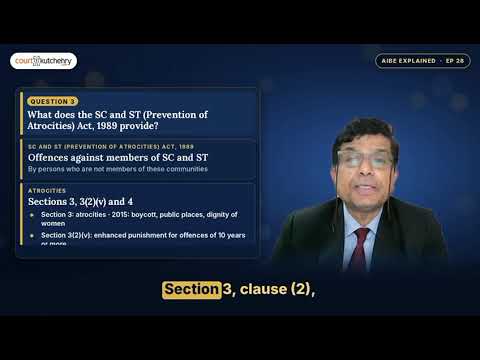
Watch the Video
In this 11-minute video, Episode 28 of the “AIBE Explained” series, the episode completes the special criminal laws with four statutes that give one question in most AIBE papers: the Prevention of Corruption Act, 1988, the Narcotic Drugs and Psychotropic Substances (NDPS) Act, 1985, the Scheduled Castes and Scheduled Tribes (Prevention of Atrocities) Act, 1989 and the Arms Act, 1959. The question is usually on one of three things: sanction for prosecution, bail, or a presumption. He takes the four Acts in four questions and then solves five practice questions in the style of past papers. This article explains the same law in writing.
Sanction, Bail and Presumptions
Read these four Acts with three questions in mind. Who must approve the prosecution? How hard is it to get bail? And when does the law presume something against the accused? Almost every AIBE question on special criminal laws is a version of one of these.
Q1: The Prevention of Corruption Act, 1988
- Public servant (Section 2(c)): a wide definition covering government employees, judges, officers of public sector bodies and others performing public duties.
- Taking undue advantage (Section 7): a public servant who obtains, accepts or attempts to obtain an undue advantage to perform a public duty improperly. Punishment: three to seven years.
- Giving a bribe (Section 8): since the 2018 amendment, the bribe-giver is directly punishable. A person compelled to give a bribe is protected if he reports it to the police or an investigating agency within seven days.
- Criminal misconduct (Section 13): after 2018, limited to fraudulent misappropriation of property entrusted to the public servant and intentional illicit enrichment, that is, disproportionate assets the public servant cannot satisfactorily account for.
The two shields and the presumption
- Section 17A (prior approval): no enquiry, inquiry or investigation into an offence relatable to a recommendation made or decision taken by a public servant in the discharge of official functions without the prior approval of the competent government or authority.
- Section 19 (sanction): no court can take cognizance of offences under Sections 7, 11, 13 and 15 against a public servant without previous sanction.
- Section 20 (presumption): where it is proved that a public servant accepted an undue advantage, the court presumes that he did so with the corrupt motive in Section 7.
In Neeraj Dutta vs State (Govt. of NCT of Delhi), (2022) 12 SC CK 0051, a five-judge Constitution Bench held that demand and acceptance of a bribe must be proved, but can be proved by circumstantial evidence where the complainant dies, turns hostile or is unavailable. The Section 20 presumption arises only after these foundational facts are proved.
Q2: Key Provisions of the NDPS Act, 1985
Quantity decides punishment
Punishment depends on whether the quantity seized is small, intermediate or commercial, as notified by the Central Government for each drug. Consumption alone is punished under Section 27 with much lighter sentences.
Presumptions and bail
- Section 35: the court presumes a culpable mental state; the accused must prove its absence.
- Section 54: the court presumes an offence from possession of an illicit article that the accused cannot satisfactorily account for.
- Section 37 (twin conditions): for commercial-quantity offences, bail can be granted only if the Public Prosecutor is heard and the court is satisfied that there are reasonable grounds to believe that the accused is not guilty and is not likely to commit an offence while on bail.
Search safeguards
- Section 42: an empowered officer may enter, search and seize without a warrant, but must record the grounds of belief and send a copy to his superior.
- Section 50: a person about to be searched has the right to be taken before a Gazetted Officer or a Magistrate, and must be informed of that right.
- Section 64A: an addict charged with consumption or a small-quantity offence who volunteers for treatment at a recognised centre gets immunity from prosecution.
Three cases explain these safeguards. In State of Punjab vs Baldev Singh, (1999) 07 SC CK 0011, a Constitution Bench held that informing the suspect of his Section 50 right is mandatory, and a conviction resting only on a recovery made in breach of it cannot stand. In Vijaysinh Chandubha Jadeja vs State of Gujarat, (2010) 10 SC CK 0093, another Constitution Bench (decided in October 2010 and reported in 2011) held that Section 50 requires strict compliance; “substantial compliance” is not enough. And in Tofan Singh vs State of Tamil Nadu, (2020) 10 SC CK 0049, the Court held that NDPS officers are “police officers”, so a confessional statement recorded under Section 67 cannot be used to convict.
Remember this line: Section 50 is about searching a person, and its compliance must be strict.
Q3: The SC and ST (Prevention of Atrocities) Act, 1989
- Section 3: the list of atrocities committed by a person who is not a member of a Scheduled Caste or Scheduled Tribe.
- Section 4: a public servant, not being an SC/ST member, who wilfully neglects his duties under the Act is punishable.
- Section 14: Special Courts and Exclusive Special Courts for speedy trial.
- Section 15A: rights of victims and witnesses, including notice of proceedings and the right to be heard.
- Section 18: anticipatory bail is barred.
The Mahajan controversy and Section 18A
In Dr. Subhash Kashinath Mahajan vs State of Maharashtra, (2018) 03 SC CK 0040, a two-judge bench issued directions allowing anticipatory bail where there was no prima facie case, a preliminary enquiry before registering a case, and approval before arrest. Parliament responded in 2018 by inserting Section 18A: no preliminary enquiry and no approval is needed, and the bar on anticipatory bail applies notwithstanding any judgment. In Prathvi Raj Chauhan vs Union of India, (2020) 02 SC CK 0023, the Supreme Court upheld Section 18A, while recognising that a court may still grant relief where the complaint does not make out a prima facie case.
In Hitesh Verma vs State of Uttarakhand, (2020) 11 SC CK 0013, the Court held that an insult under Section 3(1)(r) is an offence only if it is made because the victim belongs to a Scheduled Caste or Tribe, and in a place within public view. An insult inside the four walls of a building, with no member of the public present, does not satisfy that ingredient.
Q4: What Does the Arms Act, 1959 Punish?
- Section 3 (licence): no person may acquire, possess or carry a firearm without a licence. Since the 2019 amendment, a person may hold at most two firearms (earlier three).
- Section 25: punishments for manufacture, sale, possession and other contraventions, graded by seriousness.
- Section 25(9): added in 2019, it punishes celebratory gunfire and rash or negligent use of a firearm that endangers human life or personal safety.
- Section 39: no prosecution for an offence under Section 3 without the previous sanction of the District Magistrate.
Key Takeaways
- PC Act: Section 7 (taking), Section 8 (giving), Section 13 (misappropriation and illicit enrichment), Section 17A (prior approval), Section 19 (sanction), Section 20 (presumption).
- Neeraj Dutta: demand and acceptance can be proved by circumstantial evidence.
- NDPS: quantity decides punishment; Section 37 twin conditions for bail; Section 50 needs strict compliance (Baldev Singh, Vijaysinh); NDPS officers are police officers (Tofan Singh).
- SC/ST Act: Section 18 bars anticipatory bail, and Section 18A (2018) was upheld in Prathvi Raj Chauhan; “public view” is essential (Hitesh Verma).
- Arms Act: at most two firearms; celebratory gunfire under Section 25(9); DM’s sanction under Section 39.
Frequently Asked Questions
Is a sanction needed to prosecute a public servant for bribery?
Yes. Section 19 of the PC Act requires previous sanction before a court takes cognizance, and Section 17A requires prior approval even for an investigation into decisions taken in official functions.
Is the bribe-giver also guilty?
Yes. Since 2018, Section 8 directly punishes giving an undue advantage, with protection for a person who was compelled and reports it within seven days.
What are the twin conditions for bail under the NDPS Act?
Under Section 37, for commercial quantity, the court must find reasonable grounds to believe that the accused is not guilty and is not likely to commit an offence while on bail, after hearing the Public Prosecutor.
Can anticipatory bail be granted under the SC/ST Act?
Sections 18 and 18A bar it. The Supreme Court in Prathvi Raj Chauhan (2020) upheld the bar, while recognising that relief remains possible where no prima facie case is made out.
How many firearms can a licensee hold?
Two, since the Arms (Amendment) Act, 2019.
Where can I watch the full explanation?
Watch the full explanation in 11 minutes: https://youtu.be/tX0uI5mXQQc.
Conclusion
The four Acts in this episode look very different, but the AIBE asks the same three things about each: sanction, bail and presumptions. Learn the section numbers for those three, and the leading Constitution Bench cases, and you will be ready for this question.
The next episode turns to commercial law: the Sale of Goods Act, 1930 and the Indian Partnership Act, 1932.
▶ Watch the video: Special Criminal Laws Part 2: Prevention of Corruption Act, NDPS, SC/ST Act Ep 28
Research Judgments Like These on CourtKutchehry
Every judgment cited in this article, and lakhs more, can be searched and read on CourtKutchehry. Searching and reading judgments is free. A membership adds unlimited summaries, all related judgments, original court PDF downloads, bookmarks, notes and the CourtKutchehry AI assistant.
| Membership | Price | Works out to | AI credits |
|---|---|---|---|
| Monthly (1 month) | ₹599 | ₹599 / month | 1,000 / month |
| Quarterly (3 months) · Save 16% | ₹1,499 | ₹499.67 / month | 1,100 / month |
| Six-monthly (6 months) · Save 33% | ₹2,399 | ₹399.83 / month | 1,200 / month |
| Yearly (12 months) · Save 44% · Best value | ₹3,999 | ₹333.25 / month | 1,300 / month |
Every plan is a one-off purchase for a fixed period: nothing auto-renews and no card is kept on file. Prices are exclusive of applicable tax, which is added at checkout. Extra AI chat credits can be topped up from ₹99. A free verified account gets 5 summaries and 50 AI trial credits.
Prices are as displayed on courtkutchehry.com on 20 November 2026 and are subject to change without notice. Please check the pricing page for the current plans and offers.
For more judgments, legal opinions and case analysis, visit courtkutchehry.com
Visit CourtKutchehry →