
COURTKUTCHEHRY SPECIAL SERIES ON LANDMARKS JUDGEMENTS ON WILLS, CODICIL & PROBATE
P.P.K. Gopalan Nambiar v. P.P.K. Balakrishnan Nambiar & Ors.: Supreme Court Validates Lakshmi Amma’s Registered Will
High Court’s Suspicion Found Without Basis
Partition Excludes Will Properties, Appeal Allowed
By Vishwas Kumar
New Delhi: March 27, 2026:
On 7 March 1995, the Supreme Court of India in P.P.K. Gopalan Nambiar v. P.P.K. Balakrishnan Nambiar & Ors. (Civil Appeal No. 1368 of 1978; (1995) 03 SC CK 0039) delivered a decisive ruling on the genuineness of a registered will executed by Lakshmi Amma. The Division Bench comprising Hon’ble Mr. Justice K. Ramaswamy and Hon’ble Mr. Justice B.L. Hansaria upheld the validity of the will, rejecting the High Court’s doubts as unfounded.
The dispute centered on whether Lakshmi Amma’s registered will (Ex. B-12) was genuine or surrounded by suspicious circumstances. The trial and appellate courts had accepted the will, but the High Court cast suspicion without any factual foundation. The Supreme Court emphasized that suspicion must rest on tangible evidence, not conjecture. Since the will was duly proved, properly attested, and uncontested in pleadings or cross-examination, the Court held it to be valid.
By affirming the will’s genuineness, the Supreme Court ruled that the properties covered under it were rightly excluded from partition, thereby protecting the testamentary intent of Lakshmi Amma. The appeal was accordingly allowed, restoring the sanctity of the registered will and reinforcing the principle that courts must not invalidate testamentary documents on speculative grounds.
This judgment is significant in succession law, as it underscores that registered wills carry strong evidentiary weight and cannot be dismissed without concrete proof of fraud, coercion, or incapacity. It strengthens the legal presumption in favour of duly executed wills and ensures that rightful beneficiaries are not deprived due to unfounded suspicion.
For More, Read Here the Summary of the Judgement from the Book: WILL WRITING SIMPLIFIED, read below or open page no 436, Chapter 14.1 in the book. (Online book purchase link available here on: Buy online: Amazon | Flipkart
|
|
Case Summary |
: |
P.P.K. Gopalan Nambiar v. P.P.K. Balakrishnan Nambiar & Ors. |
|
|
Court |
: |
Supreme Court of India |
|
|
Citations |
: |
(1995) 03 SC CK 0039: Civil Appeal No. 1368 of 1978. |
|
|
Link |
: |
|
|
|
Decided on |
: |
07 March 1995 |
|
|
Coram |
: |
Hon’ble Mr. Justice K. Ramaswamy and Hon’ble Mr. Justice B.L. Hansaria. |
|
|
Relevant Paragraphs |
: |
Para Nos.2–6 |
1. Facts of the Case:
The appellant, first defendant in O.S. No.199/68 before the District Munsif, Payyoli, relied upon a registered Will (Ex.B-12 dated 1.11.1955) executed by his mother, Lakshmi Amma, who held property under a maintenance arrangement (Ex.A-2 of 17.12.1941). The trial court decreed partition but excluded the Will property. The appellate court upheld the Will and excluded it from partition. The High Court reversed that decision, holding the Will suspicious. The appellant obtained special leave.
2. Law Points Involved:
Proof of Will validity of registered Will, suspicious circumstances, abatement under Order 22 CPC, devolution under Order 22 Rule 10 CPC.
3. Acts / Provisions / Articles Referred:
(i). Civil Procedure Code, 1908 — Order 22 Rules 10 & 9; Order 8 Rule 9
(ii). Principles under Section 63, Indian Succession Act, 1925 (implied);
(iii). Section 68, Evidence Act, 1872 (proof of execution and attestation of Will).
4. Judgments Referred:
High Court judgment in Second Appeal Nos. 753/75 & 977/75 (Kerala High Court, 23.11.1977); legal precedents on “suspicious circumstances in Wills” noted but not specifically enumerated.
5. Obiter Dicta:
Suspicious features must be “real, germane and valid” - not mere fantasies of a doubting mind. Mere exclusion of daughters or benefit to one heir cannot, by itself, constitute suspicious circumstance if the Will is otherwise duly executed and proved.
6. Ratio Decidendi:
When a Will is registered and its execution and attestation are properly proved, and no specific plea or evidence challenges its validity, the presumption of due execution stands. Courts must base suspicion on concrete material; unfounded conjecture cannot defeat a duly proved Will.
7. Final Ruling:
Appeal allowed. The judgments of the High Court and District Munsif were set aside; the decree of the Subordinate Judge upholding the Will was restored. Properties under Ex.B-12 stand excluded from partition. No costs.
8. Gist (Dispute & Final Decision):
Dispute centered on whether Lakshmi Amma’s registered Will (Ex.B-12) was genuine or surrounded by suspicious circumstances. The Supreme Court held that the High Court erred in doubting the Will without factual
basis. Suspicion must have tangible foundation; since the Will was duly proved and uncontested in pleadings or cross-examination, it was valid. The Will properties were rightly excluded from partition; appeal allowed.
Read full Judgement Here:
P.P.K. Gopalan Nambiar v. P.P.K. Balakrishnan Nambiar & Ors.
Supreme Court of India
(1995) 03 SC CK 0039: Civil Appeal No. 1368 of 1978.
You Can Also Purchase the Book from here on: Buy online: Amazon | Flipkart
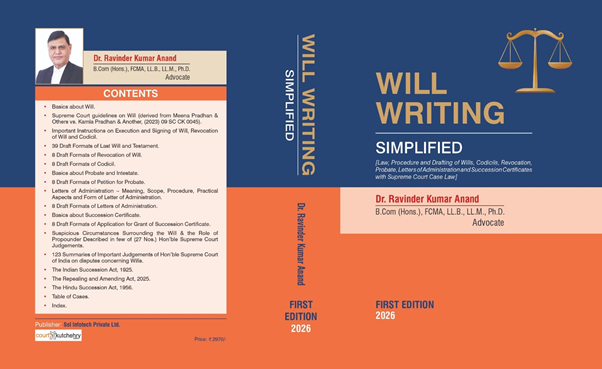
OUR RECOMMENDATION: Check out 123 Key Judgements, as highlighted in the book, WILL WRITING SIMPLIFIED, for the quick research and reference purposes. Click the link here: https://www.courtkutchehry.com/pages/blog/123-supreme-court-judgments-on-wills/
Keywords for SEO & Quick Search
- P.P.K. Gopalan Nambiar v. P.P.K. Balakrishnan Nambiar Supreme Court case
- Civil Appeal No. 1368 of 1978 judgment
- Lakshmi Amma registered will dispute
- Suspicious circumstances will validity India
-
- Ramaswamy B.L. Hansaria judgment
- Supreme Court succession law 1995
- Partition exclusion will properties ruling