
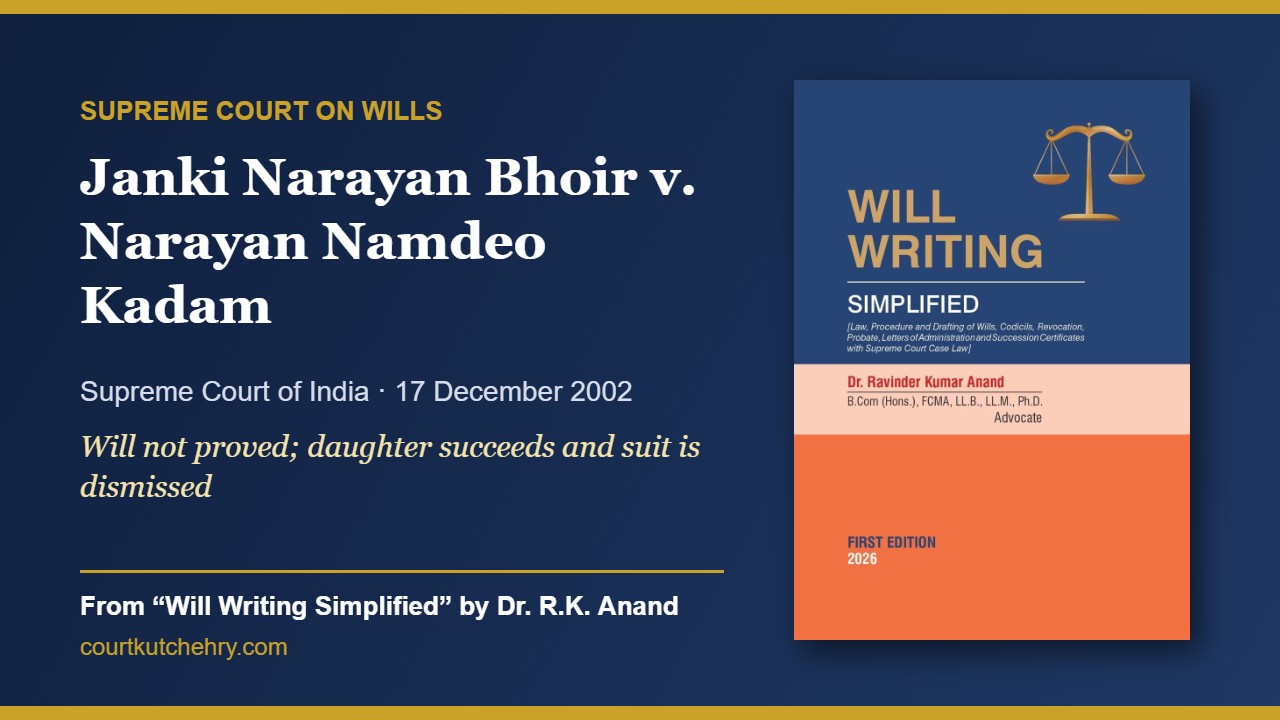
A man leaves his land and house by Will to the son of his cousin, passing over his only daughter. At trial, the one attesting witness who is called cannot say whether the other witness was even present. The other witness is alive but is never summoned. The High Court treats the scribe as a second witness and upholds the Will. On 17 December 2002, the Supreme Court reversed the High Court and dismissed the suit. This article explains Janki Narayan Bhoir v. Narayan Namdeo Kadam and what it teaches about proving a Will through attesting witnesses.
Case at a Glance
| Case | Janki Narayan Bhoir v. Narayan Namdeo Kadam |
|---|---|
| Court | Supreme Court of India |
| Citation | (2002) 12 SC CK 0087; Civil Appeal No. 11194 of 1995; (2003) 2 SCC 91 |
| Decided on | 17 December 2002 |
| Bench | Justice Doraiswamy Raju and Justice Shivaraj V. Patil |
| Provisions | Section 63(c), Indian Succession Act, 1925; Sections 68, 71 and 114 illustration (g), Indian Evidence Act, 1872 |
| Result | Appeal allowed; Will held not proved; first appellate decree restored and suit dismissed |
The Facts
Honaji Dama Kadam died leaving agricultural land and a house. The respondent, the son of his cousin brother, sued for possession as owner under a Will dated 23 October 1975. The appellant, the testator's only daughter, resisted (paras 1, 5).
The Will bore the signatures of two attesting witnesses, Ramkrishna Wagle and Prabhakar Sinkar, and of the scribe, Duttatray Raikar. Only Sinkar was examined. He did not know whether Wagle was present at the execution, did not remember whether he and the scribe were present when he signed, and did not see Wagle at that time (para 5). Wagle was alive, and no reason was shown for not calling him (para 6).
What the Lower Courts Held
- The trial court accepted the Will and decreed the suit.
- The District Judge, in first appeal, held that execution was not proved, since the only attesting witness examined did not prove the attestation by the other, and dismissed the suit.
- The High Court, in second appeal, set aside that judgment, held the Will proved by treating the scribe as an attesting witness, and restored the trial court's decree (paras 1, 5).
The Question Before the Supreme Court
Is a Will proved when the only attesting witness examined cannot speak to the other witness's attestation, the other witness is alive but not called, and the scribe is treated as a substitute witness? Can Section 71 of the Evidence Act fill the gap?
The Law on Proving Attestation
Section 63(c) of the Indian Succession Act requires a Will to be attested by two or more witnesses, each of whom saw the testator sign (or received his acknowledgment) and signed in his presence. The Court stressed that attestation is mandatory and that “execution” means fulfilling all these formalities, not merely the testator putting his signature (paras 9-10).
Section 68 of the Evidence Act (now Section 67 of the Bharatiya Sakshya Adhiniyam, 2023, which replaced the Evidence Act from 1 July 2024) says a document required by law to be attested cannot be used as evidence until at least one attesting witness is called, if alive and capable. The Court explained what this means for a Will: the one witness examined must prove not only his own attestation but also that of the other witness. If he cannot, the other attesting witness, if available, must be called (para 10).
Section 71 (now Section 70 of the BSA) allows other evidence where the attesting witness denies or does not recollect the execution. The Court approved the Bombay High Court's view in Vishnu Ramkrishna Wani v. Nathu Vithal Wani and disapproved the contrary approach in Mt. Manki Kaur v. Hansraj Singh, noting that the latter concerned a mortgage bond, not a Will (paras 12-13).
The Supreme Court’s Reasoning
1. Sinkar did not prove Wagle's attestation
Sinkar's evidence spoke at most to his own signature. He could not say that Wagle had seen the testator sign or had signed in his presence. The requirement of Section 63(c), proved as Section 68 demands, was therefore not met.
2. The living witness should have been called
Wagle was alive, and nothing prevented his examination. “Wagle, the other attesting witness, being alive ought to have been examined in order to prove the Will” (para 6). Calling all available attesting witnesses also avoids an adverse inference under Section 114, illustration (g), that evidence withheld would have been unfavourable (para 11).
3. Section 71 is a fallback, not a shortcut
“Section 71 is permissive and an enabling Section permitting a party to lead other evidence in certain circumstances” (para 11). It helps where a witness who is called denies the execution or cannot recall it. It does not excuse a party from calling an available attesting witness in the first place (paras 11-12).
4. The scribe was not an attesting witness
The respondent's own counsel conceded that the scribe was not an attesting witness. Nothing showed that he signed with the intention of attesting. “The High Court was also wrong in treating the scribe of the Will, Raikar, as an attesting witness without any basis” (para 14). The Court did not need to decide whether a scribe can ever be an attesting witness (para 12).
5. No ground for interference in second appeal
The Court noted that the High Court had not identified any substantial question of law before reversing the first appellate court's well-reasoned judgment (para 14).
The Final Decision
“In this view the impugned judgment and decree cannot be sustained” (para 15). The appeal was allowed, the High Court's judgment was set aside, the District Judge's judgment was restored, and the suit was dismissed. There was no order as to costs.
Key Takeaways
- One attesting witness may prove a Will, but he must prove both attestations.
- If he cannot, and the second attesting witness is alive and available, the second witness must be examined.
- Section 71 applies only when the witnesses called deny or forget execution; it does not cover a witness never called.
- A scribe is not an attesting witness merely because his signature appears on the Will.
- Failure to call an available witness can attract an adverse inference.
Practical Lessons for Will Makers and Lawyers
- Have both witnesses sign together, in your presence and in each other's presence. Then either one can later speak to the other's attestation.
- Pick witnesses who can be found. Note their full names, addresses and phone numbers with the Will.
- Do not count the scribe or typist as a witness unless he is meant to be one and signs as such.
- For lawyers: before closing evidence, ask your attesting witness about the other witness's presence and signature. If he falters and the other witness is alive, summon him. Section 71 will not rescue you.
Frequently Asked Questions
Is examining one attesting witness enough to prove a Will?
It can be, but only if that witness proves the testator's signature and the attestation by the other witness as well.
What if the examined witness cannot speak to the other witness's attestation?
Then the other attesting witness, if alive and available, must be examined. Otherwise the Will is not proved.
When can Section 71 of the Evidence Act be used?
When the attesting witness who is called denies or does not recollect the execution. It cannot be used to avoid calling an available witness.
Can the scribe of a Will act as an attesting witness?
Not just by writing and signing the Will as scribe. In this case there was no basis to treat him as one, and the Court left open whether a scribe could ever qualify.
What was the result for the daughter?
The Will was held not proved and the cousin's son's suit for possession was dismissed, so the daughter's position was restored.
Conclusion
Janki Narayan Bhoir is one of the most cited decisions on proof of Wills because it states the rule so cleanly. The law needs two attesting witnesses, and the evidence must show that both did what Section 63(c) requires.
Its practical message is equally clear: if your witness cannot cover the other's attestation and the other is alive, call him. No other provision will take his place.
Read More in “Will Writing Simplified”

This judgment is one of 123 Supreme Court judgments on Wills summarised in Chapter 14 of Will Writing Simplified by Advocate Dr. Ravinder Kumar Anand. The book covers the law, procedure and drafting of Wills, codicils, revocation, probate, letters of administration and succession certificates, with Supreme Court case law.
Special limited-period offer: available at 50% off on Amazon.
Buy Will Writing Simplified on Amazon →
Research Judgments Like These on CourtKutchehry
Every judgment cited in this article, and lakhs more, can be searched and read on CourtKutchehry. Searching and reading judgments is free. A membership adds unlimited summaries, all related judgments, original court PDF downloads, bookmarks, notes and the CourtKutchehry AI assistant.
| Membership | Price | Works out to | AI credits |
|---|---|---|---|
| Monthly (1 month) | ₹599 | ₹599 / month | 1,000 / month |
| Quarterly (3 months) · Save 16% | ₹1,499 | ₹499.67 / month | 1,100 / month |
| Six-monthly (6 months) · Save 33% | ₹2,399 | ₹399.83 / month | 1,200 / month |
| Yearly (12 months) · Save 44% · Best value | ₹3,999 | ₹333.25 / month | 1,300 / month |
Every plan is a one-off purchase for a fixed period: nothing auto-renews and no card is kept on file. Prices are exclusive of applicable tax, which is added at checkout. Extra AI chat credits can be topped up from ₹99. A free verified account gets 5 summaries and 50 AI trial credits.
Prices are as displayed on courtkutchehry.com on 20 November 2026 and are subject to change without notice. Please check the pricing page for the current plans and offers.
For more judgments, legal opinions and case analysis, visit courtkutchehry.com
Visit CourtKutchehry →