
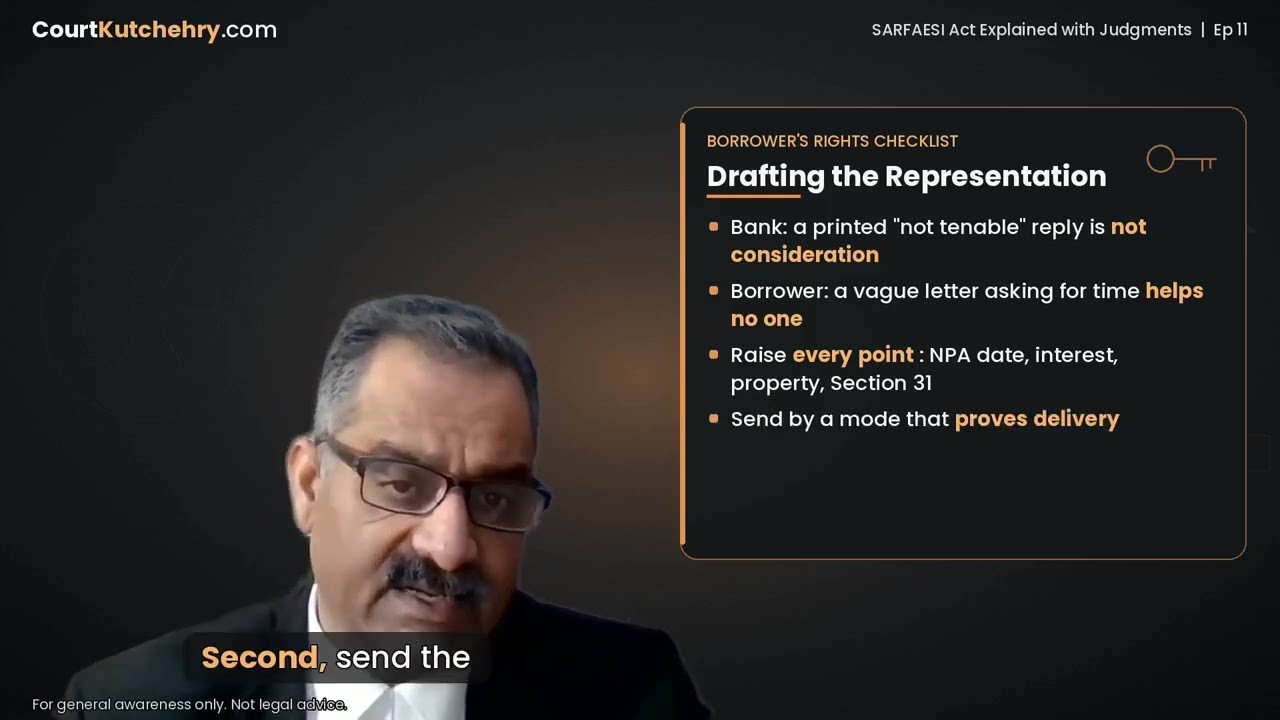
Watch the Video
In this 9-minute video, Vineet Kohli, Advocate, explains the borrower’s representation against a SARFAESI demand notice and the bank’s duty to reply with reasons under Section 13(3A), in Episode 11 of “SARFAESI Act Explained with Judgments”. This article sets out the same points in writing, with links to the judgments on CourtKutchehry.
The Borrower’s First Line of Defence
Once a bank issues a demand notice under Section 13(2) of the Securitisation and Reconstruction of Financial Assets and Enforcement of Security Interest Act, 2002, the borrower has 60 days to pay. But the Act also gives him something more important than time: the right to object. Section 13(3A) makes the bank consider the borrower’s objection and, if it rejects it, tell him why.
This is the borrower’s first line of defence, and it is often the place where a later SARFAESI challenge is won or lost.
Section 13(3A): What It Says
Under Section 13(3A), if, on receipt of the Section 13(2) notice, the borrower makes a representation or raises an objection, the secured creditor shall consider it. If the secured creditor comes to the conclusion that the representation or objection is not acceptable or tenable, it shall communicate the reasons for non-acceptance within 15 days of receipt of the representation or objection.
Reading it phrase by phrase
- “On receipt of the notice”: the right to object arises from the demand notice itself. In practice the representation should go well within the 60 days.
- “Representation or objection”: no form is prescribed. A clear letter setting out the grounds is enough.
- “Shall consider”: this is a duty to apply the mind, not a formality.
- “Not acceptable or tenable”: the duty to give reasons arises when the bank rejects the objection. If it accepts the point, it acts on it, for example by correcting the amount demanded.
- “Within fifteen days of receipt”: the period runs from the date the bank receives the representation, not from the date the borrower wrote it.
Where It Came From: Mardia Chemicals
Section 13(3A) was inserted in 2004, after the Supreme Court’s judgment in Mardia Chemicals Ltd. vs Union of India, (2004) 04 SC CK 0076. The Court upheld the SARFAESI Act but said that a fair procedure requires the secured creditor to apply its mind to the borrower’s objections and to give reasons for rejecting them, so that the borrower knows the case he has to meet.
The idea is simple: the borrower should be heard before his property is touched, not only after.
Remember this line: the bank must consider the objection and give reasons; a printed rejection is not consideration.
What the Reply Does, and Does Not, Do
The proviso to Section 13(3A) adds an important limit. The reasons communicated, or the likely action of the secured creditor at that stage, do not confer any right on the borrower to approach the DRT under Section 17.
So the borrower cannot go to the DRT merely because the bank has rejected his objection. The remedy under Section 17 arises when the bank actually takes a measure under Section 13(4), such as taking possession.
Why? At this stage the bank has only demanded money. If every reply could be challenged, the speedy remedy the Act gives would be lost. Instead, the objection and the reply become part of the record, to be examined if a later measure is challenged before the DRT.
ITC Ltd. v. Blue Coast Hotels (2018)
In ITC Limited vs Blue Coast Hotels Ltd., (2018) 03 SC CK 0035, decided on 19 March 2018, the Supreme Court considered a borrower that had defaulted for years and then relied on procedural objections to undo an auction of its hotel property.
The Court treated the duty under Section 13(3A) as an important one. It noted that the creditor had not sent a written reply to one of the borrower’s representations. But it found that the creditor had in fact considered the borrower’s repayment proposals and given it repeated extensions, while the borrower only sought time without paying. In those circumstances, the Court held, the non-compliance could not help the borrower, and it refused discretionary relief. The Supreme Court allowed the appeals and set aside the High Court’s judgment.
The lesson the video draws: late procedural objections, raised after a long default, should not be used to undo a valid sale. The Court looks at whether the borrower was actually heard.
Practice Points for Advocates
- Raise every point in the representation. Wrong NPA date, wrong calculation of interest, charges not agreed in the loan documents, property not covered by the mortgage, or an exemption under Section 31. A point raised for the first time much later carries less weight.
- Prove the date of delivery. Send the representation by a mode that proves receipt and keep the record. The bank’s 15 days run from receipt.
- Record any failure to reply. If the bank did not reply, or replied without dealing with the points, say so clearly in the Section 17 application when a measure is challenged.
- For the bank: reply point by point, with reasons, and record that the objections were examined before any measure was taken.
A Practical Example: Penal Interest Not Agreed
A borrower writes to the bank that the amount demanded includes penal interest that was never agreed in the loan documents. The bank must examine this. If it agrees, it should correct the demand. If it disagrees, it must reply with reasons within 15 days, for example by pointing to the clause in the loan agreement that provides for penal interest.
If the bank simply ignores the objection and goes on to take possession, the borrower can raise that failure before the DRT in his Section 17 application. If the bank replies with reasons, it has done what Section 13(3A) requires and may proceed after the 60 days.
Quick Test
- Within how many days must the bank communicate its reasons for rejecting the objection? Fifteen days from receipt of the representation.
- After which judgment was Section 13(3A) inserted? Mardia Chemicals, 2004.
- Does the bank’s reply itself give a right to approach the DRT? No. The remedy arises against measures under Section 13(4).
Key Takeaways
- Section 13(3A): the bank must consider the borrower’s objection and communicate reasons for rejecting it within 15 days of receipt.
- The provision was inserted in 2004 after Mardia Chemicals, which said fairness requires the bank to apply its mind and give reasons.
- Under the proviso, the reply does not by itself give a right to approach the DRT; the Section 17 remedy arises against Section 13(4) measures.
- ITC v. Blue Coast Hotels (2018): where the borrower was in substance heard, procedural objections after a long default did not undo the sale.
- Raise every point in the representation, prove its delivery, and record any failure to reply in the Section 17 application.
Frequently Asked Questions
What is a representation under Section 13(3A)?
It is the borrower’s written objection to the Section 13(2) demand notice. No form is prescribed; it should state each ground clearly, with supporting documents.
How long does the bank have to reply?
If it rejects the objection, it must communicate its reasons within 15 days of receiving the representation.
Can I go to the DRT against the bank’s reply?
No. The proviso to Section 13(3A) says the reply does not by itself give a right to approach the DRT. The remedy under Section 17 arises once a measure under Section 13(4) is taken.
Does my representation stop the 60 days from running?
No. The notice period continues. The representation obliges the bank to consider the points and reply.
What happened in ITC v. Blue Coast Hotels?
The Supreme Court found that the creditor had in substance considered the borrower’s proposals, refused relief to a borrower that had defaulted for years, and upheld the creditor’s action, setting aside the High Court’s judgment.
Where can I watch the full explanation?
Watch Vineet Kohli, Advocate, explain it in 9 minutes: https://youtu.be/83rqraagPAU.
Conclusion
Section 13(3A) gives the borrower a real voice before any measure is taken. The bank must read the objection, think about it, and explain its decision.
For the borrower, the representation is the place to put every point on record. For the bank, a short, reasoned reply removes a ground of challenge. The next episode asks what happens when that reply comes late.
▶ Watch the video: Objecting to a SARFAESI Notice: Section 13(3A), Bank’s 15-Day Reply | SARFAESI Explained Ep 11
Research Judgments Like These on CourtKutchehry
Every judgment cited in this article, and lakhs more, can be searched and read on CourtKutchehry. Searching and reading judgments is free. A membership adds unlimited summaries, all related judgments, original court PDF downloads, bookmarks, notes and the CourtKutchehry AI assistant.
| Membership | Price | Works out to | AI credits |
|---|---|---|---|
| Monthly (1 month) | ₹599 | ₹599 / month | 1,000 / month |
| Quarterly (3 months) · Save 16% | ₹1,499 | ₹499.67 / month | 1,100 / month |
| Six-monthly (6 months) · Save 33% | ₹2,399 | ₹399.83 / month | 1,200 / month |
| Yearly (12 months) · Save 44% · Best value | ₹3,999 | ₹333.25 / month | 1,300 / month |
Every plan is a one-off purchase for a fixed period: nothing auto-renews and no card is kept on file. Prices are exclusive of applicable tax, which is added at checkout. Extra AI chat credits can be topped up from ₹99. A free verified account gets 5 summaries and 50 AI trial credits.
Prices are as displayed on courtkutchehry.com on 20 November 2026 and are subject to change without notice. Please check the pricing page for the current plans and offers.
For more judgments, legal opinions and case analysis, visit courtkutchehry.com
Visit CourtKutchehry →