
Watch the Video
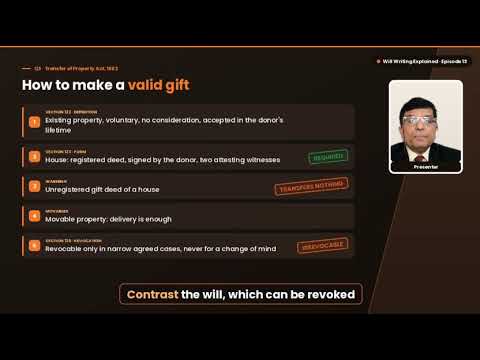
In this 10-minute video, CourtKutchehry presents Episode 13 of the CourtKutchehry will-writing series, based on the book “Will Writing Simplified” by Dr. Ravinder Kumar Anand. A mother dies without a will, leaving a bank account, shares and a flat. The bank wants one paper, the society another. The episode explains who inherits when there is no will, what a succession certificate covers, how to apply, letters of administration, which one a family actually needs, and why a legal heir certificate or mutation is not proof of title. This article covers the same points, for education only and not as legal advice.
Who Inherits When There Is No Will?
When a person dies intestate (without a will), the property goes to the legal heirs under the personal law that governed the deceased:
- Hindus, Buddhists, Sikhs and Jains: the Hindu Succession Act, 1956. For a Hindu man, Section 8 gives the property first to the Class I heirs, such as widow, sons, daughters and mother, together. For a Hindu woman, Section 15 gives it first to her sons and daughters (including the children of a predeceased child) and her husband, with special rules for property she inherited from her parents or from her husband or father-in-law.
- Christians and Parsis: the intestate succession chapters of the Indian Succession Act, 1925.
- Muslims: Muslim personal law.
In the opening example, the mother’s husband (if alive) and children are her first heirs under Section 15. Knowing who the heirs are is only half the problem. The other half is proving it to a bank, a company or a housing society.
What a Succession Certificate Covers (Sections 370 to 390)
A succession certificate is granted under Part X of the Indian Succession Act (Sections 370 to 390). It is meant for debts and securities: money owed to the deceased, such as bank deposits, and securities such as shares, debentures and similar instruments.
The certificate authorises the holder to collect those debts and securities, and protects the person who pays him. A bank or company that pays the certificate-holder in good faith gets a valid discharge (Section 381).
What it does not do:
- it does not cover immovable property such as a flat or land;
- it does not finally decide who owns the money; the inquiry is summary, and a person with a better title can still claim it from the holder in proper proceedings.
How to Apply for a Succession Certificate
- Where: before the District Judge within whose jurisdiction the deceased ordinarily resided at the time of death, or, if there was no fixed residence, where the property is found.
- What the petition states (Section 372): the time of death, the deceased’s residence, the family and other near relatives, the petitioner’s right, the absence of any impediment, and the specific debts and securities for which the certificate is sought.
- Notice: the court issues notice to the relatives and publishes it, so that anyone with an objection can appear.
- Decision (Section 373): the court decides the right to the certificate in a summary manner. If the question of right is too complicated, it may still grant the certificate to the applicant who appears to have the best prima facie title.
- Security and fee: the court may require security (Section 375), and court fee is payable on the value of the debts and securities under the State’s law.
Letters of Administration
Letters of administration are a grant by the court to an administrator (Section 2(a)) to administer the whole estate of the deceased, movable and immovable. They are granted:
- when the deceased left no will: to the person entitled to the estate under the applicable succession law (Section 218); or
- when there is a will but no executor able and willing to act: letters of administration with the will annexed (Section 232).
The administrator, like an executor, becomes the legal representative of the deceased, must file an inventory and accounts, and is accountable to the court. Letters of administration are a heavier, slower process than a succession certificate, but they cover everything.
Which One Does Your Family Actually Need?
Back to the mother with a bank account, shares and a flat:
- Bank account and shares: a succession certificate for those specific debts and securities is usually enough, where the bank or company will not release them on nomination and indemnity papers alone.
- The flat: a succession certificate does not cover it. Depending on the society and the authority, the family may need letters of administration, or may be able to proceed on proof of heirship with a registered release or relinquishment deed by the other heirs in favour of one of them.
- Several assets and a dispute among heirs: letters of administration give one person authority over the whole estate, under the court’s supervision.
Remember too that a nominee in the bank or the society only receives the asset; ownership follows the succession law. And if there is a will, the route is probate (with an executor) or letters of administration with the will annexed, not a succession certificate.
Legal Heir Certificate and Mutation Are Not Title
Families often rely on two papers that do less than they think:
- A legal heir certificate, issued by a revenue authority such as a tehsildar, records who the heirs are for purposes such as pensions, employment benefits or utility transfers. It is not a court’s decision on title.
- A mutation in revenue or municipal records changes the name in which tax is paid or the land is recorded. It is also not proof of ownership.
The Supreme Court made this clear in Balwant Singh v. Daulat Singh, (1997) 07 SC CK 0003: a mutation entry neither creates nor extinguishes title; it serves only fiscal purposes, such as fixing who pays land revenue. In that case a widow who had been removed from the revenue record did not lose her title because of it.
Remember this line: a mutation tells the State whom to tax; it does not tell the world who owns.
Key Takeaways
- Without a will, property goes to heirs under personal law: Sections 8 and 15 of the Hindu Succession Act for Hindus, the 1925 Act for Christians and Parsis, and Muslim personal law for Muslims.
- A succession certificate (Sections 370–390) covers debts and securities, such as bank deposits and shares, not immovable property.
- It is granted by the District Judge after a summary inquiry (Section 373) and protects those who pay the holder (Section 381).
- Letters of administration cover the whole estate, where there is no will (Section 218) or no executor (Section 232).
- A legal heir certificate or mutation is not proof of title (Balwant Singh v. Daulat Singh, 1997).
Frequently Asked Questions
What is the difference between a succession certificate and letters of administration?
A succession certificate lets the holder collect specified debts and securities of the deceased. Letters of administration authorise an administrator to manage the whole estate, movable and immovable.
Can a succession certificate be used to transfer a flat?
No. A succession certificate covers debts and securities only. For immovable property, families usually need letters of administration, or proof of heirship with release deeds, depending on the authority.
Where do I apply for a succession certificate?
Before the District Judge within whose jurisdiction the deceased ordinarily resided at the time of death, or where the property is found if there was no fixed residence.
Does a succession certificate decide who owns the money?
No. The court decides the right to the certificate summarily. The holder can collect, but a person with a better title can still claim the money from him in proper proceedings.
Is mutation of property proof of ownership?
No. In Balwant Singh v. Daulat Singh the Supreme Court held that a mutation entry neither creates nor extinguishes title and serves only fiscal purposes.
Where can I watch the full explanation?
Watch the full explanation in 10 minutes: https://youtu.be/PnlRa1vuYz4.
Conclusion
When there is no will, the succession law decides who inherits, but the family still has to prove it. A succession certificate unlocks bank deposits and shares; letters of administration cover the whole estate; and a legal heir certificate or mutation, useful as they are, are not title.
The simplest way to spare your family this paperwork is the one this series keeps returning to: write a proper will, name an executor, and keep it where it can be found.
▶ Watch the video: No Will? Succession Certificate vs Letters of Administration | Will Writing Ep 13
📖 Read more: Succession Certificate vs Probate vs Letter of Administration in Indian Laws
Research Judgments Like These on CourtKutchehry
Every judgment cited in this article, and lakhs more, can be searched and read on CourtKutchehry. Searching and reading judgments is free. A membership adds unlimited summaries, all related judgments, original court PDF downloads, bookmarks, notes and the CourtKutchehry AI assistant.
| Membership | Price | Works out to | AI credits |
|---|---|---|---|
| Monthly (1 month) | ₹599 | ₹599 / month | 1,000 / month |
| Quarterly (3 months) · Save 16% | ₹1,499 | ₹499.67 / month | 1,100 / month |
| Six-monthly (6 months) · Save 33% | ₹2,399 | ₹399.83 / month | 1,200 / month |
| Yearly (12 months) · Save 44% · Best value | ₹3,999 | ₹333.25 / month | 1,300 / month |
Every plan is a one-off purchase for a fixed period: nothing auto-renews and no card is kept on file. Prices are exclusive of applicable tax, which is added at checkout. Extra AI chat credits can be topped up from ₹99. A free verified account gets 5 summaries and 50 AI trial credits.
Prices are as displayed on courtkutchehry.com on 20 November 2026 and are subject to change without notice. Please check the pricing page for the current plans and offers.
For more judgments, legal opinions and case analysis, visit courtkutchehry.com
Visit CourtKutchehry →