
COURTKUTCHEHRY SPECIAL SERIES ON LANDMARKS JUDGEMENTS ON WILLS, CODICIL & PROBATE
Moonga Devi & Ors. v. Radha Ballabh: Supreme Court Orders Fresh Hearing on Disputed Will
High Court’s Reliance on Advocate’s Admission Found Improper
Probate Proceedings to be Re-heard De Novo Under Section 63
By Vishwas Kumar
New Delhi: March 30, 2026:
On 18 April 1972, the Supreme Court of India delivered a significant ruling in Moonga Devi & Ors. v. Radha Ballabh (Civil Appeal No. 1235 of 1969; (1972) 04 SC CK 0040), addressing the contentious issue of a Will allegedly executed by an 87-year-old testator that disinherited his daughter. The case raised fundamental questions about the genuineness of testamentary documents and the proper application of evidentiary rules.
The dispute originated when the Will was challenged as suspicious, given the advanced age of the testator and the exclusion of her natural heir. The High Court, however, upheld the Will, relying heavily on an advocate’s admission and its own comparison of signatures. This approach was sharply criticized by the Supreme Court, which noted that such reliance was unauthorized and contrary to Section 63 of the Indian Succession Act, which prescribes strict requirements for proving a Will.
The Full Bench comprising Hon’ble Mr. Justice K.S. Hegde, Hon’ble Mr. Justice A.N. Grover, and Hon’ble Mr. Justice G.K. Mitter held that the High Court had erred in bypassing proper evidentiary standards. The Court emphasized that signature comparison by judges, without expert testimony or compliance with statutory provisions, could not substitute for legally mandated proof. Similarly, admissions made by advocates without authority from their clients could not bind parties in matters of such gravity.
Consequently, the Supreme Court directed that the probate proceedings be re-heard de novo, ensuring that the genuineness of the Will would be tested strictly in accordance with law. This ruling reinforced the principle that testamentary disputes must be adjudicated with scrupulous adherence to statutory safeguards, especially when natural heirs are disinherited.
The judgment remains a cornerstone in succession law, underscoring the judiciary’s vigilance against procedural shortcuts in matters affecting inheritance and family rights.
For More, Read Here the Summary of the Judgement from the Book: WILL WRITING SIMPLIFIED, read below or open page no 436, Chapter 14.1 in the book. (Online book purchase link available here on: Buy online: Amazon | Flipkart
|
|
Case Summary |
: |
Moonga Devi & Ors. v. Radha Ballabh. |
|
|
Court |
: |
Supreme Court of India |
|
|
Citations |
: |
(1972) 04 SC CK 0040: (Civil Appeal No. 1235 of 1969 |
|
|
Link |
: |
https://www.courtkutchehry.com/judgements/647344/moonga-devi-and-others-vs-radha-ballabh/
|
|
|
Decided on |
: |
18 April 1972 |
|
|
Coram |
: |
Hon’ble Mr. Justice K.S. Hegde, Hon’ble Mr. Justice A.N. Grover and Hon’ble Mr. Justice G.K. Mitter. (Full Bench) |
|
|
Relevant Paragraphs |
: |
Para Nos.2 to 8 |
1. Facts of the Case:
Testator Chhangur Sahu of Varanasi, aged about 87, executed a registered Will on 10 May 1960 leaving life interest to his wife Moonga Devi and after her death the estate to Radha Ballabh, his relation and executor, with directions for maintenance and marriage of the executor’s sister’s daughter. His own daughter Sumitra Devi was excluded. After his death (20 October 1962), Radha Ballabh sought probate in Allahabad High Court. The widow and daughter entered caveat alleging forgery and claiming inheritance as heirs. During hearing, their counsel (V.P. Mishra) made a statement admitting due execution and did not cross-examine the attesting witness. Later the ladies repudiated his admission as unauthorised and moved applications (58-A, 59-A) to reopen the issue. The learned Single Judge dismissed their applications and granted probate by himself comparing signatures. Division Bench dismissed appeal summarily.
2. Law Points Involved:
(i). Proof of execution and attestation of Will under Section 63, Indian Succession Act, 1925.
(ii). Scope of Court’s duty in probate proceedings where advocate’s unauthorised admission prejudices illiterate parties.
(iii). Whether Court can decide genuineness of Will by comparing signatures without evidence of attesting witness.
3. Acts / Provisions / Articles Referred:
Section 63 of the Indian Succession Act, 1925.
4. Judgments Referred:
Allahabad High Court (probate order by Mathur J., and summary dismissal by Division Bench).
5. Obiter Dicta:
The Supreme Court observed that probate matters require special scrutiny, and a Court cannot decide execution merely by its own comparison of signatures. Before acting on an advocate’s admission prejudicing illiterate female parties, the Court must ascertain if such admission was authorised.
6. Ratio Decidendi:
Probate cannot be granted on the basis of an unauthorised admission by counsel without proof of execution and attestation as mandated by Section 63 of the Succession Act. Where serious doubt exists about advocate’s authority, and attesting witness was not cross-examined, the High Court errs in granting probate solely by comparing signatures.
7. Final Ruling:
Appeal allowed. Orders of the Allahabad High Court set aside. Proceedings for probate to restart from the stage when issues were framed. Appellants entitled to costs in Supreme Court and High Court. Matter not to be heard by any Judge who had earlier expressed opinion in the case.
8. Gist / Dispute & Final Decision:
Dispute concerned genuineness of a Will allegedly executed by an 87-year-old testator disinheriting his daughter. The Supreme Court found that the High Court had wrongly relied on an advocate’s unauthorised admission and on its own comparison of signatures, contrary to Section 63. Probate was ordered to be re-heard de novo in accordance with law.
Read full Judgement Here:
Moonga Devi & Ors. v. Radha Ballabh.
Supreme Court of India
(1972) 04 SC CK 0040: (Civil Appeal No. 1235 of 1969
https://www.courtkutchehry.com/judgements/647344/moonga-devi-and-others-vs-radha-ballabh/
You Can Also Purchase the Book from here on: Buy online: Amazon | Flipkart
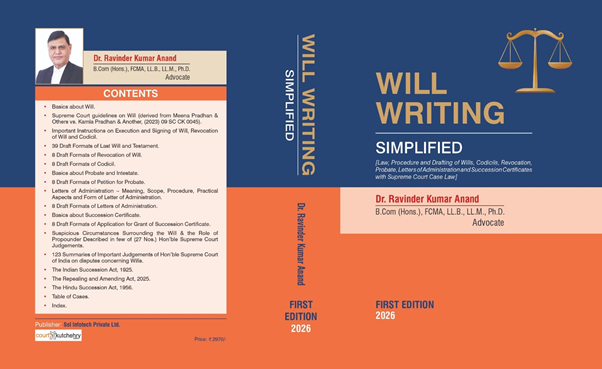
OUR RECOMMENDATION: Check out 123 Key Judgements, as highlighted in the book, WILL WRITING SIMPLIFIED, for the quick research and reference purposes. Click the link here: https://www.courtkutchehry.com/pages/blog/123-supreme-court-judgments-on-wills/
Keywords for Search Optimization
Moonga Devi v. Radha Ballabh case, Supreme Court of India 1972 judgment, Civil Appeal No. 1235 of 1969, Justice K.S. Hegde, Justice A.N. Grover, Justice G.K. Mitter, disputed Will India, probate re-hearing Supreme Court, Section 63 Succession Act, testamentary disputes India, inheritance law precedent.