COURTKUTCHEHRY EXCLUSIVE: EXTRACTS FROM BEST SELLING BOOK: WILL WRITING SIMPLIFIED
Meena Pradhan and Others v. Kamla Pradhan and Another (2023) 09 SC CK 0045: A Landmark on Testamentary Suspicion
Supreme Court Clarifies Burden on Propounder
Unequal Bequests Do Not Equal Suspicion
By Vishwas Kumar
New Delhi: April 08, 2026:
The Supreme Court’s decision in Meena Pradhan and Others v. Kamla Pradhan and Another, Civil Appeal No. 3351 of 2014 has emerged as a touchstone in Indian succession law. Delivered in 2023, the ruling reaffirms the principle that suspicion surrounding a Will must be real, germane, and valid, not speculative or fanciful. This case continues to be cited by lawyers across India because it consolidates precedent on how courts should evaluate allegations of undue influence, forgery, or lack of testamentary capacity.
For a deeper understanding of testamentary law principles, refer to this landmark Supreme Court judgment on wills in the case of Chiranjilal Shrilal Goenka (Deceased) through LRs vs Jasjit Singh and Others, which elaborates on key aspects of proof and validity of wills in India.
Background of the Case
The dispute revolved around a Will executed by the testator on 30 July 1992, just a week before his death. The Will bequeathed property in favor of his second wife and her child, which was challenged by other family members on multiple grounds: proximity to death, alleged unsoundness of mind, non-examination of one attesting witness, and claims of unfair disposition. Both the trial court and appellate court upheld the Will’s validity, and the Supreme Court confirmed these concurrent findings.
Key Observations by the Court
- Execution Close to Death
The Will was executed seven days before the testator’s demise. The Court held that proximity to death alone does not create suspicion if attestation is clear and the testator’s capacity is proven. This reinforced the principle that timing, without supporting evidence of incapacity or coercion, cannot invalidate a Will.
- Attestation and Evidence Act Compliance
Section 68 of the Evidence Act requires examination of at least one attesting witness. The Court found the testimony of Suraj Bahadur Limboo (PW-2) categorical and sufficient, even though the second witness was not examined. This clarified that non-examination of one witness does not automatically taint the Will.
- Mental Fitness and Free Will
Allegations of unsoundness of mind or undue influence were dismissed due to lack of medical or factual evidence. The Court emphasized that the propounder must prove the testator’s sound disposing mind, but once attestation evidence is consistent, the burden shifts to challengers to show incapacity. - Family Disputes and Bigamy Allegations
The defendants argued that the testator’s marriage with Plaintiff 1 was invalid. The Court held that such personal disputes are irrelevant to testamentary proof. The validity of a Will depends on compliance with statutory requirements, not on the fairness of family relationships. - Unequal Bequests
The Will favoured the second wife and her child. The Court reiterated that fairness is not the test; a Will reflects the testator’s conscious choice. Unequal distribution does not raise suspicion unless accompanied by evidence of coercion or manipulation. - Forgery Allegations
Both lower courts found the Will genuine, and the Supreme Court upheld these findings. It stressed that absent material evidence of forgery or undue influence, speculative doubts cannot override statutory compliance. - Judicial Conscience Test
The Court reaffirmed that judicial conscience is invoked only when genuine suspicion exists. Here, due execution and attestation were proved, leaving no room for doubt.
Precedent and Continuing Relevance
This judgment is frequently cited because it consolidates earlier rulings, including Shivakumar v. Sharanabasappa (2020), which held that suspicious circumstances must be “real, germane and valid.” Lawyers rely on Meena Pradhan to argue against speculative challenges to Wills, especially in cases involving unequal bequests or execution close to death.
The case also strengthens the principle of concurrent findings: when both lower courts have upheld a Will after proper appreciation of evidence, the Supreme Court will not interfere unless findings are perverse. This provides stability and predictability in succession disputes.
Why Lawyers Still Cite It
- It clarifies the burden on the propounder when suspicion is alleged.
- It distinguishes between real suspicion and fanciful doubts.
- It affirms that unequal or “unfair” dispositions are legally valid.
- It reinforces statutory compliance under Section 63 of the Succession Act and Section 68 of the Evidence Act.
- It provides a strong precedent for resisting challenges based on family disputes, timing of execution, or speculative allegations.
In essence, Meena Pradhan v. Kamla Pradhan is a landmark that shields genuine testamentary intent from being derailed by speculative objections. It remains a cornerstone in petitions where Wills are contested, guiding courts to focus on evidence rather than conjecture.
RESEARCH RESOURCES:
Explore will litigation cases here. Click the link here: https://www.courtkutchehry.com/pages/blog/123-supreme-court-judgments-on-wills/
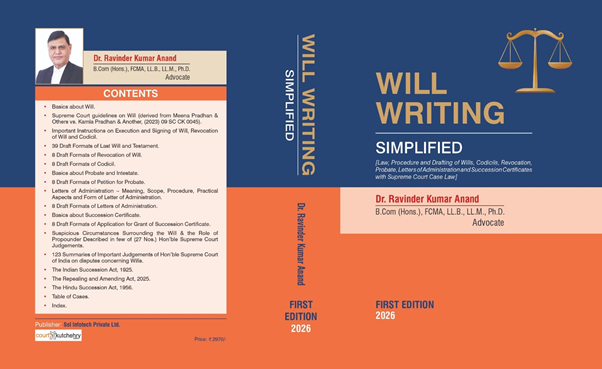
EXTRACTS FROM BOOK, WILL WRITING SIMPLIFIED, By Dr Ravinder Kumar Anand. [📘 Buy Will Writing Simplified online: Amazon | Flipkart ]
Case Title Meena Pradhan and Others v. Kamla Pradhan and Another, (2023) 09 SC CK 0045: Civil Appeal No. 3351 of 2014.
https://www.courtkutchehry.com/judgements/1177443/meena-pradhan-ors-vs-kamla-pradhan-anr/]
| Suspicious Circumstance | Court’s Observation & Para Reference in the Judgement |
|---|---|
| Execution of Will close to death (7 days before death) | The Will dated 30.07.1992 was executed only a week before the testator’s death (07.08.1992). However, the Court found clear and consistent attestation evidence and no indication that the testator lacked capacity or acted under influence; hence, this proximity did not raise suspicion. [Para 1, 12–13] |
| Non-examination of one attesting witness (Lok Bahadur Thapa) | The Court held that only one attesting witness (Suraj Bahadur Limboo, PW-2) is required to prove execution under Section 68 Evidence Act if alive and capable. PW-2’s categorical testimony satisfied legal proof. [Para 1, 8, 12] |
| Challenge to mental fitness / free will of testator | No medical or factual evidence supported the allegation. The Will was voluntary and executed in a sound state of mind. [Para 13] |
| Alleged bigamous marriage / family disputes | Personal disputes were held irrelevant to testamentary validity. [Para 15] |
| Benefit to second wife and her child | Unequal distribution is not suspicious if it reflects the testator’s intent. [Para 10(ix), 13] |
| Alleged forgery or manipulation | No evidence of coercion, fraud, or undue influence found. [Para 13–14] |
| Absence of suspicious features in execution | Court found no real suspicious circumstances; all doubts were speculative. [Para 10(xi), 12–14] |
| Statutory compliance (Sec 63 & Sec 68) | Will must be signed and attested by two witnesses; one witness must be examined. [Para 7–8] |
| Burden on propounder | Must remove all legitimate doubts when suspicion is raised. [Para 10(viii)–(x)] |
| Suspicion must be real | Suspicion must be genuine, not imaginary. [Para 10(xi)] |
| Proof of sound mind | Testator must understand contents and act voluntarily. [Para 10(ix), 11] |
| Concurrent findings upheld | Supreme Court won’t interfere unless findings are perverse. [Para 14] |
FAQ Section
Q1: Why was the Will’s execution close to death not considered suspicious?
Because attestation evidence was clear, and there was no proof of incapacity or coercion. Timing alone cannot invalidate a Will.
Q2: Is it mandatory to examine all attesting witnesses?
No. Section 68 of the Evidence Act requires only one attesting witness to be examined, provided they are alive and capable.
Q3: What if the testator’s mental fitness is challenged?
The challenger must provide medical or factual evidence. Mere allegations are insufficient; the propounder must show the testator acted voluntarily with a sound mind.
Q4: Can family disputes or allegations of bigamy affect the validity of a Will?
No. Personal disputes do not impact testamentary proof. The Will’s validity depends on statutory compliance and genuine execution.
Q5: Does unequal distribution of property make a Will suspicious?
No. Fairness is not the legal test. A Will reflects the testator’s conscious choice, even if unequal.
Q6: What is meant by “suspicious circumstances must be real, not fanciful”?
It means courts will only intervene when genuine evidence of coercion, forgery, or incapacity exists. Speculative doubts are insufficient.
Q7: Why is this case still cited by lawyers?
Because it sets a clear precedent on burden of proof, statutory compliance, and the irrelevance of speculative challenges, making it a powerful authority in succession disputes.
BOOK REFERENCE:
[📘 Buy Will Writing Simplified online: Amazon | Flipkart ]