
Watch the Video
In this 9-minute video, Vineet Kohli, Advocate, presents Episode 2 of “SARFAESI Act Explained with Judgments”. He explains how the Act survived the borrowers’ challenge in the Supreme Court in Mardia Chemicals, how Parliament amended it in 2004, 2012 and 2016, and how a Constitution Bench brought co-operative banks within it. This article walks through the same ground in writing, with links to both judgments on CourtKutchehry.
A Bank That Acts Without a Court
The SARFAESI Act, 2002 allows a bank or financial institution to enforce its security without filing a suit. Once a secured loan turns into a non-performing asset, the lender can send a demand notice, take possession of the mortgaged property and sell it, all on its own. For borrowers, this was a dramatic change from the slow civil-court route.
So it is no surprise that, soon after the Act came into force, borrowers challenged it in the Supreme Court. This episode follows that challenge and then traces how Parliament has reshaped the Act through three major rounds of amendment.
The Challenge to the Act
The borrowers’ case can be put in three complaints:
- No independent hearing before the property was taken.
- The bank was, in effect, a judge in its own cause, deciding its own claim and then enforcing it.
- The remedy before the Debts Recovery Tribunal was illusory, because the old Section 17(2) required the borrower to deposit 75% of the bank’s claim before he could even be heard.
Put together, the argument was that enforcement without a court was arbitrary and violated Article 14 of the Constitution.
Mardia Chemicals v. Union of India (2004)
The Supreme Court decided the challenge in Mardia Chemicals Ltd. v. Union of India, (2004) 04 SC CK 0076, AIR 2004 SC 2371, on 8 April 2004. A three-judge Bench (V.N. Khare, CJI, Brijesh Kumar and Arun Kumar, JJ.) upheld the Act. Parliament was entitled to provide a speedy, non-judicial method of enforcing security, in the larger public interest of recovering money that banks lend out of public deposits.
But the Court did not give banks a blank cheque. It added safeguards that still shape every SARFAESI case:
- Objections must be considered. When the borrower replies to the Section 13(2) demand notice, the secured creditor must consider the objections and communicate its reasons for rejecting them before it takes measures under Section 13(4).
- The 75% pre-deposit was struck down. The old Section 17(2), which made a deposit of 75% of the claim a condition for approaching the Tribunal, was held unreasonable, arbitrary and violative of Article 14. Imposed at the very first stage, it made the remedy illusory.
- The civil-court bar is wide, but not absolute. Reading Section 34, the Court held that a civil suit may still lie in a narrow class of cases, for example where the secured creditor’s action is alleged to be fraudulent, or its claim is so absurd and untenable that it needs no inquiry. Outside that window, the borrower’s forum is the Tribunal.
Remember this line: Mardia Chemicals upheld the Act, but made fairness part of it.
The 2004 Amendment: Parliament Responds
Parliament moved quickly after the judgment. The 2004 amendment:
- inserted Section 13(3A), which writes the Mardia safeguard into the Act: the secured creditor must consider the borrower’s representation or objection and communicate its reasons if it does not accept it;
- rewrote Section 17, so that the remedy before the DRT became an application (not an “appeal”) by any person aggrieved by the measures, to be filed within 45 days; and
- removed the pre-deposit for approaching the DRT.
A pre-deposit still exists, but only at the second level, when a party appeals from the DRT to the Debts Recovery Appellate Tribunal under Section 18.
The 2012 and 2016 Amendments
The 2012 amendment (in force from 15 January 2013)
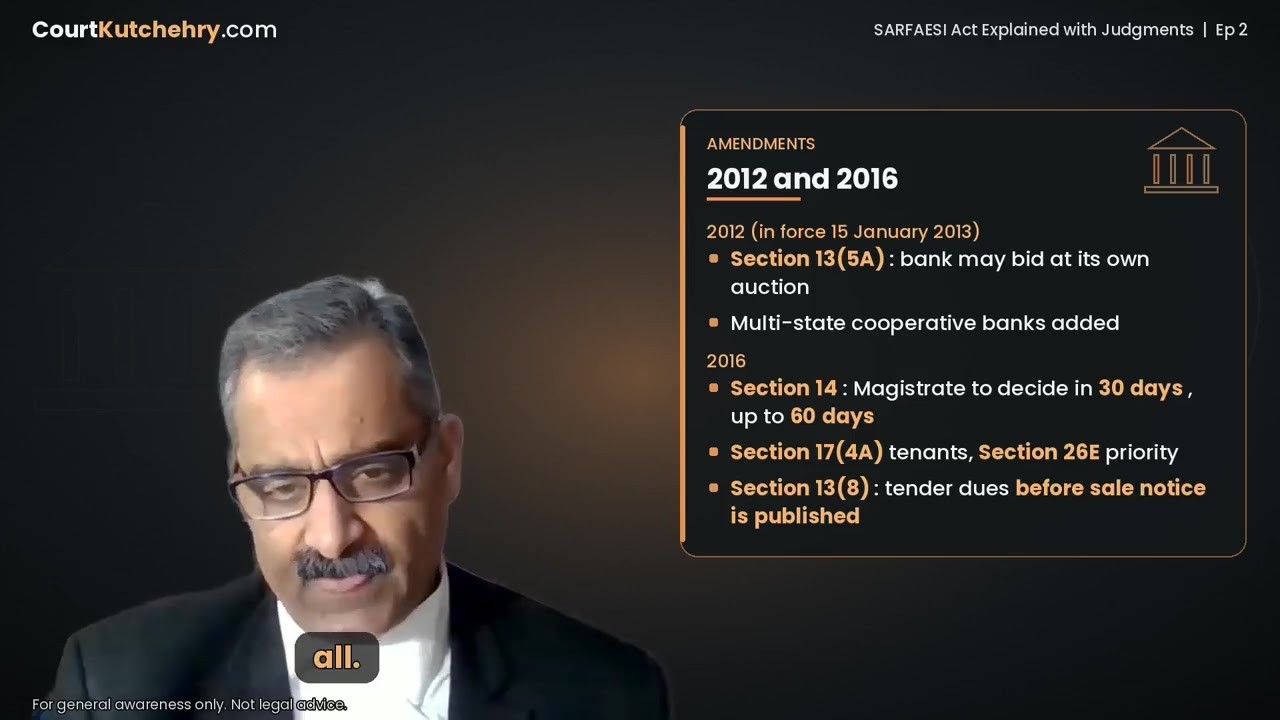
- Section 13(5A) allowed the secured creditor to bid at its own auction of immovable property, where an earlier sale had failed for want of a bid at the reserve price.
- Multi-State co-operative banks were expressly added to the definition of “bank” in Section 2(1)(c).
The 2016 amendment
The 2016 amendment was the largest overhaul of the Act. Among its changes:
- a time limit for the Magistrate under Section 14: the request for help in taking possession must be decided within 30 days, extendable for reasons recorded in writing up to 60 days in all;
- protection for tenants under Section 17(4A), so that a person claiming a tenancy can have his claim examined by the DRT;
- stronger Central Registry (CERSAI) provisions, with registration of security interests by secured creditors under a new Chapter IV-A;
- priority of secured creditors under Section 26E over other debts, revenues, taxes and cesses, once the security interest is registered; and
- a change to the right of redemption under Section 13(8): the borrower must now tender the dues before the publication of the notice for public auction, not up to the date of the sale itself.
Co-operative Banks: The Constitution Bench
For years, borrowers of co-operative banks argued that SARFAESI did not reach them, because co-operative societies are a State subject. A five-judge Constitution Bench settled this in Pandurang Ganpati Chaugule v. Vishwasrao Patil Murgud Sahakari Bank Ltd., (2020) 05 SC CK 0002, decided on 5 May 2020.
The Court held that co-operative banks registered under State laws, and multi-State co-operative banks, are “banks” under Section 2(1)(c) of the SARFAESI Act. Their banking activity falls under Entry 45 of List I (banking), so Parliament was competent to provide this recovery procedure for them. The Court upheld the Central Government’s notification of 28 January 2003 that specified co-operative banks as banks for the Act, and treated it, and the later insertion of multi-State co-operative banks, as made by way of abundant caution.
Practice Points for Advocates
- Check the date of every judgment you cite. A ruling on the old Section 17 or the old Section 13(8) may not apply to a measure taken after the 2004 or 2016 amendments. Match the judgment to the version of the Act that governed your facts.
- Mardia Chemicals remains the foundation. Its reasoning on fair procedure, on the duty to consider objections and on the limited scope of a civil suit is cited in almost every SARFAESI case.
- Do not argue that co-operative banks are outside the Act. After the Constitution Bench in Pandurang Ganpati Chaugule, that argument is closed. Spend the client’s time on real objections: the dues, the NPA date and the notice itself.
Practical Illustration
A borrower receives a Section 13(2) notice, sends detailed objections, and the bank ignores them and takes possession. That is exactly what Mardia Chemicals forbade, and today Section 13(3A) requires the bank to reply with reasons. The borrower can challenge the possession before the DRT under Section 17 within 45 days, and he does not have to deposit anything to be heard.
Now take a co-operative bank that issues a demand notice. If the borrower’s only reply is that “a co-operative bank cannot use SARFAESI”, he has wasted his sixty days. The better course is to examine the account statement, the classification date and the security documents, and to raise genuine objections under Section 13(3A).
Quick Test
- In which case did the Supreme Court uphold the SARFAESI Act? Mardia Chemicals Ltd. v. Union of India (2004).
- Which provision was struck down? The old Section 17(2), which required a 75% pre-deposit before approaching the Tribunal.
- Are co-operative banks covered by the Act? Yes, as held by the Constitution Bench in Pandurang Ganpati Chaugule (2020).
The next episode begins the section-wise study, starting with Section 1 and the scheme of the Act.
Key Takeaways
- Mardia Chemicals (2004) upheld the SARFAESI Act but required the bank to consider the borrower’s objections and give reasons.
- The old 75% pre-deposit for approaching the Tribunal was struck down; since 2004, there is no pre-deposit before the DRT.
- The 2004 amendment added Section 13(3A) and rewrote Section 17; the 2012 amendment allowed banks to bid at their own auctions under Section 13(5A).
- The 2016 amendment added a Magistrate time limit, tenant protection, CERSAI registration, priority under Section 26E and a new redemption cut-off in Section 13(8).
- Co-operative banks are “banks” under the Act (Pandurang Ganpati Chaugule, Constitution Bench, 2020).
Frequently Asked Questions
Is the SARFAESI Act constitutional?
Yes. A three-judge Bench of the Supreme Court upheld it in Mardia Chemicals Ltd. v. Union of India on 8 April 2004, subject to safeguards for the borrower.
Do I have to deposit 75% of the dues to approach the DRT?
No. That condition was struck down in Mardia Chemicals and removed by the 2004 amendment. A pre-deposit applies only to an appeal from the DRT to the Appellate Tribunal under Section 18.
Can I file a civil suit to stop the bank?
Generally, no. Section 34 bars civil courts. After Mardia Chemicals, a suit lies only in narrow cases, such as an allegation of fraud or a claim that is absurd on its face. The regular forum is the DRT.
Until when can a borrower redeem the property after the 2016 amendment?
Under the amended Section 13(8), the borrower must tender the full dues, with costs and charges, before the notice for public auction is published.
Can a co-operative bank use SARFAESI?
Yes. The Constitution Bench in Pandurang Ganpati Chaugule (2020) held that co-operative banks and multi-State co-operative banks are banks under Section 2(1)(c).
Where can I watch the full explanation?
Watch Vineet Kohli, Advocate, explain it in 9 minutes: https://youtu.be/GCVnYP64wnc.
Conclusion
The SARFAESI Act survived its first and biggest test because the Supreme Court found a balance: banks may enforce security without a court, but they must listen to the borrower, give reasons, and leave him a real remedy before the Tribunal.
Parliament has since rebuilt the Act around that balance, in 2004, 2012 and 2016. For an advocate, the practical lesson is simple: always read a SARFAESI judgment against the version of the Act that applied on its date.
▶ Watch the video: Mardia Chemicals and the SARFAESI Amendments of 2004, 2012 and 2016 | SARFAESI Act Explained Ep 2
Research Judgments Like These on CourtKutchehry
Every judgment cited in this article, and lakhs more, can be searched and read on CourtKutchehry. Searching and reading judgments is free. A membership adds unlimited summaries, all related judgments, original court PDF downloads, bookmarks, notes and the CourtKutchehry AI assistant.
| Membership | Price | Works out to | AI credits |
|---|---|---|---|
| Monthly (1 month) | ₹599 | ₹599 / month | 1,000 / month |
| Quarterly (3 months) · Save 16% | ₹1,499 | ₹499.67 / month | 1,100 / month |
| Six-monthly (6 months) · Save 33% | ₹2,399 | ₹399.83 / month | 1,200 / month |
| Yearly (12 months) · Save 44% · Best value | ₹3,999 | ₹333.25 / month | 1,300 / month |
Every plan is a one-off purchase for a fixed period: nothing auto-renews and no card is kept on file. Prices are exclusive of applicable tax, which is added at checkout. Extra AI chat credits can be topped up from ₹99. A free verified account gets 5 summaries and 50 AI trial credits.
Prices are as displayed on courtkutchehry.com on 20 November 2026 and are subject to change without notice. Please check the pricing page for the current plans and offers.
For more judgments, legal opinions and case analysis, visit courtkutchehry.com
Visit CourtKutchehry →