
COURTKUTCHEHRY SPECIAL SERIES ON LANDMARKS JUDGEMENTS ON WILLS, CODICIL & PROBATE
Malayammal & Ors. v. A. Malayalam Pillai & Ors.: Supreme Court Upholds Validity of Charitable Endowment, Strikes Down Samadhi Construction
Samadhi Endowment Declared Invalid by Apex Court
Matam, Guru Pooja, and Feeding the Poor Recognized as Charitable Objects
By Vishwas Kumar
New Delhi: March 30, 2026:
In a landmark ruling delivered on 10 October 1990, the Supreme Court of India in Malayammal & Ors. v. A. Malayalam Pillai & Ors. (Civil Appeal No. 140 of 1977; (1990) 10 SC CK 0069) clarified the scope of charitable endowments under Hindu law. The case revolved around the validity of a Will that directed the creation of an endowment for constructing a Samadhi (memorial tomb) and a Matam (religious rest house), along with provisions for Guru Pooja and feeding the poor.
The Division Bench of the High Court had earlier upheld the endowment in its entirety. However, upon appeal, the Supreme Court—comprising Hon’ble Mr. Justice K. Jagannatha Shetty, Hon’ble Mr. Justice N.D. Ojha, and Hon’ble Mr. Justice R.M. Sahai—took a nuanced view. The Court categorically held that an endowment for constructing a Samadhi does not fall within the ambit of recognized charitable purposes. Such a memorial, though religiously significant to some, was deemed outside the scope of legally valid charitable objects.
On the other hand, the Court emphasized that the directions for establishing a Matam, conducting Guru Pooja, and feeding the poor were separable from the invalid portion and constituted valid charitable purposes under Hindu law. These acts were recognized as serving broader social and spiritual welfare, thereby meriting judicial protection.
Consequently, the Supreme Court reversed the Division Bench judgment and restored the decree of the Single Judge, thereby allowing the appeal with costs. This ruling underscores the principle that while personal or sectarian memorials may not qualify as charitable, activities promoting community welfare and spiritual sustenance do.
The judgment remains a significant precedent in defining the contours of charitable endowments, balancing religious practices with legal recognition of public benefit.
For More, Read Here the Summary of the Judgement from the Book: WILL WRITING SIMPLIFIED, read below or open page no 436, Chapter 14.1 in the book. (Online book purchase link available here on: Buy online: Amazon | Flipkart
|
|
Case Summary |
: |
Malayammal & Ors. v. A. Malayalam Pillai & Ors. |
|
|
Court |
: |
Supreme Court of India |
|
|
Citations |
: |
(1990) 10 SC CK 0069: Civil Appeal No. 140 of 1977. |
|
|
Link |
: |
|
|
|
Decided on |
: |
10 October 1990 |
|
|
Coram |
: |
Hon’ble Mr. Justice K. Jagannatha Shetty, Hon’ble Mr. Justice N.D. Ojha and Hon’ble Mr. Justice R.M. Sahai. |
|
|
Relevant Paragraphs |
: |
Para Nos.2–21 |
1. Facts of the Case:
The appeal arose from a Madras High Court decree in a suit for partition and possession of properties left under a Will dated 3 March 1942 by one Karuppanna Pillai. The Will distributed his A–E schedule properties among family members and created an endowment regarding “E Schedule” properties for construction of his Samadhi (tomb) and a Matam to perform Guru Pooja, poor feeding, and distribution of saffron clothes. The plaintiffs challenged the validity of this endowment, claiming that a trust for a tomb or Samadhi Kainkaryam is void in Hindu law and that E Schedule properties should fall into the residuary clause for family division.
2. Law Points Involved:
Whether a Hindu testator can validly dedicate property for constructing and maintaining his own tomb (Samadhi) and performing rituals thereat, and whether such endowment can be sustained when mixed with charitable and religious purposes like Guru Pooja and poor feeding.
3. Acts / Provisions / Articles Referred:
Hindu Law of Religious and Charitable Trusts; Mayne’s Hindu Law (11th Ed.); general principles under the Hindu law of endowments concerning religious and charitable purposes.
4. Judgments Referred:
(i). N. Subramania Pillai v. A. Draivaisundaram Pillai, (1949) 11 PRI CK 0003.
(ii). Saraswati Ammal v. Rajagopal Ammal, (1953) 10 SC CK 0005.
(iii). Nagu Reddiar v. Banu Reddiar, (1978) 04 SC CK 0026.
(iv). Veluswami Goundan Vs Dandapani by next friend and mother Govindammal and Others, (1946) 01 MAD CK 0035.
5. Obiter Dicta:
The Court reaffirmed that there is no strict separation between religion and charity in Hindu law; charity is a part of religion. Yet, perpetual dedication for a tomb of an ordinary person is not a recognised religious or charitable purpose under Hindu law only that of a saint might be.
6. Ratio Decidendi:
Dedication for construction of a Samadhi for an ordinary person is invalid, but a court must preserve valid charitable or religious intentions expressed elsewhere in the Will. If separable, charitable and religious purposes (e.g., Matam, Guru Pooja to deities, poor feeding) must be upheld even if the tomb-related direction fails. The Court held that the Matam and Samadhi were distinct separated by about 15 feet-and that ceremonies conducted there were for Lord Subramaniaswami and not for the testator. Hence, the charitable trust was valid in part.
7. Final Ruling:
The Supreme Court allowed the appeal, set aside the Division Bench decision, and restored the judgment of the learned Single Judge. The endowment relating to the Samadhi was invalid, but the Matam and associated religious and charitable directions were upheld. The dedication of E Schedule properties for these valid purposes was sustained.
8. Gist (Dispute & Final Decision):
(i). Dispute—whether endowment for construction of Samadhi and Matam under a Will is valid.
(ii). Held—Endowment for Samadhi invalid as not a recognised charitable object; however, directions for Matam, Guru Pooja, and feeding the poor are separable and valid. Division Bench judgment reversed; Single Judge’s decree restored; appeal allowed with costs
Read full Judgement Here:
Malayammal & Ors. v. A. Malayalam Pillai & Ors.
Supreme Court of India
(1990) 10 SC CK 0069: Civil Appeal No. 140 of 1977.
You Can Also Purchase the Book from here on: Buy online: Amazon | Flipkart
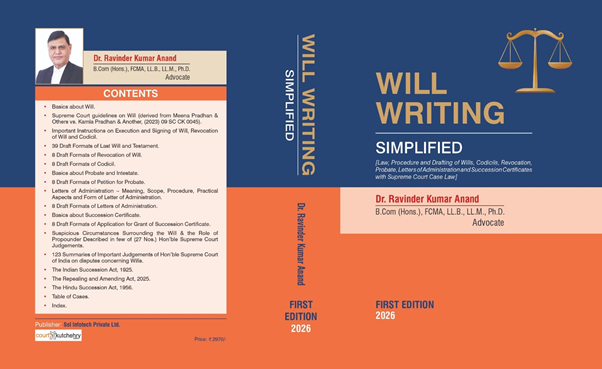
OUR RECOMMENDATION: Check out 123 Key Judgements, as highlighted in the book, WILL WRITING SIMPLIFIED, for the quick research and reference purposes. Click the link here: https://www.courtkutchehry.com/pages/blog/123-supreme-court-judgments-on-wills/
Keywords for Search Optimization
Malayammal v. A. Malayalam Pillai case, Supreme Court of India 1990 judgment, charitable endowment Hindu law, Samadhi endowment invalid, Matam Guru Pooja feeding poor, Civil Appeal No. 140 of 1977, Justice K. Jagannatha Shetty, Justice N.D. Ojha, Justice R.M. Sahai, Indian trust law, religious endowment case.