
COURTKUTCHEHRY SPECIAL SERIES ON LANDMARKS JUDGEMENTS ON WILLS, CODICIL & PROBATE
Mahesh Kumar (Dead) by LRs v. Vinod Kumar and Others: Supreme Court Restores 1992 Will, Upholds Appellant as Sole Legatee
Inheritance Dispute Between Brothers Finally Settled
High Court Reversed; Trial Court Decree Restored by Apex Court
By Vishwas Kumar
New Delhi: March 23, 2026:
On 13 March 2012, the Supreme Court of India delivered a decisive judgment in Mahesh Kumar (Dead) by LRs v. Vinod Kumar and Others (Civil Appeal Nos. 7587–88 of 2004), resolving a contentious inheritance battle between two brothers over the validity of their father’s second Will executed in 1992.
Supreme Court judgments explaining will disputes in India of Mahesh Kumar Case
The dispute arose when the appellant, Mahesh Kumar, claimed exclusive rights to the estate based on the 1992 Will, while his brother Vinod Kumar challenged its genuineness. The High Court had earlier invalidated the Will, citing alleged suspicion and the absence of simultaneous attestation by witnesses. However, the matter reached the Supreme Court, where a Division Bench comprising Justice G.S. Singhvi and Justice S.J. Mukhopadhaya examined the evidence afresh.
The Court held that both attesting witnesses had duly proved the execution of the Will and clarified that Section 63(c) of the Indian Succession Act does not mandate simultaneous attestation. It further observed that the testator had executed the Will freely and consciously, particularly in recognition of the care provided by the appellant during his old age. The Supreme Court found no suspicious circumstances surrounding the document and emphasized that the High Court had erred in discarding the Will without sufficient grounds.
Consequently, the Supreme Court reversed the High Court’s judgment and restored the Trial Court’s decree, thereby upholding Mahesh Kumar as the sole legatee under the 1992 Will. This ruling not only reaffirmed the principles governing attestation of Wills but also underscored the importance of respecting the testator’s autonomy in deciding succession.
By conclusively settling the dispute, the judgment brought clarity to the family conflict and reinforced judicial consistency in interpreting succession laws.
For More, Read Here the Summary of the Judgement from the Book: WILL WRITING SIMPLIFIED, read below or open page no 436, Chapter 14.1 in the book. (Online book purchase link available here on: Buy online: Amazon | Flipkart
|
|
Case Summary |
: |
Mahesh Kumar (Dead) by LRs v. Vinod Kumar and Others. |
|
|
Court |
: |
Supreme Court of India |
|
|
Citations |
: |
(2012) 03 SC CK 0027: Civil Appeal Nos. 7587-88 of 2004. |
|
|
Link |
: |
https://www.courtkutchehry.com/judgements/667710/mahesh-kumar-dead-by-lrs-vs-vinod-kumar-and-others/
|
|
|
Decided on |
: |
13 March 2012 |
|
|
Coram |
: |
Hon’ble Mr. Justice G.S. Singhvi and Hon’ble Mr. Justice S.J. Mukhopadhaya. (Division Bench) |
|
|
Relevant Paragraphs |
: |
Para Nos. 10–13, 18–21, 25–31 |
1. Facts of the Case:
The dispute arose between three sons of late Shri Harishankar—Mahesh Kumar (Appellant), Vinod Kumar and Anand Kumar (Respondents)—regarding the father’s share in joint family property. The controversy centered around two Wills executed by Harishankar: a registered Will dated 9.6.1989 in favour of all three sons, and a subsequent unregistered Will dated 10.2.1992 bequeathing his entire share solely to Mahesh Kumar. Respondent No.1 filed a suit seeking declaration, possession, injunction and rent, asserting exclusive ownership under the 1989 Will. The Appellant contended that his father had validly executed the 1992 Will after being cared for by him and his wife in old age. The trial court upheld the 1992 Will; the High Court reversed, holding it invalid; hence, the appeals before the Supreme Court.
2. Law Points Involved:
(i). Proof of execution and attestation of Wills – Sections 63(c), Indian Succession Act, 1925 and Section 68, Evidence Act, 1872.
(ii). Burden of proof on propounder to remove suspicious circumstances.
(iii). Effect of non-registration of Will.
(iv). Active participation of beneficiary in execution of Will.
(v). Attestation requirement – simultaneous presence of both witnesses not mandatory.
(vi). Principles governing interference with concurrent findings of fact.
3. Acts / Provisions / Articles Referred:
(i). Indian Succession Act, 1925 – Section 63(c)
(ii). Evidence Act, 1872 – Sections 45, 47, 67, 68
(iii). Civil Procedure Code, 1908 – Order XVIII Rule 4
(iv). Madhya Pradesh Land Revenue Code, 1959 – Section 50
(v). Constitution of India – Articles 226 & 227
4. Judgments Referred:
(i). H. Venkatachala Iyengar v. B.N. Thimmajamma, (1958) 11 SC CK 0008.
(ii). Rani Purnima Debi v. Kumar Khagendra Narayan Deb, (1961) 08 SC CK 0021.
(iii). Uma Devi Nambiar v. T.C. Sidhan (2003) 12 SC CK 0031.
https://www.courtkutchehry.com/judgements/654716/uma-devi-nambiar-and-others-vs-tc-sidhan-dead/]
(iv). Naranjan Umeshchandra Joshi v. Mrudula Jyoti Rao, (2006) 12 SC CK 0022; https://www.courtkutchehry.com/judgements/656962/niranjan-umeshchandra-joshi-appellant-hash-mrudula-jyoti-rao-and-others-respondent]
(v). S.R. Srinivasa v. S. Padmavathamma (2010) 04 SC CK 0083.
https://www.courtkutchehry.com/judgements/665477/sr-srinivasa-and-others-vs-s-padmavathamma/]
(vi). Pentakota Satyanarayana v. Pentakota Seetharatnam, (2005) 09 SC CK 0005.
5. Obiter Dicta:
The Court reiterated that exclusion of certain heirs or active participation of a beneficiary in execution of a Will, without more, does not amount to suspicious circumstance. The mere non-registration of a Will or execution before relatives of the beneficiary does not invalidate it when due execution and attestation are proved.
6. Ratio Decidendi:
A Will is proved if the propounder demonstrates due execution and attestation under Section 63(c) of the Succession Act read with Section 68 of the Evidence Act. Simultaneous attestation by both witnesses is not required. Once due execution is proved and the testator was of sound mind, the burden of disproving authenticity shifts to the challenger. When the High Court misreads evidence or imposes extraneous conditions, its interference with trial findings is unwarranted.
7. Final Ruling:
The Supreme Court allowed the appeals, set aside the High Court’s judgment, and restored the trial court decree upholding the validity of the Will dated 10.2.1992 executed by Shri Harishankar in favour of Mahesh Kumar. The Will was held duly executed and attested; no suspicious circumstances were proved. Parties to bear their own costs.
8. Gist / Dispute & Final Decision:
Conflict between two brothers over genuineness of father’s second Will (1992). High Court found Will invalid due to lack of simultaneous attestation and alleged suspicion. Supreme Court held that both attesting witnesses had proved execution; Section 63(c) does not demand simultaneous attestation; Will executed freely by testator, cared for by appellant in old age. High Court judgment reversed; Trial Court decree restored; Appellant upheld as sole legatee under 1992 Will.
Read full Judgement Here:
Mahesh Kumar (Dead) by LRs v. Vinod Kumar and Others.
Supreme Court of India
(2012) 03 SC CK 0027: Civil Appeal Nos. 7587-88 of 2004.
https://www.courtkutchehry.com/judgements/667710/mahesh-kumar-dead-by-lrs-vs-vinod-kumar-and-others/
You Can Also Purchase the Book from here on: Buy online: Amazon | Flipkart
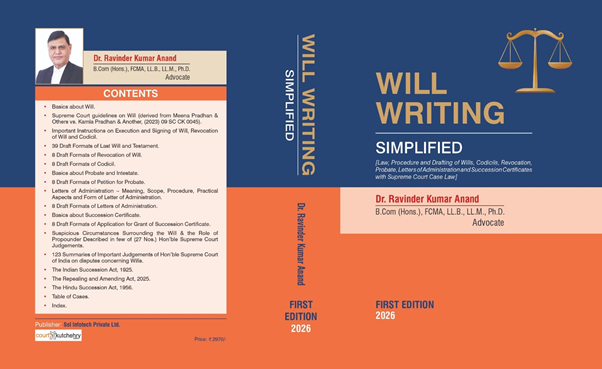
OUR RECOMMENDATION: Check out 123 Key Judgements, as highlighted in the book, WILL WRITING SIMPLIFIED, for the quick research and reference purposes. Click the link here: https://www.courtkutchehry.com/pages/blog/123-supreme-court-judgments-on-wills/
Keywords for SEO & Faster Searches
- Mahesh Kumar v. Vinod Kumar Supreme Court case
- 2012 inheritance dispute judgment India
- 1992 Will validity Supreme Court
- Section 63(c) Indian Succession Act attestation
- Civil Appeal Nos. 7587–88 of 2004
- Supreme Court reverses High Court Will dispute