
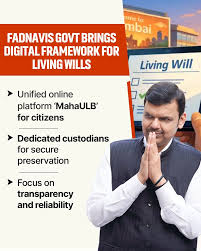
Digital Living Wills: Maharashtra’s Quiet Legal Revolution
Supreme Court’s 2023 guidelines finally find teeth in state-backed infrastructure
Inheritance battles may now be defused at the ICU, not the courtroom
By Vishwas Kumar
New Delhi: May 06, 2026:
Maharashtra’s new digital living will framework is a landmark move in India’s healthcare and inheritance law, ensuring families can make medical and financial decisions with clarity and reduced conflict. By embedding advance directives into state-backed infrastructure, it strengthens compliance with the Supreme Court’s 2023 guidelines and addresses India’s mounting inheritance disputes.
For readers researching property transfer, gift deed validity, and family settlement disputes, the Supreme Court judgment in N.P. Saseendran Vs N.P. Ponnamma & Ors is an important case on whether a document operates as a valid gift deed or merely as a will. The Supreme Court examined issues under the Transfer of Property Act, including gift acceptance, revocation, reservation of limited rights, and unilateral cancellation of a registered deed, making it useful for understanding property inheritance disputes and family property transfer litigation in India.
Analytical Article
India’s inheritance disputes are often seen as courtroom dramas, but their roots lie in hospital wards. Families, confronted with incapacitated loved ones, are forced into emotionally charged financial decisions without guidance. Maharashtra’s decision to digitize living wills through its MahaULB portal is a significant legal and financial intervention that could reshape this landscape.
The Legal Backdrop
The Supreme Court of India’s 2023 revised guidelines simplified the process of creating and enforcing living wills. Key provisions include:
- Execution requirements: Signed before two independent witnesses, attested by a notary or gazetted officer, and submitted to the local magistrate.
- Implementation safeguards: Certification by two independent medical boards — one from the treating hospital and another from the district medical officer — confirming the patient’s condition is terminal and irreversible.
- Checks against misuse: The dual-board system ensures that directives are not enforced prematurely or under family pressure.
These rules were designed to balance patient autonomy with safeguards against coercion. Yet, their effectiveness depended on accessibility and retrievability — areas where Maharashtra has now innovated.
Maharashtra’s Digital Fix
The MahaULB portal allows citizens to upload advance medical directives, with municipal commissioners acting as custodians. This digital infrastructure ensures:
- Secure storage: Prevents disputes over authenticity or claims of coercion.
- Retrievability in emergencies: A living will in a drawer is useless if inaccessible during a crisis.
- Institutional permanence: Timestamped and digitally traceable documents reduce the scope for manipulation in estate battles.
This move transforms living wills from fragile personal papers into enforceable public records.
Why It Matters
India faces a legal crisis in inheritance: over 1.5 million inheritance-related cases pending in 2025, with 50% involving gender-based claims and 25% hinging on ancestral vs. self-acquired property distinctions. Many of these disputes are seeded in ICU waiting rooms, where families disagree on treatment costs and choices. By clarifying patient wishes, digital living wills shift families from conflicted decision-makers to executors of a legal directive.
The fiscal urgency is equally stark. 81% of older adults lack health insurance, leaving families financially exposed. Without documented medical preferences, they risk both emotional trauma and crushing hospital bills.
Lessons for Other States
States like Karnataka, Delhi, and Tamil Nadu, with ageing populations and high private hospital density, must replicate Maharashtra’s model. Tamil Nadu alone recorded 27 lakh pending cases in 2024, with 30% related to divorce and inheritance. Building retrieval infrastructure is not just a moral imperative but a fiscal necessity.
Broader Implications
Maharashtra’s framework does more than reduce disputes. It:
- Strengthens estate planning by removing ambiguity at the most volatile stage.
- Aligns with global best practices, echoing EU norms on medical directives.
- Provides a template for digital governance, where legal documents gain enforceability through state-backed systems.
In short, it bridges the gap between law and lived reality, ensuring that medical crises do not spiral into financial wars.
[LEGAL HELP]
CONTENTS FROM BOOK, WILL WRITING SIMPLIFIED, By Dr Ravinder Kumar Anand. [📘 Buy Will Writing Simplified online: Amazon | Flipkart ]
Draft of Petition for Probate of the Last Will and Testament excluding children and bequeathing the estate to friends, with the Petitioner named as Executor.
IN THE HON’BLE COURT OF THE DISTRICT JUDGE / COMPETENT PROBATE COURT
(Civil Original Jurisdiction)
PROBATE PETITION NO._____ OF 20___
In the matter of the Estate of:
Ms./Mrs. [Name of Deceased]
[Aadhaar No.___/PAN No./Passport No. ____, issued on ____ at _____],
Son/Daughter/Wife of [Father’s or Husband’s Name],
Residing at [Full Residential Address].
… Deceased
THE HUMBLE PETITION OF
Mr./Ms./Mrs. [Petitioner’s Full Name],
[Aadhaar No.___/PAN No./Passport No. _____, issued on ____ at ____]
Son/Daughter/Wife of [Father’s or Husband’s Name],
Residing at [Full Residential Address].
… Petitioner
VERSUS
State & Other …Respondents
Petition for Probate of Last Will and Testament dated _________ under Sections 276 & 278 of the Indian Succession Act, 1925
MOST RESPECTFULLY SHOWETH:
1. That the Petitioner, namely Mr./Ms./Mrs. ___ (holder of Aadhaar No. ___ / PAN No. _____ / Passport No. ______, issued on _____ at ______), residing at __________, is filing the present Petition under Sections 276 and 278 of the Indian Succession Act, 1925, for the grant of Probate of the Last Will and Testament dated ____ executed by the deceased Testator, Mr./Ms./Mrs. ______, S/D/W of _______ (holder of Aadhaar No. _____ / PAN No. ____ / Passport No. _____, issued on ___ at ______).
2. That the Petitioner is filing the present Petition in the capacity of the Executor / Executrix / Beneficiary named under the said Last Will and Testament dated ______ of the above-named deceased Testator.
3. That the Petitioner is the duly appointed Executor/Executrix named in the Last Will and Testament dated [●] (“the said Will”) executed by the Testator Late [Full Name of Testator], hereinafter referred to as "the Testator", who died at [place of death] on [exact date of death], within the jurisdiction of this Hon’ble Court.
4. That the Testator, at the time of execution of the Will and at the time of his death, was a resident of [full residential address] and was possessed of, or otherwise well entitled to, various movable and immovable properties, as more fully described hereinafter.
5. That the Testator left behind a duly executed Last Will and Testament dated [insert date], which was executed voluntarily and consciously in a sound disposing state of mind, free from undue influence, coercion, misrepresentation, fraud or pressure of any nature.
6. That the said Will stands duly executed in the presence of two attesting witnesses, namely:
a. [Full Name of Witness 1], S/W/D/o [●], residing at [full address], bearing [ID details];
b. [Full Name of Witness 2], S/W/D/o [●], residing at [full address], bearing [ID details];
both competent to attest and capable of being summoned to depose if necessary.
7. That the Testator expressly revoked all previous Wills and Codicils, if any, and declared the said Will to be his Last and Final Will.
8. That the Testator, despite having children, namely:
(i). [Full Name of Son], aged ___, residing at ________;
(ii). [Full Name of Daughter], aged ___, residing at ________;
deliberately excluded them from inheritance based on his stated reasons.
9. That the Testator was looked after and cared for during his lifetime by the following friends, in whose favour he has made the bequests:
(i). [Friend 1 Name], [details]
(ii). [Friend 2 Name], [details]
10. That the Testator has, by the said Will, bequeathed his entire estate consisting of the following properties in favour of the said friends:
A. Movable Properties:
• Equity shares, mutual funds – Annexure A(i)
• Bank accounts – Annexure A(ii)
• Fixed deposits – Annexure A(iii)
• Vehicles, jewellery, artworks – Annexure A(iv)
B. Immovable Properties:
• House No. [●], at _____________
• Plot No. [●], at _____________
• Apartment No. [●], at __________
• Industrial Plot No. [●], at ______
• Agricultural land bearing Survey/Khasra/ Khatoni No. [●]
11. That the Testator also bequeathed all after-acquired and subsequently discovered properties to the said beneficiaries.
12. That the Petitioner was appointed as the sole Executor/Executrix with authority to apply for Probate.
13. That no Probate or Letters of Administration has been granted previously by any Court.
14. That this Petition is filed bona fide for obtaining Probate of the said Will so as to administer the estate of the deceased according to law.
15. That the Petitioner has not filed any similar Petition in any Court.
16. That the names and addresses of all surviving legal heirs of the Testator are as follows (though none are entitled to a share under the Will):
(i) ___________________________
(ii) ___________________________
17. That the Petitioner shall rely upon the list of documents annexed herewith, and in the event any further document comes to the knowledge of the Petitioner and/or is required by this Hon’ble Court, the Petitioner seeks liberty to file the same as and when necessary.
18. That the cause of action first arose on the demise of the deceased Testator on __________ at __________, when the Will came into operation, and continues to subsist till the grant of Probate.
19. That the present Petition is within limitation under the Indian Succession Act, 1925 and the Limitation Act, 1963. Without prejudice, the Petitioner craves leave to seek condonation of delay, if any.
20. That to the best of the Petitioner’s knowledge, no caveat has been filed or is pending before this Hon’ble Court. If any caveat is filed subsequently, the Petitioner undertakes to contest the same as per law.
PRAYER
In the aforesaid facts and circumstances, the Petitioner most respectfully prays that this Hon’ble Court may kindly be pleased to:
(i). Grant Probate of the Last Will and Testament dated _____ of the deceased Testator Late Shri/Smt./Ms. __________;
(ii). Appoint the Petitioner as Executor/Executrix to administer the estate of the deceased in accordance with the Will;
(iii). Exempt the Petitioner from furnishing security, as expressly provided in the Will;
(iv). Pass such other and further orders as this Hon’ble Court may deem fit in the interest of justice.
(Petitioner)
Through
(Advocate for the Petitioner)
Place:
Date:
VERIFICATION
I, Mr./Ms./Mrs. _, the Petitioner above-named, do hereby verify that the contents of paragraphs _ to _ of the present Petition are true and correct to my knowledge and belief and nothing material has been concealed.
Verified at __________ on this ___ day of __________ 20__.
(Petitioner)
LIST OF DOCUMENTS
Annexure P-1 Certified Copy of Death Certificate
Annexure P-2 Original / Certified Copy of Last Will and Testament
Annexure P-3 Identity Proof [Aadhaar No./PAN No./Passport No.] & Consent of Executor
Annexure P-4 Identity Proof [Aadhaar No./PAN No./Passport No.] of Petitioner
Annexure P-5 Valuation Report (if required by Court)
Annexure P-6 Affidavit of Attesting Witnesses (if applicable)
Annexure P-7 Identify Proof of the Beneficiary namely Mr. _____ S/o _____ R/o ______(holder of Aadhaar No._/PAN No./Passport No. _______, issued on ______ at _____)
Annexure P-8 Identify Proof of the Beneficiary namely Mr. _____ S/o _____ R/o _______(holder of Aadhaar No._/PAN No./Passport No. ______, issued on _______ at _____)
Annexure P-9 Identify Proof of the Beneficiary namely Mr. ________ S/o ______ R/o _____(holder of Aadhaar No._/PAN No./Passport No. ______, issued on ______ at ______)
Annexure P-10 Any other documents the Petitioner may submit later with Court’s permission.
FAQ: Key Legal Points
Q1. What is a living will?
A living will is a legal document where a person records their medical treatment preferences in case of incapacitation.
Q2. What did the Supreme Court’s 2023 guidelines change?
They simplified execution (witnesses + notary + magistrate submission) and mandated dual medical board certification before enforcement.
Q3. How does Maharashtra’s digital system improve this?
By storing directives on the MahaULB portal with municipal commissioners as custodians, ensuring secure, retrievable, timestamped records.
Q4. Can families override a living will?
No. Once certified by medical boards, the directive is binding. Families act as executors, not decision-makers.
Q5. Why is this important for inheritance disputes?
Ambiguous medical decisions often trigger financial conflicts. A clear directive reduces disputes over who paid, who decided, or who bore costs.
Q6. Do other states have similar systems?
Not yet. Karnataka, Delhi, and Tamil Nadu are urged to build retrieval infrastructure given their high inheritance caseloads.
Q7. What happens if someone doesn’t have a living will?
Families must make decisions collectively, often leading to conflict, financial strain, and later inheritance disputes.
In essence, Maharashtra’s digital living will framework is not just healthcare reform — it is inheritance reform. By embedding clarity into the most vulnerable moments, it promises to reduce both emotional trauma and India’s staggering backlog of property disputes.