

COURTKUTCHEHRY EXCLUSIVE: EXTRACTS FROM BEST SELLING BOOK: WILL WRITING SIMPLIFIED
Supreme Court on Suspicious Wills: Madhukar D. Shende v. Tarabai Aba Shedage
Court rules that absence of medical evidence or proximity to death does not automatically invalidate a Will.
The 2002 judgment emphasizes that suspicion cannot replace proof and testamentary freedom must be respected.
By Vishwas Kumar
New Delhi: April 02, 2026:
When an elderly person executes a Will, families often question whether they were of sound mind or under undue influence. Courts are then asked to decide whether the Will reflects genuine intent or is clouded by suspicion.
important succession law cases
In Madhukar D. Shende v. Tarabai Aba Shedage (2002) [Read judgement here: https://www.courtkutchehry.com/judgements/653626/madhukar-d-shende-vs-tarabai-aba-shedage/ ] , the Supreme Court of India addressed precisely these concerns. The case involved an 80-year-old testator who executed a Will just two days before her death, leaving property to her niece. The lower courts rejected the Will, citing suspicion, but the Supreme Court overturned those findings.
This landmark ruling clarified that suspicion cannot replace legal proof, and that testamentary freedom must be upheld when execution and attestation are duly proved.
Detailed Explanation of the Extract
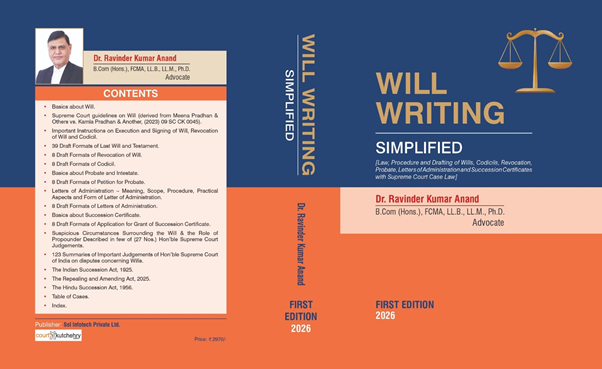
The extract from Will Writing Simplified by Dr. Ravinder Kumar Anand highlights the suspicious circumstances alleged and the Court’s observations. [📘 Buy Will Writing Simplified by Dr. Ravinder Kumar Anand online: Amazon | Flipkart ]
Here is a plain-language breakdown:
- Testator’s Age and Illness: The testator was about 80 years old. The Court held that “there is no rule requiring medical evidence to prove testamentary capacity; soundness can be inferred from facts.” Absence of a doctor’s testimony cannot create suspicion.
- Will Executed Two Days Before Death: The Court said execution close to death does not make a Will suspicious per se. No evidence showed incapacity or coercion.
- Registration at Home: The Sub-Registrar went to the testator’s house. The Court found this valid, noting she was elderly. Questioning this while doubting her capacity was contradictory.
- Beneficiary Not Examined: The niece was ill, but her son testified. The Court held her absence was no ground for suspicion when attesting witnesses proved execution.
- Witnesses as Acquaintances: Attesting witnesses were classmates of the beneficiary’s son. The Court called this reasoning “absurd and far-fetched,” noting they were natural witnesses.
- Sound Mind: No one pleaded incapacity. Registration before the Sub-Registrar confirmed she was of sound mind.
- Bequest to Niece: The niece had cared for the testator for 25–30 years. The Court found the bequest natural, not suspicious.
- Challenge by Stranger: The Will was challenged by a tenant/trespasser. The Court held such objections cannot outweigh valid proof.
- Earlier Litigation: A previous appellate judgment had already upheld the same Will. Ignoring it was a serious error under the Evidence Act.
- Lower Courts’ Error: The Supreme Court condemned the findings as “vitiated by suspicion and conjectures having no foundation in evidence.”
- Burden of Proof: The Court reiterated that the propounder must satisfy the conscience of the court that the Will was duly executed and the testator was of sound mind.
- Suspicion vs Proof: “Law of evidence does not permit conjecture or suspicion having the place of legal proof.”
- Judicial Caution: The Court warned: “The delicate structure of proof should not be demolished by wayward pelting of stones of suspicion.”
- Final Result: The Supreme Court held the Will was duly executed, set aside lower court findings, and decreed ownership in favour of the plaintiff.
Legal Context
- Indian Succession Act, 1925:
- Section 63 requires a Will to be signed by the testator and attested by two witnesses.
- Section 68 of the Evidence Act requires at least one attesting witness to prove execution.
- Doctrine of Suspicious Circumstances:
- Suspicion must be real, not assumed. Minor irregularities do not invalidate a Will.
- Evidence Act, 1872:
- Sections 11, 13 & 35 require courts to consider earlier judgments and documentary evidence.
Case Studies & Examples
- Hypothetical Example: Suppose a grandmother executes a Will a week before her death, leaving property to the niece who cared for her. If witnesses confirm execution and no incapacity is proven, the Will will likely be upheld, following Madhukar Shende.
- Real Case Reference: In this case, despite age, proximity to death, and witness connections, the Court upheld the Will because execution and attestation were proved and the bequest was natural.
Historical & Comparative Context
- Evolution in India: Earlier cases stressed vigilance in suspicious Wills. This case refined the principle, clarifying that suspicion must be based on evidence, not conjecture.
- Comparison with England: English courts also emphasize proof over suspicion. Indian courts highlight cultural norms, such as family members or acquaintances acting as witnesses.
Implications for Society, Families, and Courts
- For Families: The case shows that age or illness does not automatically invalidate a Will. Genuine care and affection can justify bequests.
- For Courts: The judgment warns against replacing proof with suspicion. Judges must balance scepticism with fairness.
- For Society: Encourages individuals to draft Wills clearly, involve trusted witnesses, and register them properly.
FAQ Section
1. Does old age make a Will invalid?
No. Testamentary capacity depends on soundness of mind, not age.
2. Is medical evidence required?
No. “There is no rule of law which requires a doctor to be present when a will is executed.”
3. Does executing a Will close to death raise suspicion?
Not automatically. Unless incapacity or coercion is proven, proximity to death is not suspicious.
4. Can relatives or acquaintances be witnesses?
Yes. It is natural to call known persons to witness a Will.
5. What if the beneficiary is not examined?
If attesting witnesses prove execution, beneficiary’s absence is not fatal.
6. Can strangers challenge a Will?
No. Only persons with legal interest can challenge.
7. What is the burden of proof in suspicious Wills?
The propounder must satisfy the court that the Will was duly executed and the testator was of sound mind.
Conclusion
The Madhukar D. Shende v. Tarabai Aba Shedage case remains a landmark in Indian succession law. It clarified that suspicion cannot replace proof, and that testamentary freedom must be respected when execution and attestation are duly proved.
For families, the case underscores the importance of drafting Wills transparently and involving credible witnesses. For courts, it reinforces vigilance without conjecture. Ultimately, the judgment ensures that genuine Wills reflecting the testator’s intent are upheld.
Book Reference
📘 Buy Will Writing Simplified by Dr. Ravinder Kumar Anand online: Amazon | Flipkart
Sentences Used from the Extract
- “There is no rule requiring medical evidence to prove testamentary capacity; soundness can be inferred from facts.”
- “Execution two days before death does not make the will suspicious per se; no evidence showed incapacity or coercion.”
- “Registration at home was perfectly valid.”
- “Beneficiary (Chingubai) was ill; her son deposed. The Court held her non-appearance is no ground for suspicion when attesting witnesses have proved due execution.”
- “The Court termed this reasoning absurd and far-fetched — they were family acquaintances and natural witnesses.”
- “Registration before Sub-Registrar confirmed she was in a sound disposing state of mind.”
- “Bequest was natural — the niece cared for the testator for 25–30 years.”
- “Challenge by a rank trespasser with no locus standi to question the will.”
- “Previous appellate judgment had accepted the same will as genuine.”
- “Suspicion cannot replace legal proof.”
- “Law of evidence does not permit conjecture or suspicion having the place of legal proof.”
- “The delicate structure of proof should not be demolished by wayward pelting of stones of suspicion.”
- “Supreme Court held the will was duly executed, set aside concurrent findings of lower courts, and decreed ownership and possession in plaintiff’s favour.”
Suggested Keywords for SEO
- Will disputes in India
- Supreme Court Will judgment
- Madhukar Shende case
- Suspicious circumstances in Wills
- Indian Succession Act Will validity
- Testamentary freedom India
- Probate of Wills India
- Will writing simplified India