
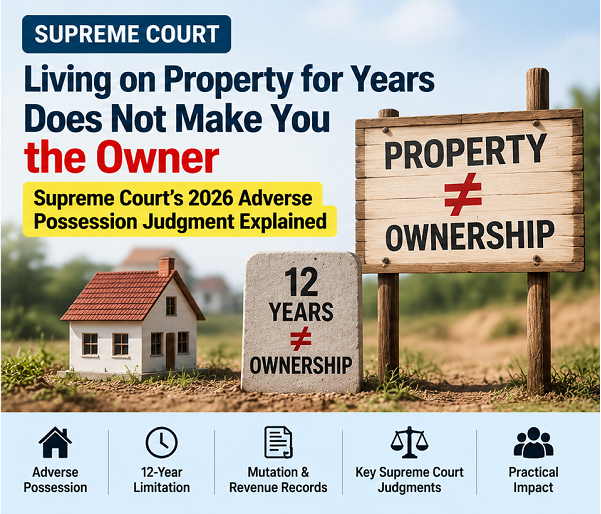
Quick Answer
The Supreme Court's recent judgment in the case of Bhag Singh (Dead) through Mahant Kashmir Singh v. Basant Kaur (Dead) through LRs & Ors. clarifies that mere possession of property for 12 years does not automatically confer ownership. Adverse possession requires specific legal conditions to be met.
Key Takeaways
- Possession must be hostile, open, continuous, and exclusive to claim adverse possession.
- The 12-year limitation period does not automatically start upon occupation; it begins when possession becomes adverse to the true owner.
- Revenue records like Jamabandi and mutation do not inherently prove ownership.
Case Background
In Bhag Singh (Dead) through Mahant Kashmir Singh v. Basant Kaur (Dead) through LRs & Ors., the dispute involved a claim of adverse possession over a property by the respondents who had been in possession for several decades. The appellants contended that the respondents' occupation was permissive and not adverse.
What Supreme Court Decided
The Supreme Court, comprising a bench led by Justice N.V. Ramana, held that the respondents did not acquire ownership through adverse possession as they could not prove that their possession was hostile to the true owner. The Court emphasized the need for clear, unequivocal evidence of hostile possession.
What Is Adverse Possession?
Under Indian law, adverse possession allows a person to claim ownership of property if they have possessed it openly, continuously, and hostilely for a specified period, usually 12 years. However, this doctrine is narrowly construed to prevent unlawful seizure of property.
Does 12 Years of Possession Automatically Make You the Owner?
No, occupying a property for 12 years does not automatically make you the owner. The occupant must demonstrate possession that is adverse to the rights of the true owner.
Essential Requirements for Adverse Possession
Actual Possession
The claimant must physically occupy the property.
Open Possession
Possession must be visible and apparent to the owner.
Continuous Possession
The occupation must be unbroken for the statutory period.
Exclusive Possession
Possession must not be shared with the owner or others.
Hostile Possession
The possession must be without the owner's consent and against their interests.
When Does the 12-Year Limitation Period Start?
The limitation period starts when the possession becomes adverse or hostile to the true owner, not merely upon occupation.
Permissive vs Hostile Possession
Permissive possession, such as a lease, does not constitute adverse possession. However, if the occupant begins to assert ownership rights openly and notoriously, it may become hostile.
Revenue Records & Ownership
Revenue records like Jamabandi and Khasra Girdawari are primarily fiscal documents, not conclusive evidence of title. They indicate possession but do not confer ownership.
Relevant Limitation Act Provisions
The Limitation Act, 1963, particularly Sections 3 and 27, governs adverse possession claims, stipulating the 12-year period for suits related to immovable property.
Important Supreme Court Judgments
| Case Name | Court | Year | Issue | Key Principle | Outcome / Relevance |
|---|---|---|---|---|---|
| Karnataka Board of Wakf v. Government of India | Supreme Court | 2004 | Adverse Possession | Hostile to true owner | Clarified hostile possession requirement |
| Annasaheb Bapusaheb Patil v. Balwant | Supreme Court | 1995 | 12-year Limitation | Continuous possession | Continuous possession alone not enough |
| Amrendra Pratap Singh v. Tej Bahadur Prajapati | Supreme Court | 2004 | Permissive Possession | Cannot be adverse | Distinguished permissive and adverse possession |
| Gaya Parshad Dikshit v. Dr. Nirmal Chander | Supreme Court | 1984 | Burden of Proof | On claimant | Claimant must prove adverse possession |
| P.T. Munichikkanna Reddy v. Revamma | Supreme Court | 2007 | Revenue Records | Not conclusive of title | Revenue records are fiscal, not title documents |
Practical Impact
This judgment highlights the importance for property owners and occupants to understand the legal nuances of adverse possession. Property lawyers should ensure clients are aware that long-term occupancy alone does not establish ownership. Buyers must verify the title and mutation records thoroughly.
FAQs
- Can I become owner after possessing property for 12 years? No, unless the possession was adverse to the true owner's rights.
- What is adverse possession? It's a legal doctrine allowing possession to ripen into ownership under certain conditions.
- When does the 12-year period begin? When possession becomes adverse to the owner.
- Can a tenant claim adverse possession? Generally no, as the possession is permissive.
- Can a relative claim adverse possession? Only if the possession is hostile and without consent.
- Does mutation prove ownership? No, mutation is a fiscal entry, not a title document.
- Does Jamabandi establish title? No, it indicates possession, not ownership.
- Who has to prove adverse possession? The person claiming it bears the burden of proof.
Conclusion
The Supreme Court's 2026 judgment reiterates the stringent requirements for adverse possession claims in India, underscoring that mere long-term occupation does not equate to ownership. Legal practitioners and property stakeholders must be diligent in understanding these legal standards to effectively navigate property disputes.
For further insights into adverse possession and related legal precedents, explore the comprehensive resources available on CourtKutchehry.