
Watch the Video
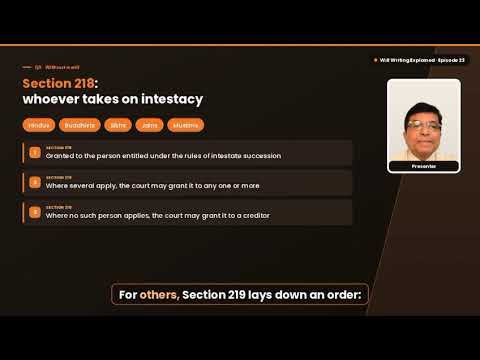
In this 11-minute video, CourtKutchehry presents Episode 23 of “Will Writing Explained”: what happens if a will names no executor, or there is no will at all? Then the court grants letters of administration. The episode explains how they differ from probate, who can apply with the will annexed (Section 232 of the Indian Succession Act, 1925) and without a will (Sections 218 and 219), the administrator’s bond, inventory and account (Sections 291 and 317), the administrator’s powers, and whether a Hindu family with no will really needs letters of administration. This article covers the same points in writing.
▶ Watch on YouTube: Letters of Administration: No Executor or No Will? | Will Writing Ep 23
Probate and Letters of Administration: The Difference
Both are grants by a court that authorise a person to administer a dead person’s estate. The difference lies in who receives the grant and why.
| Point | Probate | Letters of administration |
|---|---|---|
| Is there a will? | Yes | Yes (with the will annexed) or no (intestacy) |
| Who receives it? | Only the executor named in the will (Section 222) | An administrator chosen under the Act |
| Where does authority come from? | The will appoints the executor; probate confirms it | The court’s grant itself |
| Security | Bond usually not required, but the court may ask for one in certain cases | Administration bond with sureties (Section 291) |
An executor derives title from the will and can act even before probate in many matters. An administrator’s authority begins with the grant, though Section 220 makes the grant relate back to the date of death.
Remember this line: the executor is chosen by the testator; the administrator is chosen by the court.
With the Will Annexed: Section 232
Sometimes there is a valid will but no executor able to act. Section 232 covers cases where:
- the testator has not appointed an executor;
- the executor is legally incapable or refuses to act; or
- the executor dies before proving the will, or before administering the estate fully.
In such cases a universal or residuary legatee may prove the will and receive letters of administration with the will annexed. If there is no such legatee, or none willing, Section 234 allows the grant to a person who would be entitled on intestacy, to any other legatee with a beneficial interest, or to a creditor. The will is proved in the same way as in a probate case, and the administrator must then carry it out.
Without a Will: Sections 218 and 219
When a person dies intestate, the Act lays down who may receive letters of administration. It draws a line by community.
Section 218: Hindus, Muslims, Buddhists, Sikhs, Jains and exempted persons
Administration may be granted to any person who, under the rules for distribution of the estate applicable to the deceased, would be entitled to the whole or any part of it. If several such persons apply, the court may grant it to one or more of them. If none applies, it may be granted to a creditor.
Section 219: other deceased persons
For others, such as Christians and Parsis, Section 219 sets an order of preference. The widow is preferred unless the court excludes her for personal disqualification or because she has no interest in the estate. The court may join others with her. If there is no widow, or she is excluded, the grant goes to those beneficially entitled under the rules of distribution, with kindred of equal degree being equally entitled. A husband surviving his wife has the same right as a widow. A creditor comes last.
The Administrator’s Bond: Section 291
Because the court is entrusting someone with other people’s property, Section 291 requires every person who receives letters of administration (other than certain limited grants) to give a bond, with one or more sureties, to the District Judge for the due collection, getting in and administration of the estate. For a deceased Hindu, Muslim, Buddhist, Sikh or Jain, the Judge may also require a bond from a person receiving probate.
If the bond is breached, the court can assign it to a person who can sue on it for the benefit of everyone interested in the estate (Section 292).
Inventory and Account: Section 317
Within six months of the grant, the executor or administrator must file in court a full and true inventory of the property in his possession and of all credits and debts owing to the deceased. Within one year of the grant, he must file an account of the estate showing the assets that came into his hands and how he has applied or disposed of them. The court can extend both periods.
Wilfully failing to file the inventory or account, or filing one that is untrue in a material respect, is itself a ground to revoke the grant under Section 263, and intentional omissions or false statements are an offence under the Act.
The Administrator’s Powers
An administrator has broadly the same powers as an executor: to collect the deceased’s property and debts, sue and be sued, pay debts and expenses, and distribute the estate (Sections 305 to 307). But there is an important limit. Under Section 307(2), where the deceased was a Hindu, Muslim, Buddhist, Sikh, Jain or exempted person, an administrator may not, without the previous permission of the court:
- mortgage, charge or transfer by sale, gift, exchange or otherwise any immovable property of the estate; or
- lease any such property for a term exceeding five years.
A disposal in breach of this rule is voidable at the instance of any other person interested in the property. An administrator also may not buy estate property for himself; such a purchase is voidable too (Section 310).
Does a Hindu Family With No Will Need Letters of Administration?
Usually, no. Section 212(1) says no right to an intestate’s property can be established in court unless letters of administration have been granted, but Section 212(2) makes that rule inapplicable to the intestacy of Hindus, Muslims, Buddhists, Sikhs, Jains, Indian Christians and Parsis.
So when a Hindu dies without a will, the heirs under the Hindu Succession Act, 1956 can establish their rights directly. In practice they use:
- a succession certificate under Part X of the Act for debts and securities, such as bank deposits and shares, where the institution insists on one;
- legal heir certificates issued by revenue authorities, plus nomination and indemnity procedures, for many bank and pension matters; and
- mutation in land and municipal records on the basis of inheritance.
Letters of administration can still be useful where the estate is large or complex, where heirs disagree and someone needs clear authority to manage the property, or where a foreign institution requires a court grant.
Key Takeaways
- Letters of administration are granted where there is no executor (with the will annexed) or no will at all.
- With a will, a universal or residuary legatee applies first (Section 232), then others under Section 234.
- On intestacy, Hindus and others apply under Section 218; Christians and Parsis follow the order in Section 219.
- Administrators give a bond (Section 291) and file an inventory within six months and an account within one year (Section 317).
- For a Hindu intestate, letters of administration are not compulsory (Section 212(2)).
Frequently Asked Questions
What is the difference between probate and letters of administration?
Probate is granted only to the executor named in a will. Letters of administration are granted by the court to an administrator where there is no executor or no will.
Who can apply if the will names no executor?
A universal or residuary legatee under Section 232; failing that, an heir, another legatee or a creditor under Section 234.
Does an administrator need the court’s permission to sell property?
Yes, where the deceased was a Hindu, Muslim, Buddhist, Sikh, Jain or exempted person, for sale, mortgage or other transfer of immovable property, or a lease above five years (Section 307(2)).
What must an administrator file in court?
An inventory within six months and an account within one year of the grant, unless the court extends time (Section 317).
Do Hindu heirs need letters of administration when there is no will?
Not as a legal requirement, because Section 212(2) excludes Hindu intestacy from the rule. A succession certificate may still be needed for some debts and securities.
Where can I watch the full explanation?
Watch the video explain letters of administration in 11 minutes: https://youtu.be/S1qlsgmbSFQ.
Conclusion
Letters of administration fill the gap when a will has no one to carry it out, or when there is no will at all. The court chooses the administrator, takes security through a bond, and keeps watch through the inventory and account.
For most Hindu families without a will, the law does not require letters of administration. But where the estate is complicated or the family is divided, a court grant can bring order and clear authority. Knowing the options helps a family choose the simplest safe route.
▶ Watch the video: Letters of Administration: No Executor or No Will? | Will Writing Ep 23
Research the Law on CourtKutchehry
CourtKutchehry gives you lakhs of Indian judgments, searchable for free. A membership adds unlimited summaries, all related judgments, original court PDF downloads, bookmarks, notes and the CourtKutchehry AI assistant.
| Membership | Price | Works out to | AI credits |
|---|---|---|---|
| Monthly (1 month) | ₹599 | ₹599 / month | 1,000 / month |
| Quarterly (3 months) · Save 16% | ₹1,499 | ₹499.67 / month | 1,100 / month |
| Six-monthly (6 months) · Save 33% | ₹2,399 | ₹399.83 / month | 1,200 / month |
| Yearly (12 months) · Save 44% · Best value | ₹3,999 | ₹333.25 / month | 1,300 / month |
Every plan is a one-off purchase for a fixed period: nothing auto-renews and no card is kept on file. Prices are exclusive of applicable tax, which is added at checkout. Extra AI chat credits can be topped up from ₹99. A free verified account gets 5 summaries and 50 AI trial credits.
Prices are as displayed on courtkutchehry.com on 20 November 2026 and are subject to change without notice. Please check the pricing page for the current plans and offers.
For more judgments, legal opinions and case analysis, visit courtkutchehry.com
Visit CourtKutchehry →