
Beyond the Uniform: Legal Norms and Judicial Precedents in the School Headscarf Discourse
Balancing Institutional Discipline, Religious Freedom, and State Mandates
By Legal Editor
New Delhi: August 25, 2026:
The ongoing jurisprudence surrounding religious attire within educational institutions underscores a profound legal tension between fundamental individual rights and institutional regulation. Across Indian constitutional law, courts have repeatedly examined whether individual dress modifications based on religious claims can override prescribed, uniform dress codes in schools and colleges. At its heart, this debate pits individual religious expression under Article 25 and freedom of speech under Article 19(1)(a) against an institution’s statutory authority to enforce neutral dress codes aimed at fostering discipline, equality, and institutional identity.
The legal framework relies heavily on judicial doctrines developed over decades to evaluate when state or institutional rules impermissibly infringe upon fundamental freedoms. When a student seeks an exemption from a uniform code, the judiciary must determine whether the claimed practice is legally protected under the Constitution or whether it falls within the permissible domain of institutional administration.
Judicial Standards and Key Precedents Shaping School Dress Codes
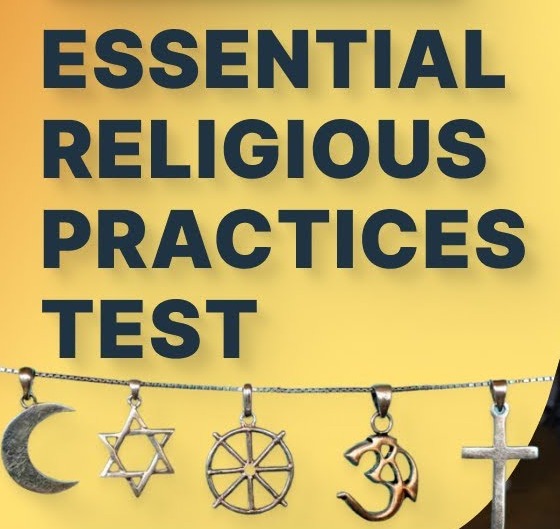
Central to the legal evaluation of religious exemptions in India is the Essential Religious Practices (ERP) doctrine. Developed by the Supreme Court, this test requires petitioners to place concrete, authoritative material before the court proving that a specific practice is core to the faith—meaning its omission would fundamentally alter the religion itself. In recent decisions, including rulings by the Allahabad High Court in Sukaina Rizvi v. State of U.P., courts have reiterated that simple assertions of religious obligation are insufficient to satisfy this evidentiary burden.
To arrive at these conclusions, courts frequently rely on persuasive precedents across various jurisdictions. Decisions such as the Karnataka High Court’s landmark ruling in , the Kerala High Court’s judgment in , and the Bombay High Court’s decisions in and collectively build a clear standard: bona fide, non-discriminatory uniform policies designed to promote a secular, religion-neutral environment take precedence over individual requests for dress modification when essentiality is not established.
Detailed Analysis of Governing Statutes, Constitutional Articles, and Legal Principles
Article 25(1) of the Constitution of India: Guarantees to all persons equal freedom of conscience and the right freely to profess, practise, and propagate religion. However, this right is explicitly subject to public order, morality, health, and other fundamental rights provisions.
Essential Religious Practices (ERP) Doctrine: A judicial test formulated to distinguish between essential religious beliefs/practices and secular activities associated with religion. Protection under Article 25 extends only to practices that are integral and essential to the faith.
Article 19(1)(a) of the Constitution of India: Protects freedom of speech and expression, which encompasses personal choice in attire. This right is subject to reasonable restrictions under Article 19(2) imposed by law in the interest of public order, decency, or morality.
Article 14 of the Constitution of India: Secures equality before the law and equal protection of the laws. In uniform dress code matters, Article 14 ensures that institutional policies are applied neutrally without arbitrary distinction or discrimination against any specific group.
Resham v. State of Karnataka (2022): Full Bench decision of the Karnataka High Court holding that wearing a headscarf is not an essential religious practice in Islam and upholding state/institutional authority to enforce uniform dress codes in educational institutions.
Fathima Thasneem v. State of Kerala (2018): Ruling by the Kerala High Court establishing that individual rights under fundamental freedom provisions cannot override the rights of an educational institution to administer its premises and prescribe uniform dress codes.
Doctrine of Estoppel and Past Leniency: A legal principle establishing that an institution's prior non-enforcement, acquiescence, or informal accommodation regarding a dress code does not waive its legal authority to strictly enforce the uniform policy in the future.
Precedential Weight of Interim Supreme Court Orders: Legal doctrine confirming that provisional interim orders passed by the Supreme Court without detailed legal reasoning do not constitute binding precedent under Article 141 of the Constitution.
Comprehensive FAQ: Key Legal Points and Principles Index
Q1: What is the Essential Religious Practices (ERP) doctrine and how do courts apply it?
The Essential Religious Practices (ERP) doctrine is a judicial test developed by the Supreme Court of India to determine whether a particular practice forms an integral, non-negotiable part of a religion. To claim protection under Article 25 of the Constitution, a petitioner must present authoritative scriptural or legal evidence demonstrating that the practice is obligatory and that its omission would alter the fundamental character of the faith.
Q2: Can a school or educational institution enforce a strict uniform policy over individual religious attire?
Yes. Courts have consistently held that educational institutions have the administrative authority to prescribe uniform dress codes, provided the rules are bona fide, non-discriminatory, and intended to maintain discipline, equality, and institutional identity. Where essential religious practice is not proven, institutional uniform policies supersede individual requests for dress modifications.
Q3: Does a school’s past failure to enforce a uniform policy grant students a permanent legal right to wear non-uniform attire?
No. Courts have clarified that past non-enforcement, administrative oversight, or informal tolerance by school authorities does not create a legal estoppel against the institution. Schools retain the legal authority to enforce official uniform regulations whenever they choose to do so.
Q4: How do courts view the purpose of a uniform dress code in educational institutions?
Judiciaries view prescribed uniforms as an effective tool to foster institutional discipline, eliminate visible socioeconomic or religious distinctions among students in the classroom, and promote a religion-neutral environment conducive to equal learning.
Q5: What is the legal significance of an interim order of the Supreme Court compared to High Court judgments?
An interim order issued by the Supreme Court that does not contain conclusive legal reasoning is provisional in nature. Under Indian jurisprudence, such orders do not establish binding legal precedent under Article 141 of the Constitution, leaving reasoned judgments from High Courts as strong persuasive authorities until a definitive Supreme Court Bench settles the issue.