
Watch the Video
In this 15-minute video, Episode 35 of the “AIBE Explained” series, the episode takes up two topics that appear in almost every AIBE paper but have no heading of their own in the syllabus: Latin legal maxims and the interpretation of statutes. It covers them in five questions (maxims from torts and contract, from criminal law and evidence, and from procedure and property, then the primary rules of interpretation, and the subsidiary rules and aids) and then solves five practice questions in the style of past AIBE papers. This article sets out the same law in writing.
Why These Two Topics Are Asked in Every Paper
Almost every AIBE paper has at least one question asking what a Latin maxim means, and one asking which rule of interpretation applies to a given situation. Because neither has its own heading in the syllabus, many candidates skip them, though they are among the quickest marks in the paper. Learn each maxim with its meaning and the provision where it lives in Indian law.
Q1: Maxims from Torts and Contract
Torts
- Injuria sine damno: violation of a legal right without actual loss. It is actionable, because the infringement of the right is itself the injury.
- Damnum sine injuria: actual loss without violation of a legal right. It is not actionable.
- Volenti non fit injuria: a person who voluntarily consents to a risk cannot later complain of harm from it. Consent must be free and to the particular risk.
- Res ipsa loquitur: “the thing speaks for itself”. Where an accident would not ordinarily happen without negligence, and the thing was under the defendant’s control, negligence may be inferred.
- Respondeat superior: let the master answer; the basis of vicarious liability of an employer for acts done in the course of employment.
Contract and sale of goods
- Consensus ad idem: meeting of minds on the same thing in the same sense, the idea behind Section 13 of the Indian Contract Act, 1872.
- Quantum meruit: “as much as he has earned”; reasonable payment for work done where the contract cannot be enforced or is discharged.
- Nemo dat quod non habet: no one can give what he does not have; a seller who is not the owner cannot pass a better title (Section 27, Sale of Goods Act, 1930, with its exceptions).
- Caveat emptor: let the buyer beware (Section 16, Sale of Goods Act).
- Uberrimae fidei: utmost good faith, as in contracts of insurance.
Remember this line: injuria sine damno is actionable; damnum sine injuria is not.
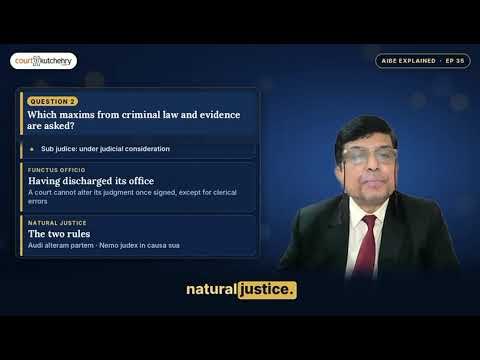
Q2: Maxims from Criminal Law and Evidence
- Actus non facit reum nisi mens sit rea: an act does not make a person guilty unless the mind is also guilty; the foundation of mens rea.
- Nullum crimen sine lege: no crime without a law. In India this is reflected in Article 20(1): no one can be convicted except for violating a law in force when the act was done, nor given a penalty greater than the one then in force.
- Autrefois acquit: a person once acquitted cannot be tried again for the same offence. Article 20(2) protects against being prosecuted and punished twice; the wider statutory rule on prior acquittal or conviction is in Section 337 of the BNSS (formerly Section 300 CrPC).
- Nemo tenetur seipsum accusare: no one is bound to accuse himself; reflected in Article 20(3).
- Res gestae: facts so connected with a fact in issue that they form part of the same transaction are relevant (Section 4 of the Bharatiya Sakshya Adhiniyam, 2023, formerly Section 6 of the Evidence Act).
- Functus officio: an authority that has decided a matter cannot reopen it, except as the law permits.
- Audi alteram partem and nemo judex in causa sua: the two pillars of natural justice; hear the other side, and no one should be a judge in his own cause.
Falsus in uno, falsus in omnibus
“False in one thing, false in everything.” In India it is not a rule of law. The Supreme Court has repeatedly said that courts must separate the grain from the chaff and may accept the reliable part of a witness’s testimony.
Q3: Maxims from Procedure and Property
- Res judicata: a matter finally decided between the same parties cannot be tried again (Section 11, CPC).
- Res sub judice: where a matter is directly and substantially in issue in an earlier pending suit, the later suit is stayed (Section 10, CPC).
- Lis pendens: during a pending suit about immovable property, a transfer by a party cannot affect the rights of the other party under the eventual decree (Section 52, Transfer of Property Act, 1882).
- Delegatus non potest delegare: a delegate cannot further delegate; it applies to agents (Section 190, Contract Act) and to delegated legislation.
- Ratio decidendi and obiter dictum: the reason for the decision binds; observations made in passing do not bind, though they may persuade.
- Stare decisis: stand by what has been decided; in India, Article 141 makes the law declared by the Supreme Court binding on all courts.
- Per incuriam: a decision given in ignorance of a binding statute or precedent loses its binding force.
- Doli incapax: incapable of crime. Under Section 20 of the BNS, nothing done by a child under seven is an offence; Section 21 protects a child above seven and under twelve who has not attained sufficient maturity of understanding.
- Qui prior est tempore potior est jure: first in time is stronger in law; the principle of priority of rights in Section 48 of the Transfer of Property Act.
Q4: The Primary Rules of Interpretation
- Literal rule. Words are given their plain, ordinary meaning. If the language is clear, the court applies it even if the result seems harsh.
- Golden rule. The literal meaning is modified only to avoid an absurdity or inconsistency. The classic statement is in Grey v. Pearson (1857).
- Mischief rule. From Heydon’s case (1584): the court asks what the law was before the Act, what mischief it did not provide for, what remedy Parliament chose, and the true reason for the remedy, and then reads the Act to suppress the mischief and advance the remedy.
- Purposive rule. The modern approach: read the words in light of the object and purpose of the statute as a whole.
Beneficial, penal and taxing statutes
Beneficial and welfare laws are construed liberally in favour of the class they protect. Penal statutes and taxing statutes are construed strictly. On tax exemptions, a Constitution Bench in Commissioner of Customs v. Dilip Kumar and Company, (2018) 07 SC CK 0094, held that an exemption notification must be interpreted strictly, the burden is on the assessee to show that he falls within it, and an ambiguity in an exemption provision is resolved in favour of the revenue.
Q5: Subsidiary Rules and Aids to Interpretation
Subsidiary rules
- Ejusdem generis: general words following specific words of one class are read as limited to that class (“cars, buses, lorries and other vehicles” means road vehicles of that kind).
- Noscitur a sociis: a word is known by the company it keeps.
- Expressio unius est exclusio alterius: express mention of one thing excludes others.
- Generalia specialibus non derogant: a general provision does not override a special provision on the same subject.
- Ut res magis valeat quam pereat: a construction that makes the law work is preferred to one that makes it fail.
Three constitutional doctrines
- Harmonious construction: provisions that seem to conflict are read together so that both can operate.
- Pith and substance: to decide which legislature had power, the court looks at the true nature of the law, and an incidental effect on another List does not invalidate it. The doctrine is associated with Prafulla Kumar Mukherjee v. Bank of Commerce (Privy Council, 1947), where a provincial money-lenders law was upheld although it incidentally touched promissory notes, a central subject.
- Colourable legislation: what a legislature cannot do directly, it cannot do indirectly.
Aids to interpretation
Internal aids are within the Act (preamble, headings, definitions, provisos, explanations, illustrations, schedules); external aids are outside it (Statement of Objects and Reasons, committee reports, debates, dictionaries, related statutes and the General Clauses Act, 1897).
Two sections of the General Clauses Act are asked often: Section 6 (effect of repeal: unless a different intention appears, a repeal does not affect anything done, rights accrued or liabilities incurred, or pending proceedings under the repealed law) and Section 13 (words importing the masculine gender include females, and the singular includes the plural, and vice versa). And remember Article 20(1): a penal law cannot operate retrospectively to create an offence or increase a punishment.
Solving the Practice Questions
The episode closes with five practice questions in the style of past papers. For a maxim, translate the Latin and link it to its home provision. For interpretation, look for the signal in the facts: plain words point to the literal rule, an absurd result to the golden rule, a gap in the old law to the mischief rule, and specific words followed by general words to ejusdem generis.
Key Takeaways
- Injuria sine damno is actionable; damnum sine injuria is not.
- Falsus in uno, falsus in omnibus is not a rule of law in India; courts separate the reliable from the unreliable.
- The four primary rules are literal, golden (Grey v. Pearson), mischief (Heydon’s case) and purposive.
- Beneficial laws are read liberally; penal and taxing laws strictly, and exemptions are read strictly against the assessee (Dilip Kumar, 2018).
Frequently Asked Questions
What is the difference between injuria sine damno and damnum sine injuria?
Injuria sine damno is a legal injury without actual loss, and it is actionable. Damnum sine injuria is actual loss without any legal injury, and it is not actionable.
Is “falsus in uno, falsus in omnibus” applied in India?
No. It is not a rule of law in India. A court can accept the reliable part of a witness’s evidence even if another part is untrue.
Which case gave us the mischief rule?
Heydon’s case (1584). The golden rule is associated with Grey v. Pearson (1857).
What does ejusdem generis mean?
General words that follow a list of specific words of the same kind are read as limited to things of that kind.
Where can I watch the full explanation?
Watch Episode 35 of AIBE Explained in 15 minutes: https://youtu.be/Cd8D5FX3yhg.
Conclusion
Legal maxims and the rules of interpretation are less a separate subject than a vocabulary that runs through the whole AIBE syllabus.
Do that, and the one or two questions that every paper asks on these topics become easy marks. The next episode moves to three short statutes: the Protection of Human Rights Act, the Senior Citizens Act and the Right to Information Act.
▶ Watch the video: Legal Maxims & Interpretation of Statutes for AIBE: 60+ Latin Maxims, Literal, Golden Ep 35
Research Judgments Like These on CourtKutchehry
Every judgment cited in this article, and lakhs more, can be searched and read on CourtKutchehry. Searching and reading judgments is free. A membership adds unlimited summaries, all related judgments, original court PDF downloads, bookmarks, notes and the CourtKutchehry AI assistant.
| Membership | Price | Works out to | AI credits |
|---|---|---|---|
| Monthly (1 month) | ₹599 | ₹599 / month | 1,000 / month |
| Quarterly (3 months) · Save 16% | ₹1,499 | ₹499.67 / month | 1,100 / month |
| Six-monthly (6 months) · Save 33% | ₹2,399 | ₹399.83 / month | 1,200 / month |
| Yearly (12 months) · Save 44% · Best value | ₹3,999 | ₹333.25 / month | 1,300 / month |
Every plan is a one-off purchase for a fixed period: nothing auto-renews and no card is kept on file. Prices are exclusive of applicable tax, which is added at checkout. Extra AI chat credits can be topped up from ₹99. A free verified account gets 5 summaries and 50 AI trial credits.
Prices are as displayed on courtkutchehry.com on 20 November 2026 and are subject to change without notice. Please check the pricing page for the current plans and offers.
For more judgments, legal opinions and case analysis, visit courtkutchehry.com
Visit CourtKutchehry →