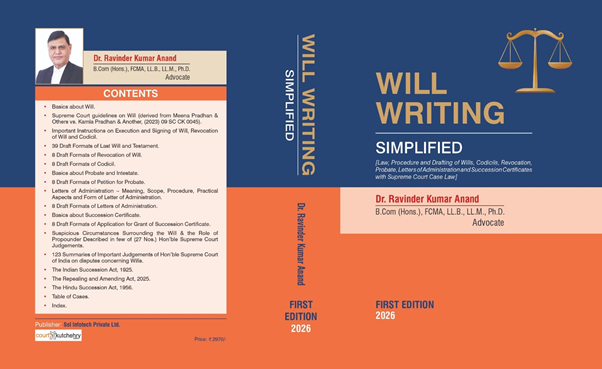
COURTKUTCHEHRY EXCLUSIVE: EXTRACTS FROM BEST SELLING BOOK: WILL WRITING SIMPLIFIED
Leela & Others v. Muruganantham & Others: Supreme Court Flags Beneficiary’s Role as Suspicious
Active Involvement of Beneficiary Heightens Burden
Registration Alone Cannot Cure Suspicion
By Vishwas Kumar
New Delhi: April 08, 2026:
The Supreme Court’s ruling in Leela & Others v. Muruganantham & Others, Civil Appeal No. 7578 of 2023 has become a defining precedent in succession law. Delivered in January 2025, the judgment underscores the principle that when a beneficiary plays an active role in the preparation or execution of a Will, the burden on the propounder becomes significantly heavier. Lawyers continue to cite this case because it crystallizes the doctrine that mere formal proof of execution is insufficient if suspicious circumstances remain unresolved.
For deeper legal insight into probate and testamentary succession, refer to this important Supreme Court judgment on wills and probate law in the case of Gumpha (Smt) and Others vs Jaibai, which discusses key legal principles governing inheritance and validity of wills in India.
Background of the Case
The dispute centered on a Will allegedly executed by a testator suffering from heart disease. The Will favoured Leela, the first appellant, who was both a beneficiary and the propounder. The courts below found multiple suspicious circumstances: stamp papers purchased in Leela’s name, contradictory recitals about the testator’s health, mismatched signatures, and discrepancies about the place of execution. Both the Trial Court and the High Court declared the Will not genuine, and the Supreme Court upheld these concurrent findings.
Key Observations by the Court
- Beneficiary’s Active Role
The Court noted that Leela purchased the stamp papers and concealed her involvement. This concealment was treated as a grave suspicious circumstance. Active participation of a beneficiary in execution is a classic red flag, requiring strict scrutiny. - Stamp Papers and Place of Execution
The Will was typed on stamp papers bought in Tenkasi but claimed to be executed in Madurai. This mismatch raised serious doubts about authenticity. The Court emphasized that geographical inconsistencies in execution, especially when the testator was ill, are unnatural and suspect. - Contradictory Recitals on Health
The Will stated that the testator was of sound mind but also suffering from heart disease. This contradiction created uncertainty about his mental and physical condition, undermining the claim of a sound disposing mind. - Non-Matching Signatures
The testator’s signature on the Will did not match his known signature on an earlier partition deed. This discrepancy was a strong indicator of possible fabrication. - Non-Examination of Scribe and Typist
While non-examination of a scribe is not always fatal, in this case, given the contradictions and doubts, failure to examine the typist and scribe added to suspicion. - Attesting Witness Related to Beneficiary
The attesting witness was Leela’s brother. His testimony was found unreliable and self-serving, further weakening the propounder’s case. - Absence of Proof of Comprehension
There was no evidence that the testator read or understood the Will. DW2 claimed it was read by a notary, but no such note existed in the document. The Court held that voluntariness and comprehension were not proved. - Sound Mind and Volition Not Established
Evidence showed the testator was in poor health and under treatment. The Court concluded that the propounder failed to prove he executed the Will with full knowledge and volition.
Precedent and Continuing Relevance
This case is frequently cited because it reinforces several critical principles:
- Active involvement of a beneficiary is inherently suspicious. The burden on the propounder becomes heavier, requiring removal of every legitimate doubt.
- Mere registration or formal proof is insufficient. Even if execution is formally proved, the Will can still fail if suspicions are not dispelled.
- Proof of sound mind and voluntariness is essential. The propounder must establish that the testator signed with full knowledge and free will.
- Concurrent findings of fact are respected. The Supreme Court upheld the lower courts’ conclusions, emphasizing that it will not interfere absent perversity.
Lawyers rely on Leela v. Muruganantham to argue that suspicious circumstances cannot be brushed aside by technical compliance. It is particularly invoked in cases where beneficiaries are directly involved in drafting or custody of Wills, or where discrepancies in execution raise doubts.
Why Lawyers Still Cite It
- It sets a clear precedent on beneficiary involvement as a suspicious circumstance.
- It highlights the importance of proving comprehension and voluntariness.
- It warns that registration does not cure suspicion.
- It strengthens the doctrine that judicial conscience must be satisfied before a Will is accepted.
- It provides a strong authority for challenging Wills where execution appears unnatural or contrived.
In short, Leela v. Muruganantham is a landmark that protects testamentary integrity by ensuring that Wills are not upheld unless suspicions are convincingly removed. It remains a powerful precedent in succession disputes, guiding courts to look beyond formal proof and examine the surrounding circumstances with rigor.
RESEARCH RESOURCES:
Explore will litigation cases here. Click the link here: https://www.courtkutchehry.com/pages/blog/123-supreme-court-judgments-on-wills/
EXTRACTS FROM BOOK, WILL WRITING SIMPLIFIED, By Dr Ravinder Kumar Anand. [📘 Buy Will Writing Simplified online: Amazon | Flipkart ]
Case Title Leela & Others v. Muruganantham & Others, (2025) 01 SC CK 0045: Civil Appeal No. 7578 of 2023.
https://www.courtkutchehry.com/judgements/1211991/leela-ors-vs-muruganantham-ors/]
| Suspicious Circumstance | Court’s Observation & Para Reference in the Judgement |
|---|---|
| Beneficiary’s active role in execution | The first appellant (Leela) actively participated in execution and concealed involvement, creating grave suspicion. [Para 14–15(i), 17–18, 24–25] |
| Stamp papers in beneficiary’s name | Will typed on stamp papers in Leela’s name at Tenkasi but claimed execution at Madurai raised doubts. [Para 14, 17, 25, 30] |
| Contradictory recitals on health | Will mentions both sound mind and illness, creating inconsistency. [Para 15(ii), 17] |
| Non-matching signatures | Signature mismatch with earlier documents weakened authenticity. [Para 15(iii)] |
| Non-examination of scribe/typist | Failure to examine key persons added suspicion. [Para 15(iv)-(v), 27] |
| Discrepancy in execution place | Madurai vs Tenkasi inconsistency raised doubts. [Para 15(vi), 28–30] |
| Will not read or understood | No proof testator understood contents. [Para 15(vii), 26] |
| Witness related to beneficiary | Witness was beneficiary’s brother; testimony unreliable. [Para 24–25, 28] |
| Execution away from home | Execution at distant place found unnatural. [Para 29–30] |
| No proof of sound mind | Evidence showed poor health and pressure. [Para 17, 24, 25] |
| Failure to prove voluntariness | Suspicion not cleared by propounder. [Para 26, 31] |
| Execution & attestation mandatory | Must comply with Sec 63 & Sec 68. [Para 20–23] |
| Mere registration insufficient | Formal proof alone not enough. [Para 20] |
| Beneficiary involvement suspicious | Active role increases burden of proof. [Para 14–15(i), 24–25] |
| Suspicion must be removed | Must satisfy judicial conscience. [Para 14, 15, 31] |
| Proof of sound mind essential | Testator must act knowingly and voluntarily. [Para 23–24] |
| Concurrent findings upheld | Supreme Court upheld lower court findings. [Para 31–32] |
FAQ Section
Q1: Why was Leela’s involvement in execution considered suspicious?
Because she purchased the stamp papers and concealed her role. Active participation of a beneficiary is a classic suspicious circumstance.
Q2: Does registration of a Will guarantee its validity?
No. Registration or formal proof does not cure suspicion. The propounder must still dispel doubts.
Q3: Why did contradictory statements about the testator’s health matter?
They created uncertainty about whether the testator was of sound mind and capable of executing the Will.
Q4: How did mismatched signatures affect the case?
The testator’s signature on the Will did not match his known signature, undermining genuineness.
Q5: Is non-examination of the scribe always fatal?
Not always, but in this case, given multiple contradictions, it added to suspicion.
Q6: Why was the attesting witness’s testimony doubted?
Because he was the brother of the main beneficiary, making his evidence unreliable and self-serving.
Q7: What precedent did the Supreme Court reaffirm?
That suspicious circumstances must be removed to the Court’s satisfaction, and mere formal proof is insufficient.
Q8: Why is this case still cited by lawyers?
Because it establishes strong precedent on beneficiary involvement, proof of voluntariness, and the insufficiency of registration alone.
BOOK REFERENCE:
[📘 Buy Will Writing Simplified online: Amazon | Flipkart ]