
COURTKUTCHEHRY SPECIAL SERIES ON LANDMARKS JUDGEMENTS ON WILLS, CODICIL & PROBATE
Leela Rajagopal and Others v. Kamala Menon Cocharan: Supreme Court Upholds Validity of Disputed Will
Clear Language and Explained Exclusion Strengthened Authenticity
Loss of Original Copy Adequately Accounted, Appeals Dismissed
By Vishwas Kumar
New Delhi: March 22, 2026:
In Leela Rajagopal and Others v. Kamala Menon Cocharan (Civil Appeal No. 9282 of 2010 with Nos. 9286 of 2010 and 7004 of 2012), decided on 8 September 2014, the Supreme Court of India delivered a significant ruling on the validity of a contested Will. The appellants, who were the sons of the testator, alleged that the Will was fabricated under undue influence and lacked voluntariness.
top court decisions on inheritance and wills
The Trial Court had agreed with the appellants, declaring the Will invalid. However, the High Court reversed this finding, holding the Will genuine. On appeal, a Division Bench comprising Justice Ranjan Gogoi and Justice R.K. Agrawal affirmed the High Court’s decision.
The Supreme Court emphasized that the language of the Will was clear and unambiguous, and the reasons for excluding the sons were explicitly stated by the testator. The Court also accepted the explanation for the loss of the original copy, noting that the circumstances did not cast suspicion on the document’s authenticity. Importantly, the Bench highlighted that the testator’s intention was manifest and consistent, leaving no room for doubt about the voluntariness of the bequest.
By dismissing the appeals, the Court upheld the High Court’s ruling that the Will was genuine and valid, thereby reinforcing the principle that testamentary freedom must be respected when the document is proven free of undue influence and supported by clear reasoning. This judgment provides clarity in succession law, particularly in disputes where allegations of fabrication and undue influence are raised, ensuring that the testator’s intent remains paramount.
For More, Read Here the Summary of the Judgement from the Book: WILL WRITING SIMPLIFIED, read below or open page no 436, Chapter 14.1 in the book. (Online book purchase link available here on: Buy online: Amazon | Flipkart
|
|
Case Summary |
: |
Leela Rajagopal and Others v. Kamala Menon Cocharan. |
|
|
Court |
: |
Supreme Court of India |
|
|
Citations |
: |
(2014) 09 SC CK 0058: Civil Appeal Nos.: 9282 of 2010 with Nos. 9286 of 2010 and 7004 of 2012. |
|
|
Link |
: |
https://www.courtkutchehry.com/judgements/685911/leela-rajagopal-vs-kamala-menon-cocharan/
|
|
|
Decided on |
: |
08 September 2014 |
|
|
Coram |
: |
Hon’ble Mr. Justice Ranjan Gogoi and Hon’ble Mr. Justice R.K. Agrawal., (Division Bench) |
|
|
Relevant Paragraphs |
: |
Para Nos. 2–13, 10–13, 14. 15. |
1. Facts of the Case:
(i). The dispute centered on the validity of a Will dated 11.01.1982 executed by K.P. Janaki Amma, mother of the parties. The trial court had dismissed the probate petition (converted to T.O.S. No. 16 of 1994) filed by respondent Kamala Menon Cocharan, holding that the Will was surrounded by suspicious circumstances. The High Court reversed this finding, upholding the Will, which led to the present appeal before the Supreme Court.
(ii). Janaki Amma had first executed a Will on 28.12.1981 bequeathing her house at 8, Malony Road, T. Nagar, Madras to her unmarried daughter Kamala and her granddaughter Geetha, excluding her sons on the ground that they were well-settled. The Will was later superseded by another dated 11.01.1982 with similar terms but mentioning five sons instead of four. After her death on 27.04.1991, Kamala sought probate, opposed by the sons on grounds of coercion and undue influence.
2. Law Points Involved:
(i). Proof of Will under Sections 63, 281, 282 of the Indian Succession Act, 1925
(ii). Limited scope of interference under Article 136 of the Constitution in factual findings regarding validity of Will
(iii). Principles governing suspicious circumstances and burden of proof in testamentary cases
3. Acts/Provisions/Articles Referred:
(i). Constitution of India, 1950 — Article 136
(ii). Indian Succession Act, 1925 — Sections 281 & 282
(iii). Evidence Act, 1872 — Principles governing proof of documents and Wills (implicitly applied)
4. Judgments Referred:
(i). H. Venkatachala Iyengar v. B.N. Thimmajamma, (1958) 11 SC CK 0008.
(ii). Bharpur Singh v. Shamsher Singh, (2008) 12 SC CK 0067.
https://www.courtkutchehry.com/judgements/661748/bharpur-singh-and-others-vs-shamsher-singh/]
(iii). Rani Purnima Debi v. Kumar Khagendra Narayan Deb, (1961) 08 SC CK 0021.
(iv). Apoline D’Souza v. John D’Souza, (2007) 05 SC CK 0070.
https://www.courtkutchehry.com/judgements/659802/apoline-dsouza-vs-john-dsouza/]
(v). Pentakota Satyanarayana v. Pentakota Seetharatnam, (2005) 09 SC CK 0005.
(vi). Mahesh Kumar (Dead) by LRs v. Vinod Kumar, (2012) 03 SC CK 0027.
https://www.courtkutchehry.com/judgements/667710/mahesh-kumar-dead-by-lrs-vs-vinod-kumar-and-others/]
(vii). Ved Mitra Verma v. Dharam Deo Verma, (2014) 07 SC CK 0016.
5. Obiter Dicta:
The Court observed that unusual or seemingly unnatural features of a Will warrant close scrutiny, but final evaluation must depend on the cumulative effect of all circumstances, not on any single factor. Article 136 jurisdiction is highly restricted and cannot be used to reopen factual findings unless they amount to a travesty of justice.
6. Ratio Decidendi:
Even where suspicious circumstances exist, if they are satisfactorily explained and the overall intention of the testator is clear, the Will can be upheld. Active participation of a beneficiary in execution or registration is not automatically fatal if the surrounding facts support voluntariness. Loss of the original Will can be justified by acceptable explanation, and a certified copy can be relied upon when genuineness is otherwise proved.
7. Final Ruling:
Appeals dismissed. The Supreme Court upheld the High Court’s order validating the Will dated 11.01.1982. It held that all alleged suspicious circumstances were satisfactorily explained and that Janaki Amma’s intention was evident and rational. No order as to costs.
8. Gist (Dispute & Final Decision):
The appellants (sons) alleged that the Will was fabricated under undue influence and not voluntary. The trial court agreed, but the High Court reversed the finding. The Supreme Court affirmed the High Court, holding that the Will’s language was clear, reasons for exclusion of sons apparent, loss of the original copy adequately explained, and the testator’s intention manifest. Hence, the Will was genuine and valid; appeals were dismissed.
Read full Judgement Here:
Leela Rajagopal and Others v. Kamala Menon Cocharan.
Supreme Court of India
(2014) 09 SC CK 0058: Civil Appeal Nos.: 9282 of 2010 with Nos. 9286 of 2010 and 7004 of 2012.
https://www.courtkutchehry.com/judgements/685911/leela-rajagopal-vs-kamala-menon-cocharan/
You Can Also Purchase the Book from here on: Buy online: Amazon | Flipkart
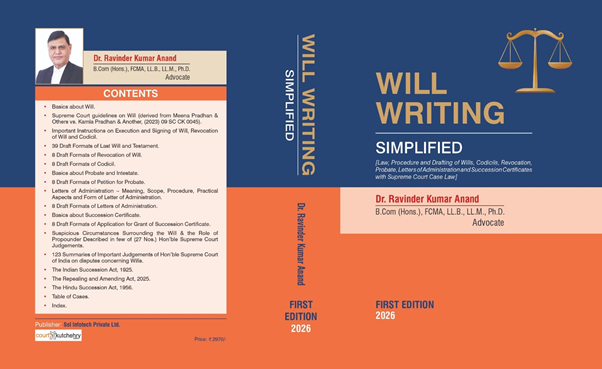
OUR RECOMMENDATION: Check out 123 Key Judgements, as highlighted in the book, WILL WRITING SIMPLIFIED, for the quick research and reference purposes. Click the link here: https://www.courtkutchehry.com/pages/blog/123-supreme-court-judgments-on-wills/
SEO-Friendly Keywords
- Leela Rajagopal v. Kamala Menon Cocharan Supreme Court case
- 2014 Supreme Court ruling on Will validity
- Testamentary freedom succession law India
- Undue influence allegations in inheritance disputes
- Loss of original Will explained Supreme Court
- Civil Appeal Nos. 9282, 9286 of 2010 & 7004 of 2012