
COURTKUTCHEHRY SPECIAL SERIES ON LANDMARKS JUDGEMENTS ON WILLS, CODICIL & PROBATE
Krishna Kumar Birla v. Rajendra Singh Lodha & Ors.: Supreme Court Rules Birla Family Lacks Caveatable Interest
Only Legal Heirs Can Challenge Probate Proceedings
Appeals Dismissed, Will Validity to Be Sole Focus
By Vishwas Kumar
New Delhi: March 24, 2026:
In Krishna Kumar Birla v. Rajendra Singh Lodha & Ors. (Civil Appeal Nos. 2277, 2275, 2279, 2276, 2278 & 2274 of 2008, decided on 31 March 2008), the Supreme Court of India delivered a crucial judgment clarifying who has the right to oppose probate proceedings. The Division Bench comprising Hon’ble Mr. Justice S.B. Sinha and Hon’ble Mr. Justice H.S. Bedi examined the dispute surrounding the 1999 Will of Priyamvada Devi Birla (PDB), which was propounded in favour of Rajendra Singh Lodha.
Members of the Birla family sought to challenge the probate, claiming interest as executors and beneficiaries under earlier mutual Wills executed in 1982. They argued that these earlier documents gave them a stake in PDB’s estate. However, the Supreme Court rejected this contention, holding that the estate in question was self-acquired by PDB and that only her legal heirs had the right to contest the probate. Since the Birla family members were not direct heirs, they lacked the necessary caveatable interest to oppose the proceedings.
The Court emphasized that probate proceedings are confined to verifying the validity of the Will itself, not adjudicating ownership or succession disputes. By dismissing all appeals, the Bench reinforced the principle that only those with a direct and present claim to the estate can intervene in probate matters. This ruling significantly narrows the scope of who may challenge testamentary documents, ensuring that probate remains a streamlined process focused solely on the authenticity of the Will.
The judgment stands as a landmark in succession law, clarifying the boundaries of caveatable interest and protecting the sanctity of probate proceedings from collateral disputes.
For More, Read Here the Summary of the Judgement from the Book: WILL WRITING SIMPLIFIED, read below or open page no 436, Chapter 14.1 in the book. (Online book purchase link available here on: Buy online: Amazon | Flipkart
|
|
Case Summary |
: |
Krishna Kumar Birla v. Rajendra Singh Lodha & Ors. |
|
|
Court |
: |
Supreme Court of India |
|
|
Citations |
: |
(2008) 03 SC CK 0012: Civil Appeal Nos. 2277, 2275, 2279, 2276, 2278 & 2274 of 2008. |
|
|
Link |
: |
|
|
|
Decided on |
: |
31 March 2008 |
|
|
Coram |
: |
Hon’ble Mr. Justice S.B. Sinha and Hon’ble Mr. Justice H.S. Bedi. |
|
|
Relevant Paragraphs |
: |
Para Nos.2–3, 34–37, 56–62, 85–97, 106–111 |
1. Facts of the Case:
Priyamvada Devi Birla (PDB) and Madhav Prasad Birla (MPB), an issueless couple, executed mutual Wills in 1982 providing that upon the death of one, the survivor would inherit the estate, and thereafter the assets would go to charitable causes. MPB died in 1990. PDB later executed another Will dated 18 April 1999 bequeathing her entire estate to Rajendra Singh Lodha (RSL), appointing him sole executor. After PDB’s death in 2004, Lodha sought probate of the 1999 Will. Members of the Birla family (K.K. Birla, B.K. Birla, and Yashovardhan Birla) filed caveats, claiming rights under the 1982 mutual Wills and alleging the 1999 Will was invalid. The Calcutta High Court discharged their caveats but retained that of Ganga Prasad Birla. Their appeals were dismissed by the Division Bench. They approached the Supreme Court.
2. Law Points Involved:
(i). Whether the Birlas had a “caveatable interest” under Sections 283 & 284 of the Indian Succession Act, 1925 and Rules 24–30 of the Calcutta High Court Rules, enabling them to maintain caveats opposing the 1999 Will.
(ii). Whether executors or relatives of a prior mutual Will have standing to object to a subsequent Will of the same testatrix.
3. Acts / Provisions / Articles Referred:
(i). Indian Succession Act, 1925 — Sections 283, 284, 295, 263
(ii). Civil Procedure Code, 1908-Order XIV Rule 1, Section 92
(iii). Indian Trusts Act, 1882 — Section 73
(iv). Constitution of India — Articles 12, 14, 227, 32
(v). Calcutta High Court (Original Side) Rules, 1914-Rules 24–30
4. Judgments Referred:
(i). Elizabeth Antony v. Michel Charles John Chown Lengera, (1990) 04 SC CK 0034.
(ii). Basanti Devi v. Ravi Prakash Ram Prasad Jaiswal, (2007) 10 SC CK 0120.
(iii). Abhiram Dass v. Gopal Dass, (1889) 06 CAL CK 0001.
https://www.courtkutchehry.com/judgements/847341/abhiram-dass-appellant-hash-gopal-dass-respondent]
(iv). Brindaban Chandra Shaha v. Sureshwar Shaha Parmanick, (1909) 07 CAL CK 0020.
5. Obiter Dicta:
The Court observed that probate proceedings are in rem and limited strictly to determining the genuineness of a Will — not disputes of title or claims of adverse ownership. The Court noted that permitting “busy bodies” or distant relatives to lodge caveats would defeat the statutory purpose of the Indian Succession Act.
6. Ratio Decidendi:
A caveatable interest requires a real and direct interest in the estate of the deceased, not a remote, speculative, or sentimental one. Only those who would have succeeded to the estate in the event of intestacy or have a special interest (such as a creditor or legatee) can maintain a caveat. Executors or relatives under a prior mutual Will have no caveatable interest unless they can show a present legal interest in the estate. Mutual Wills do not automatically prevent a later Will; they merely create equitable obligations enforceable through a separate suit, not in probate.
7. Final Ruling:
The Supreme Court upheld the Calcutta High Court’s decision.
(i). Appeals by K.K. Birla, B.K. Birla, and Yashovardhan Birla were dismissed.
(ii). The caveats filed by them were rightly discharged, as they had no caveatable interest in PDB’s estate.
(iii). Only the two sisters of MPB — Laxmi Devi Newar and Radha Devi Mohatta had a legitimate and direct interest in PDB’s estate as her heirs under the Hindu Succession Act.
(iv). The Court clarified that a probate proceeding cannot be converted into a title dispute and that “real interest test” applies, not the “bare possibility” or “common ancestor” test.
8. Gist / Dispute and Final Decision:
Dispute concerned the right of the Birla family members to oppose probate of PDB’s 1999 Will in favour of R.S. Lodha. They claimed interest as executors and beneficiaries under earlier mutual Wills of 1982. The Supreme Court ruled that they lacked caveatable interest since they had no direct or present claim to PDB’s estate, which was self-acquired. Only legal heirs could object. The Court dismissed all appeals and affirmed that the probate proceedings must remain confined to verifying the validity of the Will, not adjudicating ownership or succession disputes.
Read full Judgement Here:
Krishna Kumar Birla v. Rajendra Singh Lodha & Ors.
Supreme Court of India
(2008) 03 SC CK 0012: Civil Appeal Nos. 2277, 2275, 2279, 2276, 2278 & 2274 of 2008.
You Can Also Purchase the Book from here on: Buy online: Amazon | Flipkart
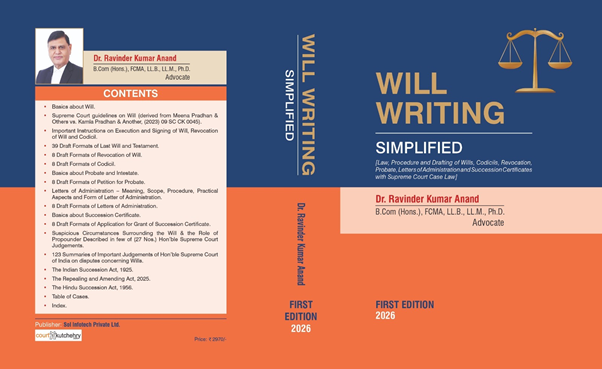
OUR RECOMMENDATION: Check out 123 Key Judgements, as highlighted in the book, WILL WRITING SIMPLIFIED, for the quick research and reference purposes. Click the link here: https://www.courtkutchehry.com/pages/blog/123-supreme-court-judgments-on-wills/
Keywords: Krishna Kumar Birla v. Rajendra Singh Lodha, Supreme Court of India 2008, Civil Appeal Nos. 2277–2274 of 2008, Justice S.B. Sinha, Justice H.S. Bedi, Priyamvada Devi Birla Will dispute, caveatable interest, probate proceedings, Birla family appeals dismissed, Indian succession law.