
COURTKUTCHEHRY SPECIAL SERIES ON LANDMARKS JUDGEMENTS ON WILLS, CODICIL & PROBATE
Kashibai & Anr. v. Parwatibai & Ors.: Supreme Court Restores Plaintiffs’ Half Share in Partition Dispute
Adoption Claim Fails Without First Wife’s Consent
Will of 1970 Declared Unproved, Trial Court Decree Revived
By Vishwas Kumar
New Delhi: March 27, 2026:
On 25 September 1995, the Supreme Court of India in Kashibai & Anr. v. Parwatibai & Ors. (Civil Appeal No. 9100 of 1995; (1995) 09 SC CK 0102) delivered a decisive ruling in a long-standing family property dispute. The Division Bench comprising Hon’ble Mr. Justice N.P. Singh and Hon’ble Mr. Justice Faizan Uddin restored the trial court’s decree granting the plaintiffs half share in the properties of deceased Lachiram, rejecting the defendants’ claims based on adoption and a disputed will.
The case arose from rival claims of widows and children of Lachiram over partition of his estate. The defendants relied on an alleged adoption and a 1970 will assert exclusive rights. However, the trial court found the adoption invalid due to the absence of consent from Lachiram’s first wife, a mandatory requirement under Hindu law. The will too was held unproved, as the attesting witnesses failed to testify to its execution, a critical requirement under the Indian Succession Act.
Despite these findings, the High Court re-evaluated the evidence and overturned the trial court’s decree. The Supreme Court held that the High Court had erred in interfering without a substantial question of law, reiterating that appellate courts cannot reassess factual determinations unless a clear legal issue arises.
By restoring the trial court’s decree, the Supreme Court reaffirmed the plaintiffs’ entitlement to half share in the properties, ensuring that inheritance rights were upheld in accordance with established legal principles. The judgment underscores the importance of strict compliance with statutory requirements in proving adoption and wills, and limits appellate interference in factual findings.
For More, Read Here the Summary of the Judgement from the Book: WILL WRITING SIMPLIFIED, read below or open page no 436, Chapter 14.1 in the book. (Online book purchase link available here on: Buy online: Amazon | Flipkart
|
|
Case Summary |
: |
Kashibai & Anr. v. Parwatibai & Ors. |
|
|
Court |
: |
Supreme Court of India |
|
|
Citations |
: |
(1995) 09 SC CK 0102: Civil Appeal No. 9100 of 1995. |
|
|
Link |
: |
https://www.courtkutchehry.com/judgements/678855/kashibai-and-another-vs-parwatibai-and-others/
|
|
|
Decided on |
: |
25 September 1995 |
|
|
Coram |
: |
Hon’ble Mr. Justice N.P. Singh and Hon’ble Mr. Justice Faizan Uddin. (Division Bench) |
|
|
Relevant Paragraphs |
: |
Para Nos. 7–12 |
1. Facts of the Case:
The plaintiffs—Kashibai (first wife of late Lachiram) and her daughter—sought partition and separate possession of half share in properties of deceased Lachiram against his second wife Parvatibai and her descendants. The dispute centered on agricultural lands and houses at Eklara. The defendants contended that Purshottam (grandson through second wife) was adopted by Lachiram under a registered Deed of Adoption dated 29.04.1970, and that Lachiram also executed a Will the same day bequeathing the properties to Purshottam, thereby excluding plaintiffs. The Trial Court and First Appellate Court found no valid adoption or Will, decreeing half share to plaintiffs. The High Court, however, reversed these concurrent findings, holding that adoption and Will stood proved and dismissed the suit, prompting appeal before the Supreme Court.
2. Law Points Involved:
(i). Proof of adoption under Section 7, Hindu Adoptions and Maintenance Act, 1956—necessity of wife’s consent.
(ii). Proof of Will under Section 68, Evidence Act, 1872 read with Section 63, Indian Succession Act, 1925.
(iii). Meaning of “attestation” under Section 3, Transfer of Property Act, 1882.
(iv). Scope of interference under Section 100(1), Code of Civil Procedure, 1908—High Court’s jurisdiction confined to substantial question of law in second appeal.
3. Acts/Provisions/Articles Referred:
(i). Code of Civil Procedure, 1908—Section 100(1)
(ii). Evidence Act, 1872—Section 68
(iii). Hindu Adoptions and Maintenance Act, 1956—Section 7
(iv). Indian Succession Act, 1925—Section 63
(v). Transfer of Property Act, 1882—Section 3
4. Judgments Referred:
Catena of precedents on scope of interference under Section 100 CPC; Supreme Court reiterated consistent view that concurrent findings of fact cannot be disturbed unless substantial question of law arises.
5. Obiter Dicta:
The Supreme Court emphasized that “attestation” and “execution” are distinct; absence of proof of due attestation vitiates proof of execution. Likewise, assumption that attesting witnesses must have seen the executant sign cannot substitute for explicit evidence as required under Section 68 Evidence Act.
6. Ratio Decidendi:
(i). An adoption made without the consent of the living wife is invalid under Section 7 of the Hindu Adoptions and Maintenance Act, 1956.
(ii). A Will must be proved in strict compliance with Sections 63(c) of the Succession Act and 68 of the Evidence Act; attesting witnesses must specifically depose to execution in testator’s presence.
(iii). High Court cannot re-appreciate evidence or disturb concurrent factual findings of lower courts in second appeal absent a formulated substantial question of law under Section 100 CPC.
7. Final Ruling:
Appeal allowed. Judgment and decree of Bombay High Court set aside. Decree of Trial Court restored. No order as to costs in Supreme Court; respondents to bear plaintiffs’ costs in lower courts.
8. Gist (Dispute & Final Decision):
Dispute arose from rival widows and children of deceased Lachiram over partition of properties. Defendants’ claim based on adoption and Will of 1970 was rejected for want of proof—adoption invalid due to absence of first wife’s consent; Will unproved as attesting witnesses failed to testify to execution. Supreme Court held High Court erred in re-evaluating evidence without a substantial question of law. Restored Trial Court decree granting plaintiffs half share in properties.
Read full Judgement Here:
Kashibai & Anr. v. Parwatibai & Ors.
Supreme Court of India
(1995) 09 SC CK 0102: Civil Appeal No. 9100 of 1995.
https://www.courtkutchehry.com/judgements/678855/kashibai-and-another-vs-parwatibai-and-others/
You Can Also Purchase the Book from here on: Buy online: Amazon | Flipkart
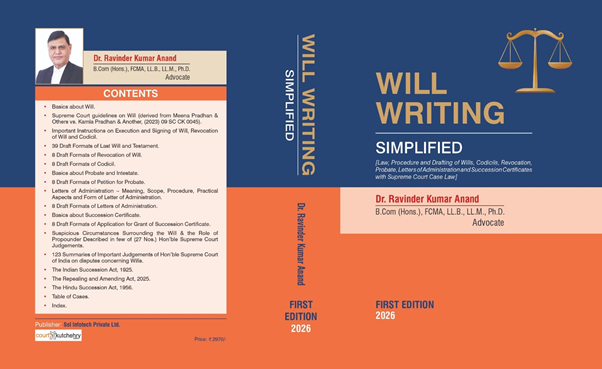
OUR RECOMMENDATION: Check out 123 Key Judgements, as highlighted in the book, WILL WRITING SIMPLIFIED, for the quick research and reference purposes. Click the link here: https://www.courtkutchehry.com/pages/blog/123-supreme-court-judgments-on-wills/
Keywords for SEO & Quick Search
- Kashibai v. Parwatibai Supreme Court case
- Civil Appeal No. 9100 of 1995 judgment
- Lachiram property partition dispute
- Adoption invalid without first wife’s consent
- Will of 1970 unproved Supreme Court
- N.P. Singh Faizan Uddin judgment
- Hindu succession law adoption and will ruling