
COURTKUTCHEHRY SPECIAL SERIES ON LANDMARKS JUDGEMENTS ON WILLS, CODICIL & PROBATE
Karunanidhi v. Seetharama Naidu & Ors.: Supreme Court Upholds Trial Court Dismissal
Inheritance Rights Under Hindu Succession Act Clarified
2005 Amendment Not Retrospective, Daughters Held Absolute Owners
By Vishwas Kumar
New Delhi: March 22, 2026:
In Karunanidhi v. Seetharama Naidu & Ors. (Civil Appeal No. 4490 of 2017), decided on 27 March 2017 by a Division Bench comprising Justice R.K. Agrawal and Justice Abhay Manohar Sapre, the Supreme Court of India delivered a significant ruling on inheritance rights under the Hindu Succession Act, 1956.
complete collection of Supreme Court will judgments in India
The dispute revolved around whether the plaintiffs—great-grandchildren through a pre-deceased daughter of a pre-deceased daughter—could claim inheritance in the property of Alamelu Ammal, daughter of the original testator. The plaintiffs relied on Section 15(2)(a) of the Act, as amended in 2005, which expanded the category of heirs eligible to inherit property from a female Hindu.
The Court, however, held that the plaintiffs’ category of heirs was introduced only in 2005, and the amendment could not be applied retrospectively to claims arising before its enactment. The High Court’s error lay in extending the amendment backwards in time. Importantly, the Bench clarified that the daughters of the testator had absolute ownership of the property, not merely a life estate, thereby extinguishing any claim of succession by the plaintiffs.
Consequently, the Supreme Court affirmed the Trial Court’s dismissal of the suit, ruling that no right accrued to the plaintiffs under the law as it stood prior to 2005. This judgment reinforces the principle that legislative amendments in succession law cannot be retroactively applied to unsettle settled property rights.
The decision is a landmark in clarifying the scope of female inheritance rights and the non-retrospective application of succession amendments, ensuring certainty in property disputes across generations.
For More, Read Here the Summary of the Judgement from the Book: WILL WRITING SIMPLIFIED, read below or open page no 436, Chapter 14.1 in the book. (Online book purchase link available here on: Buy online: Amazon | Flipkart
|
|
Case Summary |
: |
Karunanidhi v. Seetharama Naidu & Ors. |
|
|
Court |
: |
Supreme Court of India |
|
|
Citations |
: |
(2017) 03 SC CK 0077: Civil Appeal No. 4490 of 2017. |
|
|
Link |
: |
https://www.courtkutchehry.com/judgements/685141/karunanidhi-vs-seetharama-naidu/
|
|
|
Decided on |
: |
27 March 2017 |
|
|
Coram |
: |
Hon’ble Mr. Justice R.K. Agrawal and Hon’ble Mr. Justice Abhay Manohar Sapre. (Division Bench) |
|
|
Relevant Paragraphs |
: |
Para Nos. 4–5, 10–20, 25–45 |
1. Facts of the Case:
The dispute arose among descendants of one Perumal Naidu, who had executed a Will dated 27.12.1923 bequeathing his properties to his three wives, daughters, grand-daughters, and a son-in-law. After his death in 1924, litigation ensued over the Will’s validity. The Will was upheld finally in 1925. His daughters from the second wife, Alamelu Ammal and Ramanujatha Ammal, partitioned the properties in 1957. Later, both executed Wills — Alamelu (1987) bequeathing to her sister and the present appellant; and Ramanujatha (1987) also bequeathing to the appellant. After Alamelu’s death in 1987, her great-grandchildren (plaintiffs) from the first wife’s branch sued in 1988, claiming rights in the properties as reversionary heirs under Section 15(2)(a) of the Hindu Succession Act, 1956. The Trial Court and First Appellate Court dismissed the suit, holding that both daughters had absolute ownership. The Madras High Court, however, allowed the second appeal in part and granted the plaintiffs 2/3 share relying on Section 15(2)(a) and the Schedule (Class I heirs) of the Hindu Succession Act.
2. Law Points Involved:
(i). Scope of Section 15(2)(a) read with Section 8 and Schedule of the Hindu Succession Act, 1956 regarding devolution of property inherited by a female from her father.
(ii). Competence of High Court under Section 100 CPC to frame and decide substantial questions of law not raised earlier.
(iii). Effect of the 2005 Amendment Act (Act 39 of 2005) on inclusion of new Class-I heirs and its retrospective applicability.
(iv). Nature of interest- “absolute ownership” vs. “life estate” created under a Will executed prior to the Act.
3. Acts / Provisions / Articles Referred:
(i). Hindu Succession Act, 1956 – Sections 8, 15(2)(a), Schedule (Class-I heirs)
(ii). Civil Procedure Code, 1908 – Section 100(4) & (5)
4. Judgments Referred:
(i). Seetharama Naidu v. Ramanujathammal, Second Appeal No. 873 of 2003, Decided on July 26, 2012.
(ii). Lakshmi Ammal v. Srinivasan, CMP No. 8691 of 2006, order dated 25.04.2012.
5. Obiter Dicta:
The Court refrained from interpreting the expression “any property inherited by a female Hindu from her father or mother” under Section 15(2)(a), observing that such examination was unnecessary since the provision itself was inapplicable to the present facts.
6. Ratio Decidendi:
The High Court committed jurisdictional error by invoking Section 15(2)(a) in the absence of pleadings or substantial question of law under Section 100 CPC. The amendment of 2005 adding “son/daughter of pre-deceased daughter of a pre-deceased daughter” to Class-I heirs was prospective and had no retrospective effect. Since succession opened in 1987, plaintiffs had no legal right. The daughters of Perumal Naidu acquired absolute ownership under the 1923 Will and not life interest; hence their testamentary dispositions were valid.
7. Final Ruling:
Appeal allowed. High Court’s judgment set aside. The judgments of the Trial Court and First Appellate Court were restored. Plaintiffs’ suit dismissed.
8. Gist Highlighting Dispute with Final Decision:
The case centered on whether the plaintiffs (great-grandchildren through a pre-deceased daughter of a pre-deceased daughter) could claim inheritance under Section 15(2)(a) of the Hindu Succession Act in respect of property of Alamelu Ammal, daughter of the original testator. The Supreme Court held that (i) the plaintiffs’ category of heirs was introduced only in 2005, (ii) the High Court erred in applying that amendment retrospectively, and (iii) the daughters had absolute ownership, not life estate. Therefore, no right accrued to plaintiffs. The Trial Court’s dismissal of the suit was affirmed.
Read full Judgement Here:
Karunanidhi v. Seetharama Naidu & Ors.
Supreme Court of India
(2017) 03 SC CK 0077: Civil Appeal No. 4490 of 2017.
https://www.courtkutchehry.com/judgements/685141/karunanidhi-vs-seetharama-naidu/
You Can Also Purchase the Book from here on: Buy online: Amazon | Flipkart
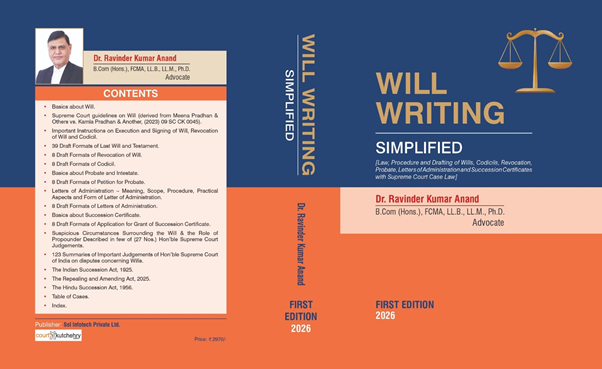
OUR RECOMMENDATION: Check out 123 Key Judgements, as highlighted in the book, WILL WRITING SIMPLIFIED, for the quick research and reference purposes. Click the link here: https://www.courtkutchehry.com/pages/blog/123-supreme-court-judgments-on-wills/
SEO-Friendly Keywords
- Karunanidhi v. Seetharama Naidu Supreme Court case
- Hindu Succession Act 1956 Section 15(2)(a)
- 2005 amendment inheritance rights India
- Supreme Court ruling on property succession
- Alamelu Ammal property dispute judgment
- Civil Appeal No. 4490 of 2017 inheritance law