
COURTKUTCHEHRY SPECIAL SERIES ON LANDMARKS JUDGEMENTS ON WILLS, CODICIL & PROBATE
Kartar Kaur & Anr. v. Milkho & Ors.: Supreme Court Declares Atma Singh’s Will Invalid
Suspicious Circumstances Render Testamentary Document Void
Inheritance Rights Restored to Wife and Daughter
By Vishwas Kumar
New Delhi: March 27, 2026:
On 29 October 1996, the Supreme Court of India in Kartar Kaur & Anr. v. Milkho & Ors. (Civil Appeal No. 13390 of 1996; (1996) 10 SC CK 0186) delivered a decisive judgment concerning the disputed will of Atma Singh. The Division Bench comprising Hon’ble Mr. Justice K. Ramaswamy and Hon’ble Mr. Justice K. Venkataswami upheld the findings of the trial court, which had declared the will forged and surrounded by suspicious circumstances, thereby restoring inheritance rights to Atma Singh’s wife and daughter.
explore top will-related judgments in India of Kartar Kaur & Anr.
The controversy arose when Atma Singh’s will allegedly favoured his sister, excluding his immediate family. The trial court had found the will unreliable, citing several red flags: the wrong name of his daughter, non-production of the original will, a doubtful thumb impression, and the unnatural exclusion of wife and child. Despite these findings, the appellate and High Courts erred in disregarding the trial court’s conclusions.
Applying the principles laid down in H. Venkatachala Iyengar v. B.N. Thimmajamma, the Supreme Court emphasized that the propounder of a will must dispel all legitimate suspicions. In this case, the propounder failed to do so. The Court also noted evidence of conspiracy through sale deeds executed on the basis of the disputed will, further undermining its credibility.
Ultimately, the Supreme Court declared both the will and the related sale deeds invalid, holding that the wife and daughter were the rightful heirs. This ruling reinforced the principle that unnatural bequests and procedural irregularities cannot override lawful inheritance rights, and that courts must scrutinize wills with heightened care when suspicious circumstances are evident.
For More, Read Here the Summary of the Judgement from the Book: WILL WRITING SIMPLIFIED, read below or open page no 436, Chapter 14.1 in the book. (Online book purchase link available here on: Buy online: Amazon | Flipkart
|
|
Case Summary |
: |
Kartar Kaur & Anr. v. Milkho & Ors. |
|
|
Court |
: |
Supreme Court of India |
|
|
Citations |
: |
(1996) 10 SC CK 0186: Civil Appeal No. 13390 of 1996. |
|
|
Link |
: |
https://www.courtkutchehry.com/judgements/684733/kartar-kaur-and-another-vs-milkho-and-others/
|
|
|
Decided on |
: |
29 October 1996 |
|
|
Coram |
: |
Hon’ble Mr. Justice K. Ramaswamy and Hon’ble Mr. Justice K. Venkataswami. (Division Bench) |
|
|
Relevant Paragraphs |
: |
Para Nos. 3–23 |
1. Facts of the Case:
Appellants (wife and daughter of Atma Singh) filed a suit challenging a registered will dated 14.06.1979 alleged to have been executed by Atma Singh in favour of his sister Milkho (respondent). They sought declaration of ownership of 1/3rd share in 429 kanal 7 marla land and invalidation of mutation No. 3030 dated 02.06.1986. The will deprived the appellants entirely. The trial court found multiple suspicious circumstances—wrong name of daughter, will attested by relatives from another village, original will not produced, and doubtful thumb impression. The will was held forged and the suit decreed. The appellate court reversed the decree; the High Court dismissed second appeal in two words: “No merit. Dismissed.” Hence, the Supreme Court appeal.
2. Law Points Involved:
(i). Proof of will — burden and standard under Section 63 of the Indian Succession Act, 1925.
(ii). Effect of suspicious circumstances surrounding execution of a will.
(iii). Role of appellate and High Courts in second appeal concerning genuineness of will (mixed question of fact and law).
(iv). Power of Supreme Court under Articles 136 and 142 of the Constitution to do complete justice by invalidating related sale deeds executed as part of a conspiracy.
3. Acts / Provisions / Articles Referred:
(i). Constitution of India, 1950 — Articles 136, 142
(ii). Indian Succession Act, 1925 — Section 63
(iii). Indian Evidence Act, 1872 (implied regarding burden and proof)
4. Judgments Referred:
(i). Bhagwan Kaur v. Kartar Kaur, (1994) 04 SC CK 0079
https://www.courtkutchehry.com/judgements/691485/bhagwan-kaur-vs-kartar-kaur-and-others/]
(ii). H. Venkatachala Iyengar v. B.N. Thimmajamma (1958) 11 SC CK 0008;
(iii). Smt. Jaswant Kaur v. Smt. Amrit Kaur, (1976) 10 SC CK 0028.
https://www.courtkutchehry.com/judgements/649331/smt-jaswant-kaur-vs-smt-amrit-kaur-and-others/]
5. Obiter Dicta:
The High Court erred in dismissing second appeal summarily; genuineness of a will is not a mere question of fact but involves mixed question of fact and law requiring judicial scrutiny. Registered will alone is insufficient proof of genuineness. Courts must act with vigilance when bequest appears unnatural or improbable.
6. Ratio Decidendi:
When execution of a will is surrounded by suspicious circumstances, the burden lies heavily on the propounder to remove all doubts and satisfy the judicial conscience regarding its genuineness. Mere registration or attestation is not conclusive. Failure to prove that the disputed thumb impression belonged to the testator, and absence of credible explanation for unnatural exclusion of wife and daughter, renders the will invalid. The appellate and High Courts’ failure to evaluate these aspects vitiates their findings.
7. Final Ruling:
Supreme Court restored trial court’s decree. The will dated 14.06.1979 and two subsequent sale deeds in favour of respondents were held invalid and non-binding on appellants. Appellants declared entitled to 1/3rd share of the land with mesne profits for three years prior to suit; trial court directed to determine amount within six months. Appeal allowed without costs.
8. Gist Highlighting Dispute with Final Decision:
Dispute concerned genuineness of Atma Singh’s will in favour of his sister, excluding his wife and daughter. The trial court found the will forged and shrouded in suspicious circumstances; appellate and High Courts erred in ignoring these findings. Supreme Court, applying H. Venkatachala Iyengar principles, held that the propounder failed to dispel suspicions—wrong name of daughter, non-production of original will, doubtful thumb impression, unnatural bequest, and conspiracy through sale deeds. The Court declared both the will and sale deeds invalid, upholding the wife and daughter’s inheritance rights.
Read full Judgement Here:
Kartar Kaur & Anr. v. Milkho & Ors.
Supreme Court of India
(1996) 10 SC CK 0186: Civil Appeal No. 13390 of 1996.
https://www.courtkutchehry.com/judgements/684733/kartar-kaur-and-another-vs-milkho-and-others/
You Can Also Purchase the Book from here on: Buy online: Amazon | Flipkart
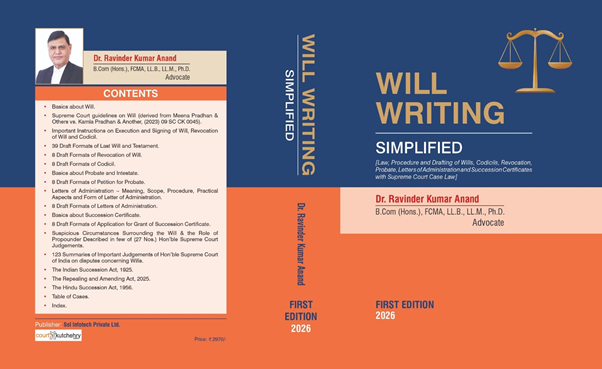
OUR RECOMMENDATION: Check out 123 Key Judgements, as highlighted in the book, WILL WRITING SIMPLIFIED, for the quick research and reference purposes. Click the link here: https://www.courtkutchehry.com/pages/blog/123-supreme-court-judgments-on-wills/
Keywords for SEO & Quick Search
- Kartar Kaur v. Milkho Supreme Court case
- Atma Singh will dispute 1996
- Supreme Court inheritance rights India
- Civil Appeal No. 13390 of 1996 judgment
-
- Ramaswamy K. Venkataswami will case
-
- Venkatachala Iyengar suspicious will principles
- Indian succession law forged will ruling