
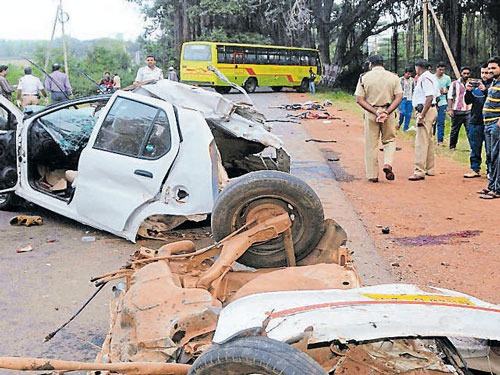
HIGH COURT UNVEILS NEW LIABILITY STANDARD FOR ROAD TRAGEDIES
Driver Completely Exonerated in Sudden Tyre Burst Accident
Judicial Order Shifts Full Financial Burden to Vehicle Owners Under Motor Vehicles Act
By Legal Editor
New Delhi: July 19, 2026:
The legal dynamics governing motor accident insurance and driver accountability in India have taken a major turn. In an analytical ruling, the Karnataka High Court in a recent case ruled that a driver cannot be held responsible for "contributory or sole negligence" if a crash is caused by a sudden tyre burst. By establishing that such mechanical failures are outside a driver's immediate control, the court cleared the employee of blame and placed the full financial obligation on the vehicle's owner.
This judgment adds crucial clarity to the interpretation of tortious liability and the Motor Vehicles Act, 1988. It addresses the grey area between an "Act of God" (vis major), driver negligence, and the maintenance duties of a car owner.
The Legal Context of the Case
The dispute centered on a bad highway accident caused by a sudden tyre blowout. The insurance company tried to avoid paying out by arguing that the driver was speeding or careless, which would mean the driver shared the blame.
However, the High Court rejected this argument. The bench emphasized that a sudden blowout is an unexpected mechanical emergency. Unless there is clear evidence that the driver saw the defect and ignored it, they cannot be blamed for losing control of the vehicle immediately after a rupture.
[Sudden Mechanical Failure: Tyre Burst]
│
┌────────────────────┴────────────────────┐
▼ ▼
[Driver Actions Exonerated] [Owner Liability Triggered]
• Out of immediate control • Duty to maintain vehicle fitness
• No inherent personal neglect • Absolute statutory obligation
Shifting from Fault to Ownership Liability
This ruling heavily relies on the legal principle of vicarious liability and the statutory duties built into the Motor Vehicles Act, 1988. Under Indian tort law, an employer or vehicle owner is held liable for acts committed by their driver during their employment. However, this case goes a step further by focusing on the roadworthiness of the vehicle itself.
The court noted that keeping a vehicle safe and fit for the road—including checking tyre health, tread wear, and inflation pressure—is ultimately the owner's job. When a tyre bursts from wear and tear or poor upkeep, it counts as a failure of this maintenance duty. Therefore, the owner must bear the financial consequences.
Key Legal Pillars Explained:
Negligence (Section 304A / Civil Tort): The court ruled that losing control because a tyre blew out does not equal reckless driving. Negligence requires a conscious disregard for safety; a sudden structural break does not fit this definition.
Absolute Owner Duty: If a vehicle is put on public roads, the owner guarantees it is safe to operate. If a mechanical parts failure causes injury, the owner remains liable to third parties.
Impact on Insurance Claims and Compensation
This decision will significantly influence how the Motor Accident Claims Tribunals (MACT) handle similar cases across India. Insurance companies frequently use claims of "driver negligence" or "contributory negligence" to lower their payouts or file recovery actions against drivers.
By ruling out driver negligence in sudden blowouts, the High Court ensures that victims can secure their compensation faster from the owner's insurance policy, without getting bogged down in long arguments over how the driver handled the emergency.
A Practical Standard for Road Safety Law
This decision brings a welcome dose of realism to transit law. It acknowledges that even the most skilled driver cannot overcome the laws of physics when a tyre disintegrates at high speed. By focusing liability on vehicle maintenance rather than split-second reactions during an emergency, the Karnataka High Court has set a fair standard that protects workers while ensuring accident victims receive the compensation they are owed.
Searchable Legal Index & Detailed FAQ
1. General Liability Questions
FAQ 1.1: What is the main takeaway from the Karnataka High Court's ruling?
FAQ 1.2: Does this mean a driver can never be blamed for an accident after a tyre burst?
2. Owner & Insurance Dynamics
FAQ 2.1: Why is the vehicle owner held liable instead of the driver?
FAQ 2.2: Will the insurance company still pay out the third-party compensation?
3. Evidentiary & Court Standards
FAQ 3.1: How does this ruling affect pending cases in the Motor Accident Claims Tribunal (MACT)?
FAQ 3.2: What kind of evidence shifts the blame back to an owner?
1. General Liability Questions
FAQ 1.1: What is the main takeaway from the Karnataka High Court's ruling?
The court established in the case that a sudden tyre burst is an unpredictable event outside a driver's immediate control. Consequently, the driver cannot be held civilly negligent for the crash, and the legal responsibility to compensate victims falls squarely on the vehicle owner.
FAQ 1.2: Does this mean a driver can never be blamed for an accident after a tyre burst?
Not necessarily. The driver is cleared if the blowout happens suddenly and without warning on a vehicle that appeared roadworthy. However, if evidence proves the driver knew the tyre was bald, damaged, or dangerously under-inflated before driving, claims of personal negligence could still be raised.
2. Owner & Insurance Dynamics
FAQ 2.1: Why is the vehicle owner held liable instead of the driver?
Under the principles of tort law and the Motor Vehicles Act, the owner has a primary duty to ensure the vehicle is safe to operate. A tyre blowout is generally treated as a mechanical upkeep failure, making the owner responsible for any third-party damage it causes.
FAQ 2.2: Will the insurance company still pay out the third-party compensation?
Yes. Since the owner is held liable, the valid third-party insurance policy tied to the vehicle must cover the compensation awarded to the victims, as long as the policy conditions (like holding a valid driving license) were followed.
3. Evidentiary & Court Standards
FAQ 3.1: How does this ruling affect pending cases in the Motor Accident Claims Tribunal (MACT)?
It prevents insurance providers from dragging out cases by trying to prove the driver was negligent for losing control after a tyre bursts. Tribunals can now fast-track compensation decisions by focusing on ownership liability.
FAQ 3.2: What kind of evidence shifts the blame back to an owner?
Evidence showing a lack of proper maintenance—such as running on bald tyres past their service life, ignoring structural cracks, or overloading the vehicle beyond its legal limit—confirms the owner's failure to maintain a roadworthy vehicle, supporting the shift in liability.
Party Involved — Previous Legal Vulnerability — Position After 2026 Ruling
Vehicle Driver — Highly vulnerable to criminal or civil negligence charges for losing control. — Exonerated; protected from financial liability if the accident stems solely from a blowout.
Vehicle Owner — Shared liability, often shifting blame to the driver's operating speed. — Holds sole civil responsibility for third-party compensation due to maintenance duties.
Insurance Companies — Exploited "driver error" arguments to delay payments or seek recovery. — Obligated to pay out under the owner's policy, provided coverage terms are met.