
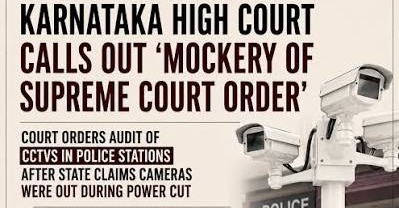
Karnataka High Court Mandates Statewide CCTV Audit: Institutional Defiance of Apex Mandates Undermines Constitutional Rights
Statewide Oversight Committee Formed to Investigate Power Backup Failures and Systemic Interrogation Lapses
Judicial Scrutiny Focuses on Whitefield Custodial Torture Allegations and Administrative Negligence
By Legal Editor
New Delhi: August 24, 2026:
In an unprecedented judicial intervention aimed at dismantling systemic resistance within law enforcement, the High Court of Karnataka [V Shailaja v The Commissioner], presided over by Justice Suraj Govindaraj, issued a sweeping order mandating an immediate, comprehensive statewide audit of Closed-Circuit Television (CCTV) systems, continuous recording devices, and uninterrupted power supply (UPS) infrastructure across all police stations in Karnataka.
The judicial inquiry originated from a petition (V. Shailaja v. The Commissioner) detailing a severe case of alleged custodial violence at the Whitefield Police Station in Bengaluru on September 4, 2024. The petitioner, appearing in person, alleged that a police officer employed brutal physical torture, using a lathi on her private parts. When the High Court requested the production of the relevant CCTV footage from the station to verify the claims, state representatives revealed that the station's Uninterrupted Power Supply (UPS) system had been entirely non-functional for nearly 1.5 years. Consequently, no video logs were recorded or uploaded to cloud storage during frequent local power outages, creating total surveillance blackouts during critical hours.
Rebutting the defence presented by the Additional Government Advocate, Justice Suraj Govindaraj observed that state law enforcement authorities were treating constitutional mandates as optional administrative suggestions. Labelling the police department’s reliance on power failure as a direct "mockery of the Supreme Court order," the court emphasized that allowing essential surveillance hardware to remain defective for extended periods effectively defeats the purpose of institutional monitoring. The court noted that Station House Officers (SHOs) cannot remain "passive spectators twiddling their thumbs" while essential safety mechanisms fail. The ruling establishes clear, binding directives requiring state authorities to audit 27 specific operational categories, deploy an automated statewide IT monitoring network, and investigate potential criminal liability for evidentiary spoliation and deliberate record suppression.
Constitutional Foundations and Statutory Architecture
The statutory framework governing police surveillance, custodial integrity, and digital evidence in India rests on binding apex precedents, constitutional protections, and statutory safeguards designed to enforce law enforcement accountability and curb police brutality.
Article 21 of the Constitution of India: Guarantees the fundamental right to life, personal liberty, and human dignity. The Supreme Court has repeatedly affirmed that custodial torture, illegal detention, and physical degradation represent direct violations of Article 21. Continuous audio-visual surveillance serves as an essential evidentiary check against physical abuse within custodial spaces.
Article 22 of the Constitution of India: Protects individuals against arbitrary arrest and illegal detention, requiring complete procedural transparency during custodial interrogation, immediate disclosure of arrest grounds, and timely production before a magistrate within 24 hours.
Mandate of Paramvir Singh Saini v. Baljit Singh & Ors. (2020): The Supreme Court of India mandated the installation of night-vision, audio-video CCTV cameras across all police stations and central investigative agencies nationwide. The directives specify mandatory coverage of lock-ups, interrogation rooms, reception areas, corridors, premises entrances, and exits. The judgment strictly requires non-stop 24/7 recording backed by continuous power supplies (solar, wind, or UPS) and a non-negotiable data retention period of 12 to 18 months.
Decisions in D.K. Basu v. State of West Bengal (2015) & Shafhi Mohammad v. State of Himachal Pradesh (2018): Formulated early guidelines for central and state oversight mechanisms, mandating independent monitoring committees to periodically inspect police station footage and ensure arrestee rights are respected during detentions.
Section 179 of Bharatiya Nagarik Suraksha Sanhita (BNSS), 2023: Regulates police power to summon and examine witnesses, explicitly restricting arbitrary police station detentions and protecting vulnerable individuals—especially women and minors—from unlawful custodial questioning.
Section 63 of Bharatiya Sakshya Adhiniyam (BSA), 2023 / Section 65B of Indian Evidence Act, 1872: Governs the legal admissibility of electronic records in court, requiring verified chain of custody, tamper-proof system logs, and continuous recording integrity for digital evidence to be accepted as substantive proof in judicial proceedings.
Systemic Failure: Passive Spectators and Evidentiary Evasion
The Karnataka High Court’s detailed observations lay bare systemic methods used by state machinery to bypass judicial accountability. During proceedings, state representatives conceded that the Whitefield Police Station operated without functional power backups for over 18 months. Consequently, no recordings were generated or uploaded to cloud storage during power cuts, rendering the surveillance system useless during the exact hours the alleged incident occurred.
The court uncovered misleading documentation where official state reports listed UPS status as "nil" instead of "not working," effectively concealing non-compliance from supervisory bodies. The High Court ordered the Additional Chief Secretary, Principal Secretary of the Home Department, and the Director General and Inspector General of Police (DGP) to oversee a strict 27-point audit across all police establishments in Karnataka.
Additionally, the court directed local power authorities, including the Bangalore Electric Supply Company Limited (BESCOM), to submit official power log records to verify whether electricity was intentionally disconnected or naturally interrupted during the incident window. The Police Computer Wing has been tasked with designing and implementing an automated state-level IT infrastructure featuring a centralized dashboard that tracks every camera, recorder, and battery unit statewide, automatically triggering system alerts whenever any hardware unit goes offline.
Searchable Legal Index & Frequently Asked Questions (FAQ)
Q1: What are the legal requirements for CCTV cameras in police stations?
Under the Supreme Court mandate in Paramvir Singh Saini v. Baljit Singh (2020), every police station and investigative agency must install night-vision, audio-video CCTV cameras. Coverage must include lockups, interrogation rooms, reception areas, corridors, entrances, and exits. Systems must operate continuously 24/7 with dedicated power backups and retain footage for 12 to 18 months.
Q2: Can law enforcement claim power failures or lack of backup as a valid defense for missing footage?
No. Courts have held that failing to maintain operational power backup systems (such as UPS, inverters, or solar units) violate constitutional mandates under Article 21. Law enforcement agencies are legally obligated to maintain uninterrupted power infrastructure to guarantee continuous recording without interruption.
Q3: What legal duties do Station House Officers (SHOs) carry regarding surveillance equipment maintenance?
SHOs bear direct legal and administrative responsibility for the operational health, daily maintenance, and immediate repair of CCTV systems in their stations. Failing to report or fix defective hardware constitutes professional negligence, exposes officers to internal disciplinary proceedings, and can lead to contempt of court charges.
Q4: How does missing or deleted CCTV footage impact custodial abuse investigations in court?
Under Section 63 of Bharatiya Sakshya Adhiniyam (BSA), 2023, electronic records are primary evidence. When law enforcement fails to produce mandatory CCTV footage without valid legal justification, courts may draw an adverse inference against the police officers involved, treating the absence of footage as intentional spoliation of evidence.
Q5: What systemic remedies did the Karnataka High Court order in 2026?
The High Court mandated a comprehensive 27-category audit across all police stations, ordered an independent verification of power grid logs via utility providers like BESCOM, and directed the Home Department to implement a state-level IT dashboard providing real-time operational status and automated alerts for system downtime.
Operational Parameter — Observed Status in State Audit — Mandatory Standard & Judicial Mandate
UPS & Power Backup — Recorded as 'Nil' or offline for up to 1.5 years — Mandatory uninterrupted power supply (UPS/Solar) ensuring continuous 24/7 operation
Data Retention — Missing footage; zero automated cloud sync — Minimum storage retention period of 12 to 18 months under Paramvir Singh Saini
Coverage Area — Sparse deployment (average 4 cameras per station) — Total coverage of lock-ups, interrogation rooms, corridors, and exits
Oversight Mechanism — Manual, unverified paper reporting concealment — Real-time centralized IT dashboard with automated offline alerts
Evidentiary Integrity — Discrepancies between station statements — Strict compliance with Section 63 BSA, 2023 electronic standards