
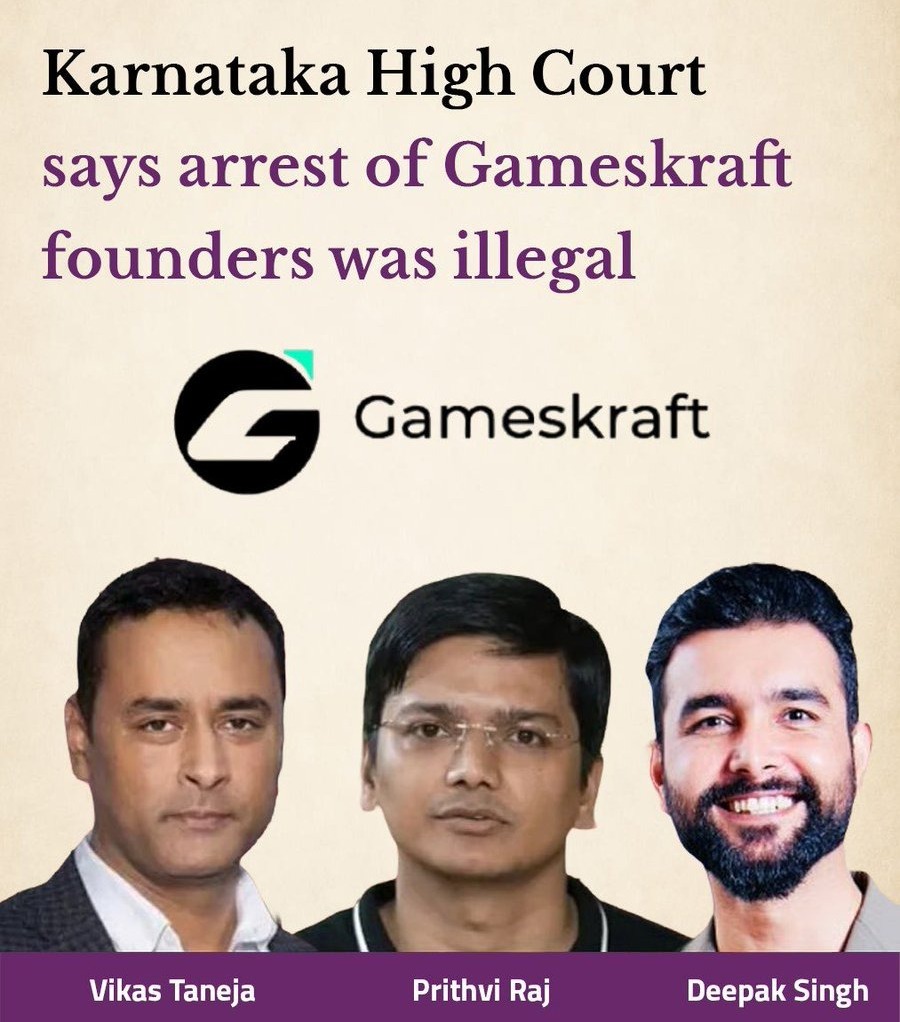
Karnataka HC Slams ED: Arrest of Gameskraft Directors Declared Illegal
Court Upholds Liberty, Questions ED’s Procedure
Ruling May Reshape Future Money Laundering Probes
By Our Legal Correspondent
New Delhi: June 17, 2026:
The Karnataka High Court has ruled that the Enforcement Directorate’s arrest of three Gameskraft directors was illegal, citing violations of statutory safeguards under the Prevention of Money Laundering Act (PMLA). This judgment not only ordered their immediate release but also raised critical questions about due process in financial crime investigations.
When dealing with inheritance disputes, courts often examine the validity, execution, and interpretation of testamentary documents. Several landmark rulings have clarified the legal requirements for a valid will, the role of attesting witnesses, suspicious circumstances, and probate proceedings. Readers looking for authoritative judicial precedents can explore these Supreme Court Judgments on Wills to understand how Indian courts resolve complex succession and property inheritance disputes.
1. Background of the Case
Gameskraft Technologies Pvt. Ltd., a Bengaluru-based online gaming company, faced allegations of fraud and money laundering. The Enforcement Directorate (ED) claimed the company manipulated gameplay, used bots against unsuspecting users, and laundered proceeds through complex financial channels. FIRs registered in Telangana formed the predicate offences under which ED invoked the PMLA.
The arrests of directors Deepak Singh, Vikas Taneja, and Prithviraj Singh in May 2026 followed ED raids across Karnataka and NCR. However, the High Court later declared these arrests unlawful.
2. Key Legal Provisions Discussed
Prevention of Money Laundering Act (PMLA), 2002
Section 19: Grants ED officers power to arrest if they have “reason to believe” based on material in possession. The court found ED failed to demonstrate fresh material justifying immediate custodial action.
Section 45: Bail provisions, requiring stringent conditions for release in money laundering cases. The HC’s ruling bypassed bail considerations by declaring the arrest itself illegal.
Constitutional Safeguards
Article 21: Protection of life and personal liberty. The judgment reinforced that liberty cannot be curtailed without strict adherence to statutory safeguards.
Article 22: Safeguards against arbitrary arrest and detention.
Criminal Procedure Code (CrPC)
Section 41 & 41A: Guidelines for arrest and issuance of summons. The HC questioned why ED did not issue summons instead of arresting the directors.
3. Court’s Reasoning
Justice M. Nagaprasanna emphasized:
Non-compliance with Section 19 PMLA: ED appeared to have prepared arrest grounds in advance, undermining statutory safeguards.
Absence of Fresh Evidence: Arrests were not based on new material obtained during searches.
Predetermined Arrests: The court noted ED’s actions seemed aimed at bypassing earlier judicial stays.
Liberty as Paramount: The ruling underscored that deprivation of liberty requires strict legal justification.
4. Implications of the Judgment
For Enforcement Agencies: Reinforces the need for procedural compliance before arresting individuals under PMLA.
For Online Gaming Sector: Highlights regulatory scrutiny over real-money gaming platforms accused of deceptive practices.
For Judiciary: Sets precedent on balancing investigative powers with constitutional rights.
For Users: Raises awareness about risks of online gaming platforms and potential consumer protection gaps.
5. Wider Context
The Gameskraft case is part of a larger debate on:
Skill vs. Chance in Gaming: Courts have previously distinguished between skill-based games (like rummy) and gambling.
Financial Regulation of Gaming Platforms: With rising complaints of fraud and addiction, regulators face pressure to tighten oversight.
ED’s Expanding Role: The agency has faced criticism for alleged misuse of arrest powers in high-profile cases.
Detailed FAQ (Searchable Index Format)
Q1. What is Section 19 of the PMLA? It empowers ED officers to arrest if they have “reason to believe” based on material evidence. The HC ruled ED failed to meet this threshold.
Q2. Why did the Karnataka High Court declare the arrests illegal? Because ED did not comply with statutory safeguards, lacked fresh evidence, and appeared to predetermine arrests.
Q3. What constitutional rights were invoked? Articles 21 and 22 of the Constitution, protecting liberty and guarding against arbitrary detention.
Q4. Could ED have issued summons instead of arrest? Yes. The HC questioned why ED did not use CrPC provisions like Section 41A to summon the directors.
Q5. What happens to the money laundering probe now? The investigation continues, but arrests have been nullified. Future ED actions must strictly comply with PMLA safeguards.
Q6. How does this affect other PMLA cases? It sets a precedent requiring ED to justify arrests with fresh, tangible evidence, reinforcing judicial oversight.
Q7. What were the allegations against Gameskraft? Manipulating gameplay with bots, cheating users, and laundering proceeds through investments and assets.
Q8. Are online gaming platforms legal in India? Skill-based games are generally legal, but chance-based gambling is prohibited. The distinction remains contentious.
Q9. What relief did the HC grant? Immediate release of the directors, declaring their arrest unlawful.
Q10. What is the significance of this ruling? It strengthens judicial checks on investigative agencies, ensuring liberty is not curtailed without due process.
Conclusion
The Karnataka High Court’s ruling in the Gameskraft case is a landmark in balancing investigative powers with constitutional safeguards. By declaring the arrests illegal, the court reinforced the principle that liberty cannot be compromised by procedural shortcuts. This judgment will likely influence future PMLA cases, reshape enforcement strategies, and intensify debates on regulating India’s booming online gaming industry.