

COURTKUTCHEHRY SPECIAL SERIES ON LANDMARKS JUDGEMENTS ON WILLS, CODICIL & PROBATE
Karmi v. Amru & Ors.: Supreme Court Rules Widow Held Only Life Estate, Not Absolute Ownership
1937 Will Found Valid and Operative
Respondents Bhagtu and Amru Recognized as Remaindermen
By Vishwas Kumar
New Delhi: March 30, 2026:
On 5 January 1971, the Supreme Court of India delivered a pivotal judgment in Karmi v. Amru & Others (Civil Appeal No. 656 of 1967; (1971) 01 SC CK 0004), clarifying the scope of succession rights under the Hindu Succession Act (HSA). The dispute centered on whether Mst. Karmi, widow of Jaimal, held his estate as an absolute owner or merely as a life holder under his Will executed in 1937.
The Trial Court and High Court had examined the Will and concluded that Jaimal had created a life estate for his widow, with the property to pass to his collaterals upon her death. Mst. Karmi, however, argued that her possession should be treated as absolute ownership under Section 14 of the Hindu Succession Act, which converts limited estates held by Hindu women into full ownership.
The matter reached the Supreme Court, where a Bench comprising Hon’ble Chief Justice J.C. Shah, Hon’ble Mr. Justice K.S. Hegde, and Hon’ble Mr. Justice A.N. Grover upheld the finding of fact that the Will was valid and operative. The Court categorically held that the life estate created under the Will did not expand into an absolute estate under Section 14, since the widow’s rights were derived solely from the Will and not from any pre-existing right in the property.
As a result, Mst. Karmi’s claim failed, and the respondents Bhagtu and Amru succeeded to the property as remaindermen under Jaimal’s Will. The ruling reinforced the principle that Section 14 of the HSA cannot be invoked to enlarge a life estate granted by a valid Will into absolute ownership.
This judgment remains a cornerstone in Indian succession law, underscoring the importance of testamentary intent and clarifying the limits of statutory expansion of women’s property rights under the Hindu Succession Act.
For More, Read Here the Summary of the Judgement from the Book: WILL WRITING SIMPLIFIED, read below or open page no 436, Chapter 14.1 in the book. (Online book purchase link available here on: Buy online: Amazon | Flipkart
|
|
Case Summary |
: |
Karmi v. Amru & Ors. |
|
|
Court |
: |
Supreme Court of India |
|
|
Citations |
: |
(1971) 01 SC CK 0004: Civil Appeal No. 656 of 1967. |
|
|
Link |
: |
https://www.courtkutchehry.com/judgements/646540/mst-karmi-vs-amru-and-others/ |
|
|
Decided on |
: |
5 January 1971 |
|
|
Coram |
: |
Hon’ble Mr. Chef Justice J.C. Shah, Hon’ble Mr. Justice K.S. Hegde and Hon’ble Mr. Justice A.N. Grover. |
|
|
Relevant Paragraphs |
: |
Para Nos. 1, 2 & 3 |
1. Facts of the Case:
One Jaimal owned the suit properties. He died in 1938 leaving behind his widow Nihali. His son had predeceased him. The appellant Mst. Karmi was the daughter of the pre-deceased son, while the respondents Bhagtu and Amru were Jaimal’s collaterals. Jaimal executed two registered wills — the first on 18 December 1935 and the second on 13 November 1937 — the latter revoking the former. By the second will he bequeathed his entire estate to his wife Nihali for life and after her death to his collaterals Bhagtu and Amru. Upon Jaimal’s death, mutation was effected in Nihali’s name. She died around 1960–61 having executed a will (25 April 1958) in favour of her grand-daughter Mst. Karmi. A dispute then arose whether Nihali held the properties as a life estate under Jaimal’s will or as his absolute heir.
2. Law Points Involved:
Whether the widow Nihali took the property under Jaimal’s will of 13 November 1937 or as his heir in her own right; and if she took only a life interest under the will, could that limited interest become absolute under Section 14 of the Hindu Succession Act 1956.
3. Acts / Provisions / Articles Referred:
Hindu Succession Act 1956 — Section 14 (1) and (2).
4. Judgments Referred:
Findings of the Trial Court, Additional District Judge, and Punjab High Court on the validity and effect of the 1937 will were examined.
5. Obiter Dicta:
A life estate created by a valid will cannot be enlarged into an absolute estate under Section 14 of the Hindu Succession Act where the widow derived possession solely from the instrument itself and not as an heir of her husband.
6. Ratio Decidendi:
The life interest granted to Nihali under Jaimal’s will was effective and binding. She took the property not as an heir but as a legatee for life. Her interest did not enlarge into full ownership under the Hindu Succession Act. Consequently, her subsequent will in favour of Mst. Karmi conferred no title beyond her life interest.
7. Final Ruling:
Appeal dismissed. The 1937 will of Jaimal was held genuine and operative. Nihali had only a life estate; therefore, Mst. Karmi acquired no right beyond that. No order as to costs.
8. Gist / Dispute and Final Decision:
The dispute concerned succession to Jaimal’s estate — whether his widow’s possession was as an absolute owner or life holder under his will. The Supreme Court upheld the finding of fact that the 1937 will was valid and operative and that the life estate given thereunder did not expand to an absolute estate under Section 14 HSA. Hence Mst. Karmi’s claim failed and the respondents Bhagtu and Amru succeeded to the property as remaindermen under Jaimal’s will.
Read full Judgement Here:
Karmi v. Amru & Ors.
Supreme Court of India
(1971) 01 SC CK 0004: Civil Appeal No. 656 of 1967.
https://www.courtkutchehry.com/judgements/646540/mst-karmi-vs-amru-and-others/
You Can Also Purchase the Book from here on: Buy online: Amazon | Flipkart
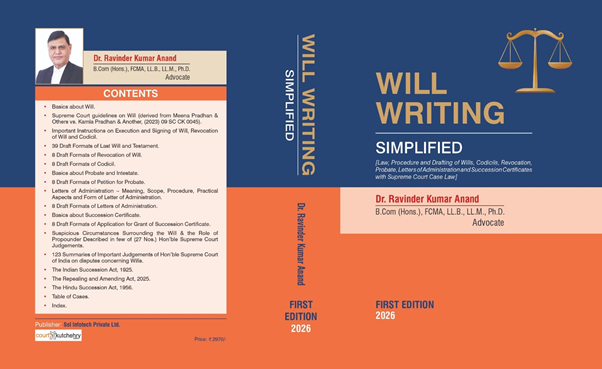
OUR RECOMMENDATION: Check out 123 Key Judgements, as highlighted in the book, WILL WRITING SIMPLIFIED, for the quick research and reference purposes. Click the link here: https://www.courtkutchehry.com/pages/blog/123-supreme-court-judgments-on-wills/
Keywords for Search Optimization
Karmi v. Amru case, Supreme Court of India 1971 judgment, Civil Appeal No. 656 of 1967, Chief Justice J.C. Shah, Justice K.S. Hegde, Justice A.N. Grover, Hindu Succession Act Section 14, widow life estate India, remaindermen succession law, Jaimal’s Will dispute, inheritance rights Supreme Court.