
COURTKUTCHEHRY SPECIAL SERIES ON LANDMARKS JUDGEMENTS ON WILLS, CODICIL & PROBATE
Kanwarjit Singh Dhillon v. Hardyal Singh Dhillon & Others: Supreme Court Clarifies Scope of Probate
Probate Validates Will, Not Ownership Rights
Civil Suit for Joint Family Property Remains Maintainable
By Vishwas Kumar
New Delhi: March 24, 2026:
In Kanwarjit Singh Dhillon v. Hardyal Singh Dhillon & Others (Civil Appeal No. 4890 of 2007, decided on 12 October 2007), the Supreme Court of India addressed a crucial question in succession law: does the grant of probate prevent civil courts from adjudicating ownership disputes? The Division Bench comprising Hon’ble Mr. Justice Tarun Chatterjee and Hon’ble Mr. Justice Dalveer Bhandari delivered a clear ruling that probate proceedings are limited in scope.
The dispute arose within the Dhillon family over joint property rights. One side argued that since probate had already been granted for a Will, no further civil suit could be entertained regarding ownership. The Supreme Court rejected this contention, holding that probate merely affirms the validity of the Will and its due execution. It does not, however, determine title or ownership of the property. Therefore, a civil suit seeking declaration of joint family ownership remains maintainable even after probate has been granted.
The Court emphasized that probate proceedings are confined to verifying whether the Will is genuine and properly executed. Questions of succession, inheritance, or ownership must be adjudicated separately in civil courts. By drawing this distinction, the judgment ensures that probate does not become a substitute for comprehensive adjudication of property rights.
This ruling is significant for inheritance disputes across India, as it clarifies that probate is not conclusive on ownership issues. Families contesting joint property claims can still approach civil courts, even if a Will has been probated. The decision strengthens the principle that probate validates testamentary documents but does not extinguish broader civil rights.
For More, Read Here the Summary of the Judgement from the Book: WILL WRITING SIMPLIFIED, read below or open page no 436, Chapter 14.1 in the book. (Online book purchase link available here on: Buy online: Amazon | Flipkart
|
|
Case Summary |
: |
Kanwarjit Singh Dhillon v. Hardyal Singh Dhillon & Others. |
|
|
Court |
: |
Supreme Court of India |
|
|
Citations |
: |
(2007) 10 SC CK 0119: Civil Appeal No. 4890 of 2007. |
|
|
Link |
: |
|
|
|
Decided on |
: |
12 October 2007 |
|
|
Coram |
: |
Hon’ble Mr. Justice Tarun Chatterjee and Hon’ble Mr. Justice Dalveer Bhandari. |
|
|
Relevant Paragraphs |
: |
Para Nos. 4–13 |
1. Facts of the Case:
The suit property originally belonged to Ishar Singh and was later mutated in the names of his sons Hazara Singh and Kirpal Singh (father of the appellant). After Kirpal Singh’s death, his son (the appellant) claimed the properties as ancestral joint Hindu family property. Eight years later, respondent no. 1 propounded an unregistered Will of late Kirpal Singh, under which he was the sole beneficiary. The widow and unmarried daughter were given only a right of residence. Probate of the Will was granted by the Punjab & Haryana High Court and confirmed by the Supreme Court. Subsequently, the appellant filed a civil suit seeking declaration that the properties were joint family properties and for injunction against alienation.
2. Law Points Involved:
Whether a civil suit for declaration of title and injunction can be maintained after grant of probate of the testator’s Will; scope of jurisdiction of a probate court; effect of probate judgment on title disputes; application of Order XIV Rule 2 CPC regarding preliminary issues.
3. Acts / Provisions / Articles Referred:
(i). Civil Procedure Code, 1908 — Order XIV Rule 2
(ii). Indian Succession Act, 1925 — Provisions relating to probate jurisdiction
4. Judgments Referred:
(i). Smt. Rukmani Devi v. Narendra Lal Gupta, (1984) 09 SC CK 0014.
(ii). Chiranjilal Shrilal Goenka v. Jasjit Singh, (1993) 03 SC CK 0052.
(iii). Ishwardeo Narain Singh v. Kamta Devi, (1953) 02 SC CK 0007.
5. Obiter Dicta:
The Court observed that the probate court is concerned only with the genuineness and due execution of a Will, not with ownership or title of the property bequeathed. Probate is conclusive only of the validity of the Will, not of the testator’s title to property.
6. Ratio Decidendi:
Grant of probate does not bar a separate civil suit to determine ownership or title. The probate court’s jurisdiction is confined to determining whether the Will was validly executed by a competent testator. Questions of whether the property was joint family property or self-acquired must be decided by a civil court after trial. Hence, dismissal of the suit on a preliminary issue was illegal.
7. Final Ruling:
The Supreme Court set aside the orders of the High Court and the trial court. It held that the suit for declaration and injunction was maintainable despite the grant of probate. The trial court was directed to frame issues (including maintainability) and dispose of the suit within one year. Appeal allowed; no order as to costs.
8. Gist Highlighting Dispute with Final Decision:
The dispute centered on whether grant of probate precluded a civil court from adjudicating title. The Court clarified that probate only affirms the validity of the Will and does not determine ownership rights. Thus, a civil suit for declaration of joint family ownership remains maintainable even after probate of the Will.
Read full Judgement Here:
Kanwarjit Singh Dhillon v. Hardyal Singh Dhillon & Others.
Supreme Court of India
(2007) 10 SC CK 0119: Civil Appeal No. 4890 of 2007.
You Can Also Purchase the Book from here on: Buy online: Amazon | Flipkart
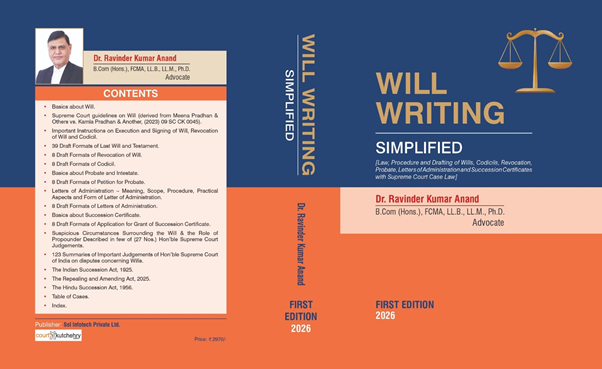
OUR RECOMMENDATION: Check out 123 Key Judgements, as highlighted in the book, WILL WRITING SIMPLIFIED, for the quick research and reference purposes. Click the link here: https://www.courtkutchehry.com/pages/blog/123-supreme-court-judgments-on-wills/
Keywords: Kanwarjit Singh Dhillon v. Hardyal Singh Dhillon, Supreme Court of India 2007, Civil Appeal No. 4890 of 2007, Justice Tarun Chatterjee, Justice Dalveer Bhandari, probate proceedings, ownership rights, joint family property dispute, succession law, Indian inheritance law.