COURTKUTCHEHRY EXCLUSIVE: EXTRACTS FROM BEST SELLING BOOK: WILL WRITING SIMPLIFIED
V. Kalyanaswamy (Dead) by LRs & Anr. vs. L. Bakthavatsalam (Dead) by LRs & Ors. (2020): Supreme Court on Secondary Evidence, Suspicious Circumstances, and Widow’s Rights
Section 69 Evidence Act and Secondary Proof of Wills
Rational Disposition and Limits of Widow’s Rights
By Vishwas Kumar
New Delhi: April 07, 2026:
The Supreme Court’s decision in V. Kalyanaswamy (Dead) by Legal Representatives & Anr. vs. L. Bakthavatsalam (Dead) by Legal Representatives & Ors., (2020) 07 SC CK 0008: Civil Appeal Nos. 1021–1026 of 2013 with 1027–1050 of 2013 is a landmark ruling in succession law. It addressed the proof of wills when attesting witnesses are dead, the admissibility of secondary evidence, and the rationality of dispositions excluding certain heirs. Lawyers continue to cite this case because it clarifies long-standing ambiguities in succession disputes and reinforces judicial principles on suspicious circumstances.
These principles are further explained in this database of inheritance law rulings. Supreme Court judgments on inheritance and wills , including the landmark case of Mst. Karmi vs Amru and Others, which clarifies key aspects of succession and property rights under Indian law.
Soundness of Mind and Voluntary Execution
The testator, R. Rangaswami Naidu, was in an advanced stage of throat cancer and feeding through a tube. Despite his condition, he insisted on signing the will himself rather than using a thumb impression. The Court held this was a conscious act, demonstrating sound disposing mind. The finding of the first appellate court was accepted, showing that physical illness does not automatically imply incapacity (Paras 35, 120, 124).
Secondary Evidence under Section 69 Evidence Act
The original will of 1955 was not produced before the civil court; only a certified copy was marked. Since both attesting witnesses were dead and the original had been filed in prior proceedings under Section 145 CrPC, the Court held that secondary evidence was rightly admitted under Section 69 of the Evidence Act. Proof of handwriting and signature sufficed when attesting witnesses were unavailable. This ruling is crucial for cases where old wills are contested and originals are missing (Paras 18–19, 31, 120–122).
Minor Discrepancies Not Fatal
The challengers pointed to contradictions regarding the place of registration—whether at home or at Ammani Ammal’s house. The Court dismissed this as immaterial, emphasizing that contemporaneous registration and personal signature before the Sub-Registrar dispelled suspicion (Para 33, 120).
Executor’s Role and Beneficiaries
The executor was the wife’s nephew, not a direct heir. The Court held this choice did not raise suspicion, as he was a neutral and trusted person. The will’s beneficiaries were the testator’s sisters’ sons, excluding his brother’s family. The Court found this rational, given his affection for sisters and absence of children. Disposition to nephews was not “unnatural” (Paras 31–32, 120–121).
Allegations of Forgery and Undue Influence
The trial court doubted genuineness, but the first appellate court and Supreme Court found no evidence of coercion or undue influence. The burden of proof lay on challengers, who failed to discharge it. The Court reiterated that once propounders explain suspicious circumstances, the will should not be rejected on conjecture (Paras 31, 35, 120–121).
Widow’s Rights under Hindu Succession Act
The widow, Krishnammal, was given life interest under the will. The Court held this rational and protective, ensuring maintenance. Importantly, it applied Section 14(2) of the Hindu Succession Act, holding that her life interest was not enlarged into absolute ownership. This clarified the scope of widow’s rights in testamentary dispositions (Paras 31–32, 130–134).
Consistent Conduct and Registration
The propounders had consistently acknowledged the will in earlier suits (O.S. 36/1963, O.S. 732/1981). This continuity fortified its genuineness. Registration contemporaneous with execution, and the testator’s personal signature, were strong indicators of voluntariness (Paras 31–32, 120–122).
Limits of High Court under Section 100 CPC
The Supreme Court criticized the High Court for reappreciating evidence in second appeal. Under Section 100 CPC, the High Court cannot reassess concurrent factual findings unless there is a substantial question of law. This reinforced appellate discipline (Paras 35, 120–122).
Why Lawyers Still Cite This Case
- Secondary Evidence Clarification: Establishes that certified copies and proof of handwriting suffice when attesting witnesses are dead.
- Suspicious Circumstances Doctrine: Clarifies that minor inconsistencies or exclusion of heirs are not inherently suspicious.
- Widow’s Rights: Defines limits of Section 14(2) Hindu Succession Act, preventing automatic enlargement of life interest.
- Appellate Discipline: Reinforces that High Courts cannot reappreciate evidence under Section 100 CPC.
- Practical Utility: Provides a roadmap for proving old wills where originals are missing and witnesses unavailable.
RESEARCH RESOURCES:
Read all probate law judgments here. Click the link here: https://www.courtkutchehry.com/pages/blog/123-supreme-court-judgments-on-wills/
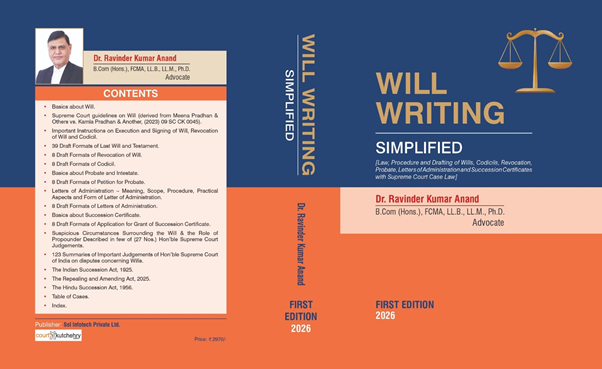
EXTRACTS FROM BOOK, WILL WRITING SIMPLIFIED, By Dr Ravinder Kumar Anand. [📘 Buy Will Writing Simplified online: Amazon | Flipkart ]
Case Title V. Kalyanaswamy (Dead) by Legal Representatives & Anr. vs. L. Bakthavatsalam (Dead) by Legal Representatives & Ors. (2020) 07 SC CK 0008: Civil Appeal Nos. 1021-1026 of 2013 with 1027-1050 of 2013.
| Suspicious Circumstance | Court’s Observation & Para Reference in the Judgement |
|---|---|
| Testator suffering from throat cancer | Court held he had sound mind; signature showed conscious act. [Paras 35, 120, 124] |
| Delay in producing Will | Secondary evidence accepted under Section 69 Evidence Act. [Paras 18–19, 31] |
| Contradictions in registration place | Minor inconsistency; not material. [Para 33] |
| Executor involvement | No suspicion; trusted person. [Paras 18, 31] |
| Selection of beneficiaries | Natural and rational distribution. [Paras 31–32] |
| Allegation of forgery | No proof of coercion or undue influence. [Paras 31, 35] |
| Missing scribe evidence | Not fatal; Will still proved. [Para 20] |
| Coparcenary property issue | Valid Will due to prior partition. [Paras 31–32] |
| Registration | Registration supports genuineness. [Paras 31] |
FAQs
Q1: Can a will be proved if both attesting witnesses are dead?
Yes. Under Section 69 of the Evidence Act, proof of handwriting and signature suffices when attesting witnesses are unavailable.
Q2: Does omission of certain heirs make a will suspicious?
No. The Supreme Court held that exclusion of heirs is not per se suspicious, as wills are meant to alter normal succession.
Q3: What if the original will is missing?
Secondary evidence, such as certified copies, is admissible if the original was lost or filed in prior proceedings.
Q4: Can minor discrepancies in registration invalidate a will?
No. Minor inconsistencies do not nullify a will if execution and registration are otherwise proved.
Q5: Does a widow’s life interest automatically become absolute under Hindu Succession Act?
No. Under Section 14(2), a life interest created by will remains limited unless expressly enlarged.
Q6: Can the High Court reassess evidence in second appeal?
No. Under Section 100 CPC, the High Court cannot reappreciate concurrent factual findings unless a substantial question of law arises.
BOOK REFERENCE:
[📘 Buy Will Writing Simplified online: Amazon | Flipkart ]