

COURTKUTCHEHRY SPECIAL SERIES ON LANDMARKS JUDGEMENTS ON WILLS, CODICIL & PROBATE
K. Naina Mohamed (Dead) Through LRs. v. A.M. Vasudevan Chettiar (Dead) Through LRs. & Ors.: Supreme Court Upholds Validity of Restrictive Clause in Will, Dismisses Appeal
Family-Only Sale Clause Found Enforceable
Rule Against Perpetuity Not Violated, Heirs’ Rights Affirmed
By Vishwas Kumar
New Delhi: March 23, 2026:
On 07 July 2010, the Supreme Court of India delivered a pivotal judgment in K. Naina Mohamed (Dead) Through LRs. v. A.M. Vasudevan Chettiar (Dead) Through LRs. & Ors. (Civil Appeal No. 8365 of 2002), addressing the enforceability of restrictive clauses in testamentary documents. The dispute centered on a Will executed by a family patriarch, which contained a clause prohibiting the sale of family property to outsiders, while permitting transactions within the family circle.
collection of top inheritance and will judgments of K.Naina Mohamed Case
The appellant challenged the validity of this clause, arguing that it offended the rule against perpetuity and unlawfully restricted alienation of property. However, a Division Bench comprising Justice G.S. Singhvi and Justice Asok Kumar Ganguly upheld the clause, ruling that such a condition amounted to a valid pre-emptive provision rather than an impermissible restraint.
The Court emphasized that the clause did not create an indefinite restriction but merely ensured that property remained within the family. It further clarified that such conditions are enforceable against purchasers who have notice of the restriction. By dismissing the appeal, the Supreme Court affirmed the decree in favour of the respondent-heirs, thereby safeguarding their rights under the Will.
This ruling is significant as it distinguishes between absolute restraints on alienation, which are void, and reasonable family-based pre-emptive clauses, which are legally sustainable. It reinforces the principle that testamentary freedom allows testators to impose conditions that preserve family assets, provided they do not contravene statutory prohibitions.
The judgment in K. Naina Mohamed v. A.M. Vasudevan Chettiar remains a guiding precedent in succession law, balancing individual property rights with the testator’s intent to maintain family ownership.
For More, Read Here the Summary of the Judgement from the Book: WILL WRITING SIMPLIFIED, read below or open page no 436, Chapter 14.1 in the book. (Online book purchase link available here on: Buy online: Amazon | Flipkart
|
|
Case Summary |
: |
K. Naina Mohamed (Dead) Through LRs. v. A.M. Vasudevan Chettiar (Dead) Through LRs. & Ors. |
|
|
Court |
: |
Supreme Court of India |
|
|
Citations |
: |
(2010) 07 SC CK 0043: Civil Appeal No. 8365 of 2002. |
|
|
Link |
: |
|
|
|
Decided on |
: |
07 July 2010 |
|
|
Coram |
: |
Hon’ble Mr. Justice G.S. Singhvi and Hon’ble Mr. Justice Asok Kumar Ganguly. (Division Bench) |
|
|
Relevant Paragraphs |
: |
Para Nos. 2–28 |
1. Facts of the Case:
Smt. Ramakkal Ammal executed a Will (22.09.1951) bequeathing her properties, creating life interests for her two sisters, Savithri Ammal and Rukmani Ammal, and granting absolute rights to their respective male heirs after their demise, with a restriction that the heirs could sell property only to family sharers and not to strangers. After Savithri’s death, a compromise partition (O.S. No. 473/1981) confirmed this arrangement. Later, Rukmani Ammal and her son sold “B” property to appellant K. Naina Mohamed, which was challenged by the respondents (heirs of Savithri Ammal) in O.S. No. 226/1983 as violating Clause 11 of the Will.
2. Law Points Involved:
Whether (i) the restriction in Clause 11 against sale to strangers was void as violating the rule against perpetuity, (ii) the sale deed executed in breach of that clause was invalid, and (iii) the second appeal before the High Court abated due to non-impleadment of legal representatives of deceased parties under Order XXII CPC.
3. Acts / Provisions / Articles Referred:
(i). Code of Civil Procedure, 1908 — Sections 2(11), Order XXII Rules 2, 4, 9(2), 10, 11, Order I Rule 9.
(ii). Indian Succession Act, 1925 — Section 114 (Rule against perpetuity).
(iii). Transfer of Property Act, 1882 — Sections 14, 54.
(iv). Bengal Tenancy Act, 1885 — Section 105.
4. Judgments Referred:
(i). State of Punjab v. Nathu Ram, (1961) 05 SC CK 0012;
(ii). Deokuer v. Sheoprasad Singh, (1965) 04 SC CK 0003;
(iii). Madan Naik v. Hansubala Devi, (1983) 04 SC CK 0019;
(iv). Amar Singh v. Lal Singh, (1996) 02 SC CK 0269;
(v). Amba Bai v. Gopal, (2001) 05 SC CK 0035;
(vi). Mohd. Arif v. Allah Rabbul Alamin, (1982) 02 SC CK 0010;
(vii). Ghafoor Ahmad Khan v. Bashir Ahmad Khan, (1982) 11 SC CK 0036;
(viii). Ram Baran Prasad v. Ram Mohit Hazra, (1966) 09 SC CK 0008;
(ix). Zila Singh v. Hazari, (1979) 02 SC CK 0051;
(x). Mohammad Raza v. Mt. Abbas Bandi Bibi, (1932) 04 PRI CK 0006;
(xi). Bishan Singh v. Khazan Singh, (1958) 05 SC CK 0006;
(xii). Shivji v. Raghunath, (1997) 02 SC CK 0133.
5. Obiter Dicta:
A restriction against alienation to strangers that allows transfer within family does not offend the rule against perpetuity. The object of such condition preserving property within family lineage is lawful and equitable. Family arrangements imposing such conditions are favored in law.
6. Ratio Decidendi:
(i). Clause 11 of the Will imposing restriction on alienation to strangers is not void; it is a valid partial restriction permitting intra-family transfer.
(ii). The rule against perpetuity under Section 114, Indian Succession Act, applies only when vesting is indefinitely postponed; a conditional pre-emptive restriction within family does not attract it.
(iii). Purchaser from a legatee with notice of restriction is bound by it.
(iv). Non-impleadment of legal representatives of deceased parties did not cause abatement as the appellant-purchaser represented their estate (Order XXII Rule 10 CPC).
7. Final Ruling:
Appeal dismissed. The Supreme Court upheld the Madras High Court judgment restoring the trial court decree directing execution of sale deed in favor of respondents. The restriction in Clause 11 of the Will was held valid, the sale to the appellant void, and the plea of abatement rejected. No order as to costs.
8. Gist (Dispute & Final Decision):
The central dispute concerned the validity of a restrictive clause in a Will prohibiting sale of family property to strangers. The Court held such a condition allowing sale within the family but not to outsiders is a valid pre-emptive clause, not offending the rule against perpetuity, and enforceable against purchasers with notice. The appeal was dismissed, affirming the respondent-heirs’ right under the Will
Read full Judgement Here:
K. Naina Mohamed (Dead) Through LRs. v. A.M. Vasudevan Chettiar (Dead) Through LRs. & Ors.
Supreme Court of India
(2010) 07 SC CK 0043: Civil Appeal No. 8365 of 2002.
You Can Also Purchase the Book from here on: Buy online: Amazon | Flipkart
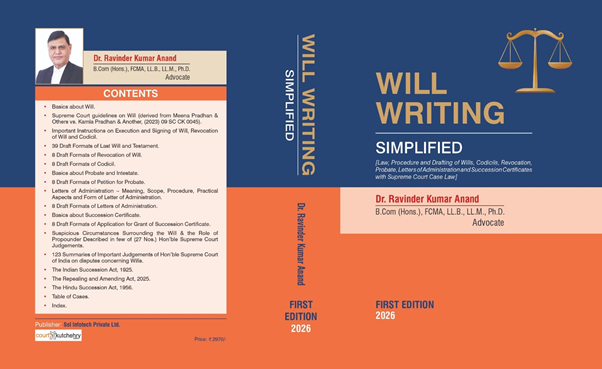
OUR RECOMMENDATION: Check out 123 Key Judgements, as highlighted in the book, WILL WRITING SIMPLIFIED, for the quick research and reference purposes. Click the link here: https://www.courtkutchehry.com/pages/blog/123-supreme-court-judgments-on-wills/
Keywords for SEO & Faster Searches
-
- Naina Mohamed v. A.M. Vasudevan Chettiar Supreme Court
- 2010 inheritance dispute judgment India
- Restrictive clause in Will property law
- Rule against perpetuity India Supreme Court
- Civil Appeal No. 8365 of 2002
- Supreme Court family property sale restriction ruling