
Watch the Video
In this 9-minute video, CourtKutchehry presents Episode 10 of “Will Writing Explained”, based on the book “Will Writing Simplified” by Dr. Ravinder Kumar Anand, Advocate. A husband and wife write one will together: everything to the survivor, then to the children. Twenty years later, the survivor remarries and writes a new will. Can she? It depends on one word: mutual. The episode explains joint wills, mutual wills, and the privileged wills of soldiers, airmen and mariners under Sections 65 and 66 of the Indian Succession Act, 1925. This article follows its seven questions.
Q1. What Is a Joint Will?
A joint will is a single document executed by two or more persons, usually a husband and wife, setting out what should happen to their property. In law it is treated as two (or more) wills on one paper:
- each testator’s part operates as his or her own will;
- each part takes effect only on that testator’s death; and
- each testator remains free to revoke his or her own part during life, like any other will.
A joint will must meet the usual formalities: each testator signs and the will is attested by two witnesses under Section 63.
Q2. What Is a Mutual Will?
A mutual will adds something more: an agreement between the testators, typically that each leaves property to the other and that the survivor will not change the final arrangement. The wills are made in reliance on each other.
The Supreme Court explained the difference in Dr. K.S. Palanisami v. Hindu Community in General, (2017) 03 SC CK 0048. A joint will is one document operating as each testator’s own will; a mutual will involves reciprocal benefits. Once the first testator dies without revoking, and the survivor takes the benefit under the will, the survivor is bound by the arrangement and cannot defeat it by a later will. In that case, the couple’s 1968 will was held joint and mutual as to its charitable purpose, and a later will made by the survivor in 1980 could not override that obligation, though the survivor’s lifetime sales were upheld.
Remember this line: a joint will is about one paper; a mutual will is about one promise.
Q3. How Does a Court Decide Whether a Joint Will Is Mutual?
A joint will is not presumed to be mutual. The court reads the will as a whole, and any surrounding evidence, to see whether the testators agreed to bind each other. Indications include:
- reciprocal gifts, each to the survivor;
- a common plan for the property after both deaths, such as “and after us, to our children equally”;
- words showing that the survivor may not revoke or alter the arrangement.
Because so much turns on this, the will should say expressly whether the survivor is free to change the arrangement or bound by it. Silence is an invitation to litigation, as the opening story shows.
Q4. One Joint Will or Two Separate Wills for a Couple?
For most couples the practical advice is two separate wills with mirror provisions, signed on the same occasion before the same witnesses. Each spouse leaves property to the other, and then to the same final beneficiaries. This gives:
- clarity about whose property is being dealt with;
- freedom for each spouse to update his or her own will, including after the other’s death; and
- no argument later about whether there was a binding mutual agreement.
If a couple genuinely wants the survivor to be bound, that is a serious decision, and the will should state it in clear terms, ideally with legal advice.
Q5. What Is a Privileged Will? (Sections 65 and 66)
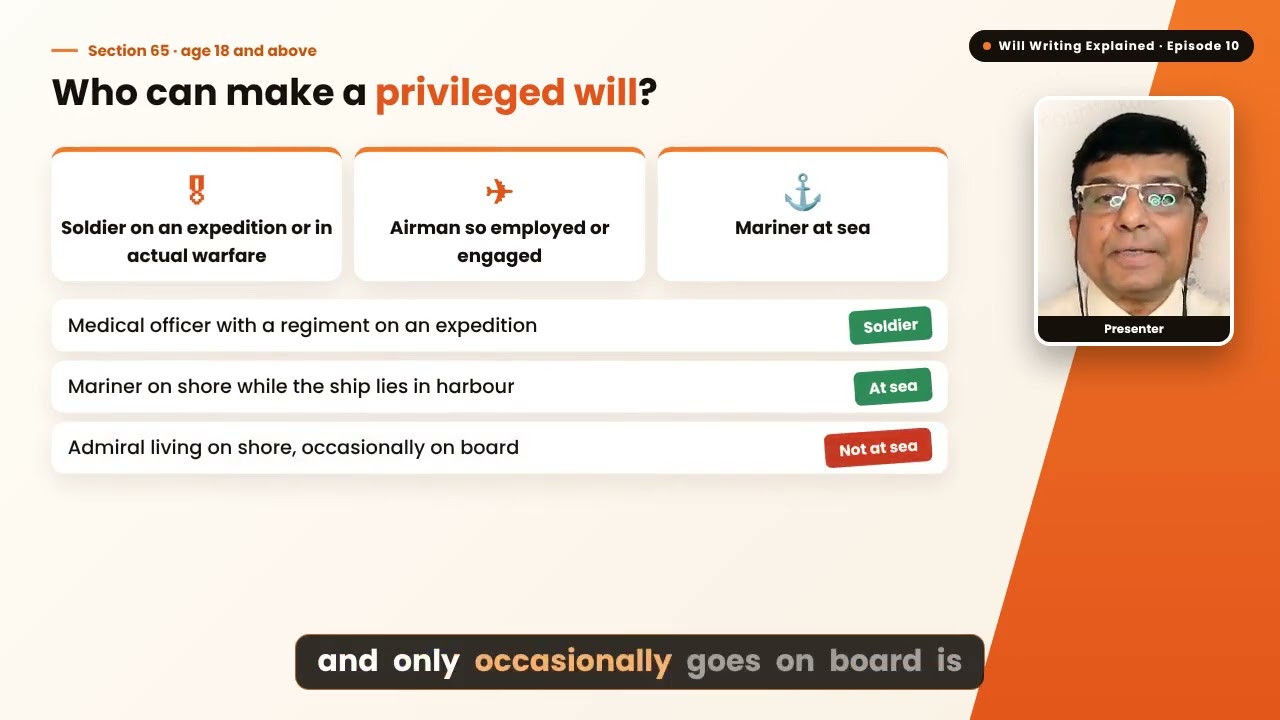
Section 65 allows a soldier employed in an expedition or engaged in actual warfare, an airman so employed or engaged, or a mariner at sea, who has completed 18 years, to make a will in the relaxed manner set out in Section 66. Such wills are called privileged wills.
Section 66 relaxes the formalities because such a person may have no time or means to arrange two witnesses. A privileged will may be made in writing or by word of mouth. For example, a will written wholly in the testator’s own hand need not be signed or attested, and an oral will may be declared before two witnesses present at the same time. An oral privileged will becomes void one month after the testator, being still alive, ceases to be entitled to make a privileged will.
Q6. Can a Hindu Soldier Make a Privileged Will?
Under the Indian Succession Act, no. Wills of Hindus, Buddhists, Sikhs and Jains are governed by the provisions of Part VI that Schedule III extends to them, and Sections 65 and 66 are not in Schedule III. A Hindu soldier, airman or sailor must therefore follow the ordinary rules of Section 63: a signature or mark and two attesting witnesses.
The practical lesson for service personnel from these communities is to make a proper, attested will in peacetime, keep it safe, and update it after postings, marriage or the birth of children.
Q7. What Is an “Unprivileged” Will?
Every will that is not a privileged will is an unprivileged will. That is the ordinary will made by almost everyone, and it must be executed under Section 63: signed or marked by the testator (or by another person in his presence and by his direction), with the signature placed to give effect to the will, and attested by two or more witnesses who each sign in the testator’s presence.
In other words, the “privilege” is only an exception for those in active service or at sea. For everyone else, there is no shortcut.
Key Takeaways
- A joint will is two wills on one paper: each part operates on that testator’s death and each can revoke his or her part.
- A mutual will adds an agreement; once the first spouse dies and the survivor takes the benefit, the survivor is bound (Dr. K.S. Palanisami, 2017).
- A joint will is not presumed to be mutual; say clearly whether the survivor is free or bound.
- For most couples, two separate mirror wills, signed together, are the practical choice.
- Sections 65 and 66 allow soldiers, airmen and mariners at sea to make privileged wills, but these sections do not apply to Hindus, Buddhists, Sikhs and Jains.
Frequently Asked Questions
What is the difference between a joint will and a mutual will?
A joint will is a single document operating as each testator’s own will. A mutual will involves an agreement and reciprocal benefits; after the first death, a survivor who takes the benefit is bound by it.
Can the surviving spouse change a joint will?
If the will is only joint, yes, as to the survivor’s own part. If it is also mutual and the survivor has taken the benefit after the first death, the survivor cannot defeat the agreed arrangement (Dr. K.S. Palanisami v. Hindu Community in General).
Should a husband and wife make one joint will?
Usually two separate wills with mirror provisions are better. They avoid disputes about whether the survivor is bound and allow each spouse to update his or her own will.
Who can make a privileged will?
Under Section 65, a soldier employed in an expedition or engaged in actual warfare, an airman so employed or engaged, or a mariner at sea, aged 18 or above, in the manner set out in Section 66.
Can a Hindu soldier make an oral will?
Not under the Indian Succession Act. Sections 65 and 66 are not extended to Hindu wills by Schedule III, so a Hindu soldier must make an ordinary will under Section 63.
Where can I watch the full explanation?
Watch the full explanation in 9 minutes: https://youtu.be/mI3wqdyhH3Y.
Conclusion
A joint will is a convenience; a mutual will is a commitment. Couples who sign one document together should decide, and write down, whether the survivor will be free to change the plan or bound by it. For most families, two mirror wills are simpler and safer.
Privileged wills are a narrow exception for soldiers, airmen and mariners in active service, and they are not available to Hindus, Buddhists, Sikhs and Jains under the Act. Everyone else must sign before two witnesses under Section 63.
▶ Watch the video: Joint Will, Mutual Will & Privileged Will Explained | Will Writing Explained – Ep 10
📖 Read more: Dr. K.S. Palanisami v. Hindu Community: Supreme Court Upholds Charitable Obligations in Joint Will
Research Judgments Like These on CourtKutchehry
Every judgment cited in this article, and lakhs more, can be searched and read on CourtKutchehry. Searching and reading judgments is free. A membership adds unlimited summaries, all related judgments, original court PDF downloads, bookmarks, notes and the CourtKutchehry AI assistant.
| Membership | Price | Works out to | AI credits |
|---|---|---|---|
| Monthly (1 month) | ₹599 | ₹599 / month | 1,000 / month |
| Quarterly (3 months) · Save 16% | ₹1,499 | ₹499.67 / month | 1,100 / month |
| Six-monthly (6 months) · Save 33% | ₹2,399 | ₹399.83 / month | 1,200 / month |
| Yearly (12 months) · Save 44% · Best value | ₹3,999 | ₹333.25 / month | 1,300 / month |
Every plan is a one-off purchase for a fixed period: nothing auto-renews and no card is kept on file. Prices are exclusive of applicable tax, which is added at checkout. Extra AI chat credits can be topped up from ₹99. A free verified account gets 5 summaries and 50 AI trial credits.
Prices are as displayed on courtkutchehry.com on 20 November 2026 and are subject to change without notice. Please check the pricing page for the current plans and offers.
For more judgments, legal opinions and case analysis, visit courtkutchehry.com
Visit CourtKutchehry →