

COURTKUTCHEHRY SPECIAL SERIES ON LANDMARKS JUDGEMENTS ON WILLS, CODICIL & PROBATE
Smt Jaswant Kaur v. Smt Amrit Kaur & Ors.: Supreme Court Rejects Suspicious Will, Restores Daughter’s Share
1945 Will of Sardar Gobinder Singh Found Unreliable
Heavy Onus on Propounder Not Discharged
By Vishwas Kumar
New Delhi: March 28, 2026:
On 25 October 1976, the Supreme Court of India in Smt Jaswant Kaur v. Smt Amrit Kaur & Ors. (Civil Appeal No. 1360 of 1975) delivered a landmark ruling on the genuineness of a disputed will executed in 1945 by Sardar Gobinder Singh. The Full Bench comprising Hon’ble Mr. Justice Y.V. Chandrachud, Hon’ble Mr. Justice P.K. Goswami, and Hon’ble Mr. Justice A.C. Gupta examined whether the will could withstand scrutiny considering several suspicious circumstances.
The Court noted a long delay in producing the will, absence of credible attesting witnesses, lack of testimony from executors, and the unnatural exclusion of close relatives. Additionally, the explanations offered by the propounder were deemed implausible. These factors collectively cast serious doubt on the authenticity of the will. The Court emphasized that in cases of contested wills, the propounder bears a heavy burden of dispelling suspicion and proving the document’s genuineness. In this case, that burden was not discharged.
Upholding the trial court’s findings, the Supreme Court ruled that the will was not genuine. Consequently, the Court restored Gulab Kaur’s heir, Jaswant Kaur, to her rightful half share in the estate, thereby rejecting the defendant’s claim. The judgment reinforced the principle that testamentary documents must be proved with clear and convincing evidence, especially when they exclude natural heirs or emerge under doubtful circumstances.
This ruling remains a cornerstone in succession law, highlighting the judiciary’s vigilance in protecting rightful heirs against suspicious wills and ensuring that inheritance rights are not undermined by fabricated or unreliable documents.
For More, Read Here the Summary of the Judgement from the Book: WILL WRITING SIMPLIFIED, read below or open page no 436, Chapter 14.1 in the book. (Online book purchase link available here on: Buy online: Amazon | Flipkart
|
|
Case Summary |
: |
Smt Jaswant Kaur v. Smt Amrit Kaur and Others. |
|
|
Court |
: |
Supreme Court of India |
|
|
Citations |
: |
(1976) 10 SC CK 0028: Civil Appeal No. 1360 of 1975. |
|
|
Link |
: |
https://www.courtkutchehry.com/judgements/649331/smt-jaswant-kaur-vs-smt-amrit-kaur-and-others/
|
|
|
Decided on |
: |
25 October 1976 |
|
|
Coram |
: |
Hon’ble Mr. Justice Y.V. Chandrachud Hon’ble Mr. Justice P.K. Goswami and Hon’ble Mr. Justice A.C. Gupta. (Full Bench) |
|
|
Relevant Paragraphs |
: |
Para Nos. 8–10, 14–26. |
1. Facts of the Case:
Sardar Gobinder Singh Sibia, a wealthy landowner, died in 1954 leaving two wives Gulab Kaur and Dalip Kaur. After his death, Gulab Kaur filed a suit seeking maintenance or half share in the estate. The defendant, her co-wife’s grandson Surjit Inder Singh, later produced a will allegedly executed by Gobinder Singh in 1945, leaving almost the entire estate to himself. The will was introduced belatedly in the proceedings and was never previously disclosed. The trial court rejected the will and decreed a half share to Gulab Kaur’s heir, Jaswant Kaur. The High Court reversed that decree, accepting the will as genuine. Jaswant Kaur appealed to the Supreme Court.
2. Law Points Involved:
(i). Burden of proof on propounder of a will to establish due execution and remove all suspicious circumstances.
(ii). Principles governing proof of wills under Section 63 of the Indian Succession Act, 1925 and Section 68 of the Evidence Act, 1872.
(iii). When execution is surrounded by suspicious circumstances, the Court must be satisfied in its conscience regarding genuineness of the testament.
(iv). Impact of Hindu Succession Act, 1956 on rights of widows vis-à-vis customary law.
(v). Nature of revocation of wills under Section 70 of the Succession Act.
3. Acts / Provisions / Articles Referred:
(i). Indian Succession Act, 1925: Sections 63, 70
(ii). Indian Evidence Act, 1872: Sections 4, 8, 14(1), 63
(iii). Hindu Succession Act, 1956: Sections 4, 8, 14(1)
4. Judgments Referred:
H. Venkatachala Iyengar v. B.N. Thimmajamma, (1958) 11 SC CK 0008.
5. Obiter Dicta:
The Court emphasized that proof of a will is not a mere adversarial exercise but a solemn matter engaging the Court’s conscience. Suspicious circumstances such as unnatural dispositions, delay in producing the will, doubtful attestation, or the propounder’s benefit require strict scrutiny and cogent explanation. Absence of such explanation invalidates the will irrespective of formal proof.
6. Ratio Decidendi:
When the execution of a will is shrouded in suspicion, the propounder must remove all legitimate doubts by satisfactory evidence. Failure to explain material suspicious circumstances renders the will invalid. The High Court erred in ignoring this settled principle and accepting the will without examining suspicious features.
7. Final Ruling:
Appeal allowed. Judgment of Punjab & Haryana High Court set aside; trial court decree restored. The will of Sardar Gobinder Singh held not proved; Jaswant Kaur entitled to one-half share in the estate. Costs awarded to appellant in both Supreme Court and High Court.
Read full Judgement Here:
Smt Jaswant Kaur v. Smt Amrit Kaur and Others.
Supreme Court of India
(1976) 10 SC CK 0028: Civil Appeal No. 1360 of 1975.
https://www.courtkutchehry.com/judgements/649331/smt-jaswant-kaur-vs-smt-amrit-kaur-and-others/
You Can Also Purchase the Book from here on: Buy online: Amazon | Flipkart
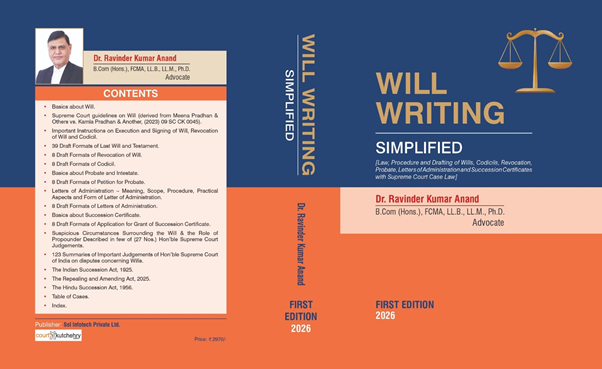
OUR RECOMMENDATION: Check out 123 Key Judgements, as highlighted in the book, WILL WRITING SIMPLIFIED, for the quick research and reference purposes. Click the link here: https://www.courtkutchehry.com/pages/blog/123-supreme-court-judgments-on-wills/
Keywords for SEO & Quick Search
- Jaswant Kaur v. Amrit Kaur Supreme Court case
- 1976 Indian Supreme Court will dispute judgment
- Sardar Gobinder Singh disputed will case
- Suspicious circumstances in will execution India
- Justice Y.V. Chandrachud inheritance ruling
- Civil Appeal No. 1360 of 1975 Supreme Court
- Apex Court daughter’s share inheritance ruling India
8. Gist Highlighting Dispute with Final Decision:
The dispute centered on whether the 1945 will of Sardar Gobinder Singh was genuine. The Supreme Court found numerous suspicious circumstances the long delay in producing the will, lack of credible attesting witnesses, absence of executors’ testimony, unnatural exclusion of close relatives, and implausible explanations by the propounder. Upholding the trial court, the Court ruled that the defendant failed to discharge the heavy onus of proving the will, thereby restoring Gulab Kaur’s heir Jaswant Kaur’s half share in the estate.