
COURTKUTCHEHRY EXCLUSIVE: EXTRACTS FROM BEST SELLING BOOK: WILL WRITING SIMPLIFIED
Supreme Court Rejects Suspicious Will in Smt Jaswant Kaur v. Smt Amrit Kaur: Lessons for Indian Succession Law
Court stresses heavy burden on propounders to dispel doubts when execution of a Will is surrounded by suspicion.
The 1976 ruling remains a benchmark in evaluating fairness, witness credibility, and unexplained delays in producing Wills.
By Vishwas Kumar
New Delhi: April 02, 2026:
Few legal battles are as emotionally charged as disputes over Wills. When property worth lakhs are at stake, families often clash over whether a Will is genuine or fabricated. Courts must then decide if the document truly reflects the testator’s wishes or if it is clouded by suspicion In Smt Jaswant Kaur v. Smt Amrit Kaur and Others (1976) [ Access the full judgement here: https://www.courtkutchehry.com/judgements/649331/smt-jaswant-kaur-vs-smt-amrit-kaur-and-others/ ]
, the Supreme Court of India dealt with precisely such a situation. The case involved a Will allegedly executed in 1945 but produced only in 1957, long after the testator’s death. The Court found multiple suspicious circumstances — from unexplained delays to contradictory witness testimony — and ultimately rejected the Will.
This judgment is a cornerstone in Indian succession law, clarifying the principles governing suspicious Wills and reinforcing the importance of credible evidence.
Detailed Explanation of the Extract
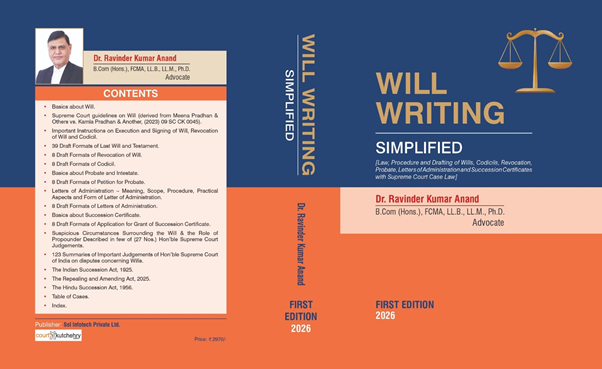
The extract from Will Writing Simplified by Dr. Ravinder Kumar Anand [📘 Buy Will Writing Simplified by Dr. Ravinder Kumar Anand online: Amazon | Flipkart] highlights the suspicious circumstances and the Court’s observations. Here is a plain-language breakdown:
- Burden of Proof on Propounder: The Court held that when execution is shrouded in suspicion, the propounder must satisfy the conscience of the Court that the Will was duly executed.
- Principles from Earlier Cases: Reiterating Venkatachala Iyengar v. Thimmajamma, the Court said that shaky signatures, feeble minds, unfair dispositions, or active participation of beneficiaries demand strict scrutiny.
- Suppression of Will: The Will was allegedly made in 1945 but surfaced only in 1957 — twelve years later and two-and-a-half years after the testator’s death. The Court found it unbelievable that such a document remained hidden.
- Timing of Discovery: The Will was suddenly produced after the Hindu Succession Act, 1956 came into force. The Court called this explanation “patently lame and unacceptable.”
- Form of Will: It was typed on both sides of a single sheet, with no drafting details or property descriptions. The Court found this highly irregular.
- Witness Credibility: The attesting witnesses were complete strangers, and their testimonies contradicted each other. The Court said it was impossible to believe they attested at the testator’s instance.
- Executors Not Examined: Both executors were alive but not examined. The Court found it hard to believe the testator would appoint executors without their knowledge.
- Unnatural Disposition: The testator excluded his wife, daughter, widowed daughter-in-law, and granddaughter, giving everything to one grandson. The Court found this disposition unfair and unnatural.
- Baseless Allegations Against Wife: The Will accused the wife of misconduct, but the Court found no evidence. In fact, she was blind for years before 1956.
- Cumulative Effect: The defendant failed to explain any of these suspicious circumstances. The Court said he had “totally failed to discharge the heavy onus.”
- High Court’s Error: The Supreme Court criticized the High Court for ignoring these suspicions and restored the Trial Court’s decree rejecting the Will.
Legal Context
- Indian Succession Act, 1925:
- Section 63 requires a Will to be signed by the testator and attested by two witnesses.
- Section 68 of the Evidence Act requires at least one attesting witness to prove execution.
- Doctrine of Suspicious Circumstances:
- As reaffirmed in Venkatachala Iyengar, if suspicious circumstances exist, the propounder must remove them with clear evidence.
- Hindu Succession Act, 1956:
- The timing of the Will’s discovery after this Act raised doubts about its authenticity.
Case Studies & Examples
- Hypothetical Example: Suppose a Will surfaces 15 years after execution, excluding all close relatives and leaving property to a distant acquaintance. If witnesses are strangers and executors are not examined, courts will likely reject it, following the reasoning in Jaswant Kaur.
- Real Case Reference: In this case, exclusion of wife and children, contradictory witness testimony, and unexplained delay led the Supreme Court to reject the Will.
Historical & Comparative Context
- Evolution in India: This case reinforced earlier principles from Venkatachala Iyengar and Rani Purnima Devi, emphasizing vigilance in suspicious Wills.
- Comparison with England: English courts also scrutinize suspicious circumstances, but Indian courts have developed stricter standards due to frequent disputes and cultural contexts.
Implications for Society, Families, and Courts
- For Families: The case shows that hiding Wills or producing them late raises serious doubts. Transparency is crucial.
- For Courts: The judgment underscores the need for meticulous scrutiny when suspicious features exist.
- For Society: Encourages individuals to draft clear, detailed Wills, disclose them to executors, and avoid unfair exclusions.
FAQ Section
1. What happens if a Will is produced years after execution?
Courts treat delayed production as suspicious unless explained with credible evidence.
2. Can a Will exclude close relatives?
Yes, but if exclusion appears unnatural or unfair, courts may scrutinize it closely.
3. Do witnesses need to be known to the testator?
Not necessarily, but if they are strangers and their testimony contradicts, courts may reject the Will.
4. Is it necessary to examine executors?
Yes. If executors are alive, their testimony is important to prove authenticity.
5. Does the form of the Will matter?
Yes. A Will lacking property descriptions or drafted irregularly raises suspicion.
6. What if allegations against excluded relatives are baseless?
Courts will disregard such allegations and treat them as signs of fabrication.
7. What is the burden of proof in suspicious Wills?
The propounder must remove all doubts and satisfy the Court’s conscience.
Conclusion
The Smt Jaswant Kaur v. Smt Amrit Kaur case remains a landmark in Indian succession law. It clarified that when execution of a Will is surrounded by suspicion, the burden lies heavily on the propounder to dispel doubts. Delayed production, contradictory witnesses, unfair exclusions, and baseless allegations all combine to undermine credibility.
For families, the case highlights the importance of drafting transparent Wills and avoiding secrecy. For courts, it reinforces vigilance in protecting testamentary freedom while preventing fraud. Ultimately, the judgment ensures that only genuine Wills reflecting the true intent of the testator are upheld.
Book Reference
📘 Buy Will Writing Simplified by Dr. Ravinder Kumar Anand online: Amazon | Flipkart
Sentences Used from the Extract
- “In cases where the execution of a will is shrouded in suspicion… the true question is whether the evidence led by the propounder is such as to satisfy the conscience of the Court that the will was duly executed.”
- “The propounder must remove all legitimate suspicions before the document can be accepted as the last will.”
- “The will is alleged to have been made on November 26, 1945 but it did not see the light of day till August 20, 1957.”
- “Patently lame and unacceptable. a purely providential discovery.”
- “The will has been typed out on both sides of a single foolscap paper… It contains no description whatsoever of any of the extensive properties bequeathed.”
- “It is intriguing that a person in the position of Sardar Gobinder Singh should choose these two strangers… The fundamental contradictions in their evidence render it impossible to hold that they attested the will at the instance of the testator.”
- “Both executors were alive but neither was examined… It is hard to believe he would not disclose even to them that such a will was made.”
- “It seems difficult to believe that a person possessed of a large estate would disinherit so many of his near relatives and shower his bounty on one grandson to the exclusion of everyone else.”
- “No evidence… to show any misconduct.”
- “The defendant has offered no explanation of any of these circumstances… He has totally failed to discharge the heavy onus.”
- “It surprises us that the High Court should have accepted the will as genuine… wholly ununder# 📰 Supreme Court Rejects Suspicious Will in Smt Jaswant Kaur v. Smt Amrit Kaur: A Landmark in Indian Succession Law
Suggested Keywords for SEO
- Will disputes in India
- Supreme Court suspicious Will judgment
- Jaswant Kaur v Amrit Kaur case
- Suspicious circumstances in Wills
- Indian Succession Act Will validity
- Testamentary freedom India
- Burden of proof in Wills
- Will writing simplified India